

A computer science student has managed to make an ancient scroll readable. He used a 6-year-old Nvidia graphics card for this. This GTX 1070 can currently be purchased second-hand for around 100 euros. The prize money for his work amounts to a hefty 36,500 euros.
Through the discovery of millennia-old treasures, we learn a lot about life in the ancient era. In 1750, there was such a find in Italy. However, at that time, some of the discovered scrolls were carelessly opened and forever destroyed. Now, those that were not opened back then are being examined.
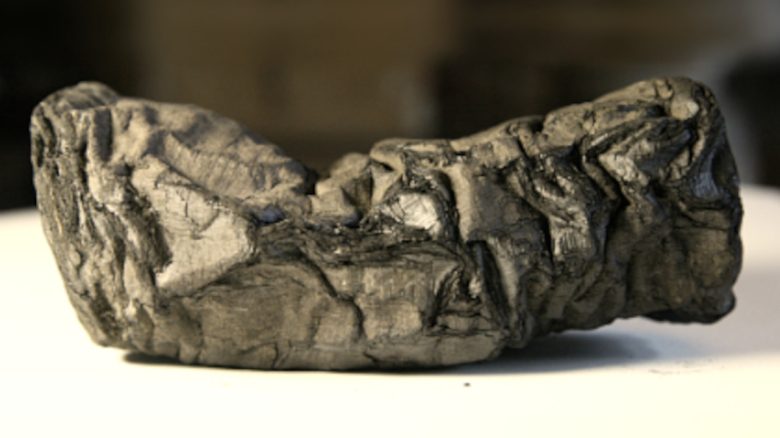
The scrolls were completely carbonized due to a volcanic eruption. Only a few years ago, with today’s technology, an X-ray method was developed to digitize the scrolls. Words, let alone entire texts, could not be deciphered using this method.
With the Vesuvius Challenge, a call was made to further decrypt these digital scrolls. A computer science student is among the successful participants. For his work, he used an old graphics card and an AI learning model. A company has already bred an artificial intelligence, combining real brain cells with computer chips that can play games.
Nvidia GTX 1070 and AI technology make student 36,500 euros richer
What is it about? In the Vesuvius Challenge, participants have been invited to decipher ancient scrolls from the Roman Empire. These 2000-year-old scrolls were heavily carbonized during a volcanic eruption of Mount Vesuvius in the cities of Pompeii and Herculaneum. In the attempt to open the parchment, they would be completely destroyed. The only way to read the content is to digitize them.
This has now been achieved by Luke Farritor, a 21-year-old computer science student. He used the computing power of an old Nvidia GTX 1070 graphics card for this. The card was originally released in 2016 and is currently traded second-hand for around 100 euros.
How did the student go about it? The student used an X-ray scan of the scroll as a basis. To make the ink on the papyrus visible, he employed an AI-based learning model. The calculations were in turn carried out by the graphics card.
In this way, he was able to identify the word ‘πορφυρας’. This means something like ‘purple dye’ or ‘violet cloths’. Luke Farritor submitted the results of his work for verification. After successful confirmation by a team of developers and papyrologists, he was rewarded with a prize of about 36,500 euros.



Why is there this competition? X-ray scans of the scrolls have already been created. The ink on the scrolls is carbon-based, just like the papyrus used. This means that the ink provides too low an X-ray contrast. The words written with the ink cannot be deciphered.
Under the leadership of Nat Friedman, the former CEO of GitHub, the Vesuvius Challenge was launched. The competition is funded through private donations. The prize money is structured in different tiers. The more words are discovered, the greater the reward for the discoverer. Details can be found on scrollprize.org.
Are there other winners? Yes, in the meantime, other participants have also been successful. They were able to read individual words using other digital methods. The prize money paid out here was significantly lower, at around 9,100 euros, compared to Luke Farritor’s total.
The grand prize of nearly 640,000 euros has, however, still not been claimed by anyone. To do so, at least four separate passages with continuous and plausible text must be deciphered. Each passage must also be at least 140 characters long.

Your opinion is important to us!
Do you like the article? Then let us know!