


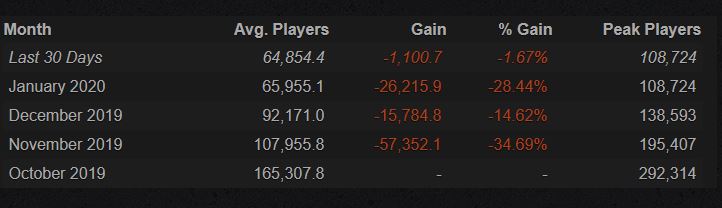
The online shooter Destiny 2 launched on Steam in October 2019. A few months later, in January 2020, the player numbers showed a clear trend: they had more than halved.

That was Bungie’s plan: The Destiny developer Bungie announced three changes in the business model with the separation from Activision. In June 2019, Bungie proclaimed a “new era for Destiny 2”:
- Destiny 2 disappears from Battle.net and officially launches on Steam
- Additionally, the base game Destiny 2 and the two DLCs from Year 1 are being offered for free as “Destiny New Light”
- Players can purchase additional content à la carte, exactly the expansions and seasons they want to play
Bungie’s plan was to gain new players through the Free2Play approach and the release of Destiny 2 on Steam and Google Stadia by letting them try it out for free and convincing them to purchase additional content like Forsaken to win them as regular players.
The existing players were to be kept engaged with the major expansion, Shadowkeep, and the seasons. With the season model, new content arrives approximately every 3 months, gradually unlocking to keep the Destiny 2 universe alive.
With the player numbers on Steam, one can now see, 4 months after the start of the “new era”, whether this plan worked.

How valuable are the Steam player numbers for Destiny 2? There have been estimates from third parties regarding the player numbers of Destiny and Destiny 2, but these have never been really official.
However, Steam evaluates the exact player numbers and displays them in graphs. Since Destiny 2 can only be played on PC via Steam, the numbers are indicative.
Thanks to the official Steam numbers, it is now easier to see the impacts of Bungie’s decisions regarding the content model in real-time.

That’s why the Steam release of Destiny 2 is strange: The release of Destiny 2 on Steam is difficult to compare with most releases on Steam:
- Destiny was already in “Year 3” at the Steam release and launched after the relatively weak expansion Shadowkeep. Destiny was well past its peak. Thus, a real launch effect was missing, as the game was already considered “old”
- Additionally, the Free2Play release was more of a taster offer for new players – Destiny 2 is therefore not a true Free2Play game like Warframe
- Destiny 2 also had an existing player base: most PC players likely transitioned from Battle.net to Steam
Player numbers on Steam drop by more than half
How have the player numbers on Steam developed?
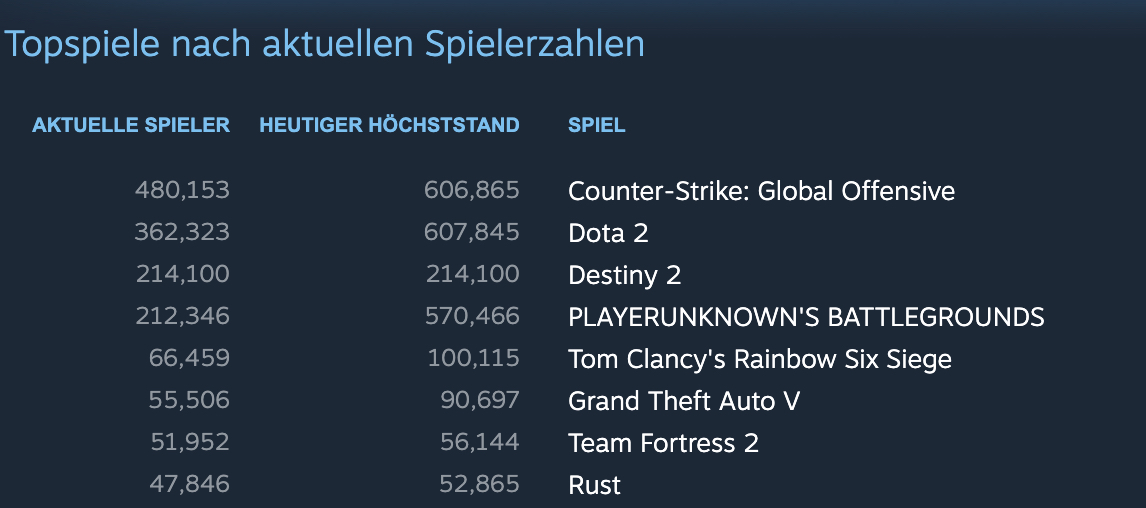
- In October 2019, Destiny 2 launched strongly with an average of 165,307 players online – At one point, Destiny 2 was the third-largest game on Steam
- But the hype did not last long; by November, 35% of players were gone, leaving Destiny with just under 108,000 players on average
- By January 2020, it was only about 66,000 – thus, Destiny 2 was approximately at the level of titles like Rust or ARK Survival Evolved, ranking around 7th to 10th on Steam
It should be noted that a number like “an average of 66,000 players online at the same time” does not mean that “only” 66,000 players are playing Destiny 2 on Steam, but merely indicates that this many are online at the same time on average.
The overall player numbers of Destiny 2 on Steam must be many times higher to achieve such average numbers.
Errors in the system
What do the numbers show? The numbers confirm a trend that has always been observable in Destiny: It is a cyclical game that gains attention and players with the release of a “major expansion” or the main game, but then struggles to retain players.
The numbers indicate that Destiny 2 functions almost like a classic PvE “store” game, similar to Witcher 3 or Fallout 4. At launch, the numbers are high, then they gradually decline as the content is completed. The decline typically continues until the numbers reach a certain plateau and then stabilize, or until a “new major expansion” arrives.
The loss from November 2019 to December 2019, with another 28% of players leaving Destiny 2, is concerning. It is possible that the plateau has not yet been reached and player numbers will continue to fall. Especially since no major new content is planned for February 2020.

If Destiny 2 had hoped for a “lasting Free2Play” effect, with players joining for free and sticking around, it is now clear that this effect does not work that way.
In successful Free2Play games designed as “Games-as-a-service”, the number of users either increases over time or remains stable – in Destiny 2 it is decreasing:
- In the Free2Play game Warframe, player numbers on Steam increased from March 2013 over the years (with slight fluctuations).
- In a Games-as-a-service game with a PvP focus like ARK Survival Evolved, player numbers remained at nearly constant levels from 2015 to today.
- In the buy-to-play game Monster Hunter World, player numbers dropped dramatically within just 2 months after release in August 2018, falling to a quarter, and later even lower. However, the numbers recovered starting in July 2019 and almost returned to launch levels with the “Iceborne” expansion in January 2020

Seasons apparently do not bind players strongly enough
What the numbers make clear: There is no significant binding effect from the “Seasons”. The current Season 9 started on December 10, important events only started in January. If Season 9 had been a “hit”, player numbers on Steam would not have dropped by 28%.
The player numbers indicate three problems:
- Anyone who wants to actively play Destiny 2 must repeatedly commit to purchasing a new season or may have already acquired the season pass with Shadowkeep – this leads to regular players easily “falling out”
- A season is apparently not seen as an “expansion” that allows for a new entry point
- It is questionable whether Destiny 2 can convert sufficient “Free2Play” players into regular players


Your opinion is important to us!
Do you like the article? Then let us know!