

The strategy game Victoria 3 (Steam) depicts the political, social, and economic conflicts of the world from 1836 to 1936. In the endgame of the game, it becomes apparent: Communism is superior to capitalism as an economic system, as the better-distributed wealth stimulates demand for goods. This presents a problem for some players, not only from a balance perspective but also for ideological reasons.
What are the different economic forms in Victoria 3? In Victoria, you build factories, plantations, and mines to simulate a country’s economy.
In one of the countless menus of the strategy game, you set the parameters under which companies operate. It is about means of production, how goods are transported, or what the focus of production should be:
- Do you want to produce simple clothing in a clothing factory or luxury fashion?
- Will the goods be transported by rail or not?
- Should it be sewn by hand or by machine?
- Will you use traditional methods, import silk from Asia, or utilize the newly researched hypermodern material “rubber” to produce synthetic fibers?
Council Republic or Planned Economy – Communism Enters Steam
One factor revolves around who actually owns the factory:
- At the beginning, everything is privately owned: wealthy aristocrats own the factories and mines.
- In the mid-game, capitalists take the helm: Their population group (POP) is rich and has a high standard of living, while workers remain stuck in the middle or lower social class.
- In the endgame, there is also the option to hand the factories and mines over to “the workers” – then communism rules. Either you opt for a planned economy or even change the form of government to a council republic, and you are already at real-existing communism.

Why is the standard of living important? The standard of living determines what products the various population groups want:
- Every population group, regardless of how poor they are, wants something to eat and to consume alcohol.
- Starting from a standard of living of 5, population groups would like to have furniture in their homes.
- Luxury clothing is only interesting for POPs that have reached a standard of living of 15 or higher.
- From a standard of living of 20, the elite wants to have a telephone in their household – because then they also want to be able to communicate.
- From a standard of living of 30, even interest in art becomes a need that must be fulfilled.
In general, the rule is: the higher the standard of living, the higher the demand for goods, and the higher the economic power of a nation.
So if you want to stimulate demand for goods and thereby increase the gross domestic product, which is so important in Victoria 3, you should keep the standard of living as high as possible and do so for as many people as possible.
Capitalism Fails Due to Resource Shortages – Wood and Oil Are Lacking
What is the problem with capitalism in Victoria 3? In Victoria 3, it is the case that even in a fantastically functioning economy, ultimately only the “wealthy class”, the capitalists, achieve a high standard of living.
The working population remains significantly below the standard of living of the rich.
In the endgame of a capitalism game:
- The poor at a standard of living of 20 – “secure”
- The middle class at 28 – “flourishing”
- The upper class at 35 – “abundant”
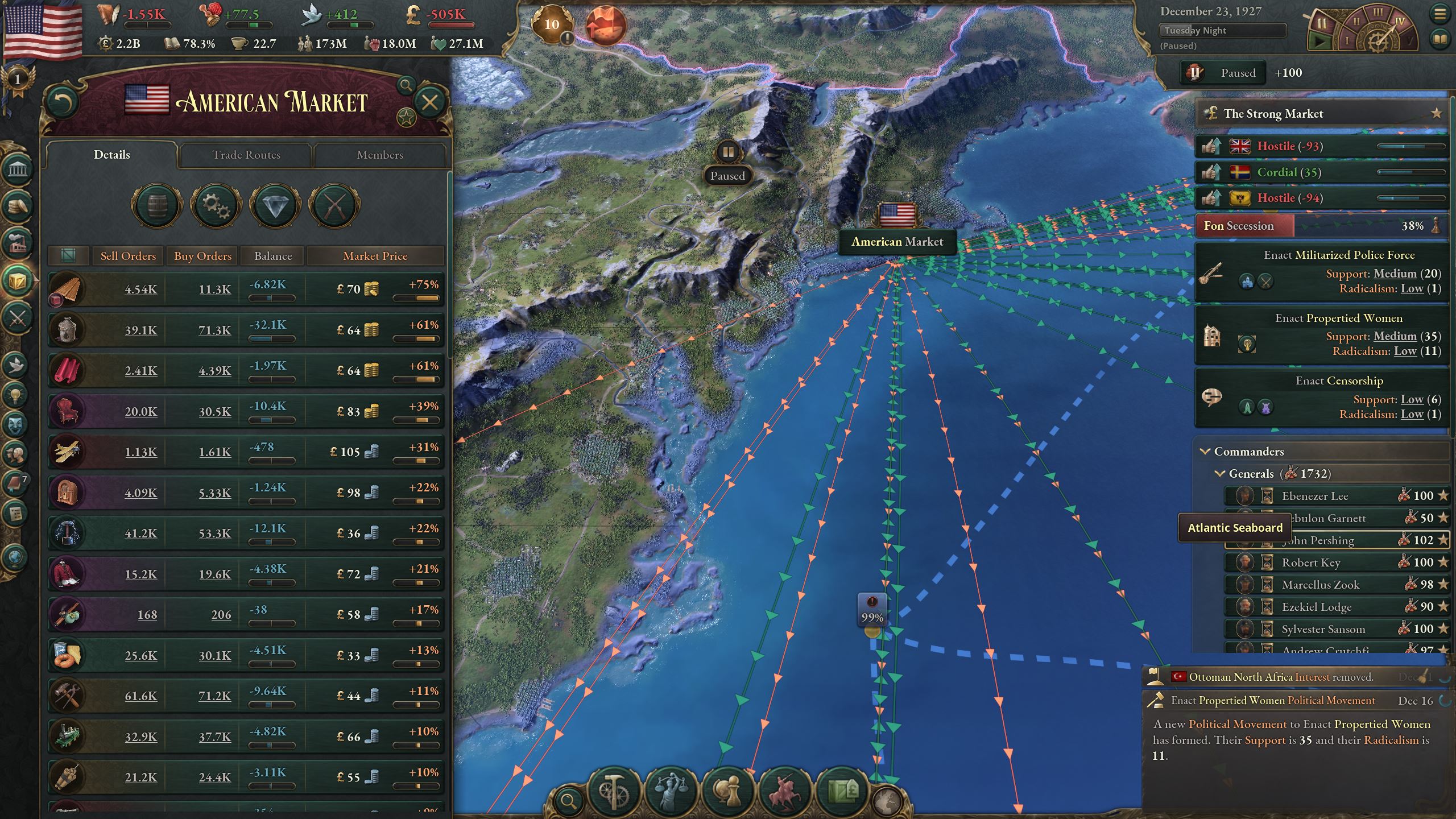
In the current patch, you reach “the limits of growth”
There are also banal balancing issues: If you aim for world domination with a country like the USA, both the economy and the military require such a high level of oil and hardwood that the world economy simply cannot satisfy it anymore, causing the economy to collapse.
The resources are simply insufficient in 1915 to satisfy all the factories and units that one builds as a “world power” later on. A problem that Paradox is already nibbling at, as they must consider: What oil fields could we have possibly discovered in 1915?
With the next patch 1.1, significantly more oil should come to Victoria 3 (via paradox). But until that comes, the classic “growth economy” in Victoria 3 has clear limits.
Communism Distributes Wealth Better – Increased Demand for Products
What is the advantage of communism? In communism, the money that otherwise the capitalists would pocket is distributed among the workers, thereby significantly increasing their standard of living and purchasing power:
- The lower class has here 27 – flourishing
- The middle class has 32 – abundant
- The upper class only has 25 – abundant
Since the middle class is much larger than the upper class, it has a positive impact on the economy, as can be seen:
How is this being discussed? The left-leaning US site Kotaku seems amused that communism is so strong. It is logical that there would be an advantage if all that money isn’t given to those who stash it in an offshore account in the Cayman Islands, but rather spent, as they believe at the US site.
It is said there, “Leftist nerds can feel validated when they play Victoria 3.”
In the community, this is discussed almost philosophically. It is said that this shows that communism looks great on paper, as long as a well-meaning, all-knowing entity distributes the money and no one pursues their own interests.
There are some who are also displeased that communism is so strong; in mods, they want to address this, as it is said:
In the comments on reddit, there is indeed an ideological dispute about how the game apparently favors communism. It is said:
- “That’s just like in real life, where Marxism is also super /sarcastically intended”
- “Biased!”
- or: That is also the only time communism works
It is questionable whether Victoria 3 remains a communist paradise – normally, this only lasts until the next patch.
In any case, I plan to play my next game as a communist leader; I am already into leftist experiments in Victoria 3:

Your opinion is important to us!
Do you like the article? Then let us know!