

YouTuber buys $1400 gaming PC from China shop Aliexpress – This is how much stress he has with it
Pre-built PCs are not always as great as they seem at first glance. A YouTuber purchased a gaming PC for 1400 Euros and looked at what he gets for the money. In the end, he had more stress with the device than he initially wanted and suspected:
YouTuber buys $1400 gaming PC from China shop Aliexpress – This is how much stress he has with it
Therefore, one often cannot avoid consulting a friend or someone knowledgeable about the subject, as pre-built PCs can also overwhelm with numerous abbreviations.
Some cryptic product descriptions can also easily be deciphered by a layperson. We will exemplarily present two examples of how product descriptions can be decoded.
Every product name can be decoded
By now, some manufacturers have realized that their product names confuse users rather than support them in making a purchasing decision. For instance, the manufacturer Dell has presented a table where users can identify the device based on the model number (via dell.com).
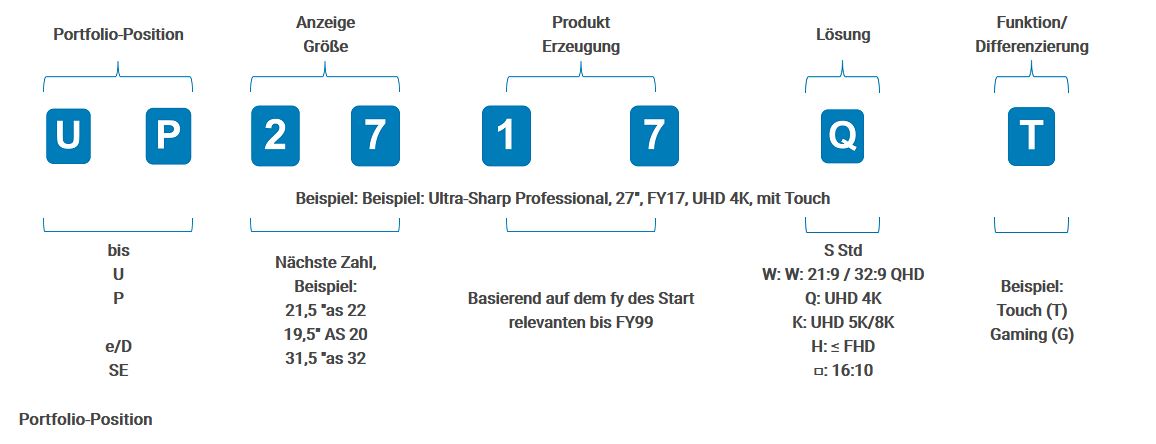
This approach sometimes resembles a crossword puzzle because you have to assign the correct letters to the right designations. Some manufacturers come up with peculiarities that can additionally confuse interested users.
We will present two examples here. First, we will decode the product name, explain the procedure, and clarify the peculiarities.
1. Example: Our first example is the AOC CQ27G2. This is a gaming monitor from the manufacturer AOC. Every letter and digit has a specific meaning:
- AOC = Branding
- C = curved
- Q = QHD (1440p)
- 27 = 27-inch
- G2 = 2nd generation
With the AOC CQ27G2, you are getting a curved 27-inch monitor from AOC with a maximum resolution of 1440p.
2. Example: Our second example is the AMD Ryzen 5 5600X. This is a processor for desktop PCs. In naming its processors, AMD has allowed itself a peculiarity:
- AMD = Branding
- Ryzen 5 = Series
- 5 = 4th generation of Ryzen (desktop)
- 600 = Performance level
- X = Indicates higher performance than the model without X
With the AMD Ryzen 5 5600X, you are getting a Ryzen processor of the fourth generation in the upper performance range. The processor is also suitable for overclocking but does not have its own graphics chip.
What do you think? Do such numbers and letters confuse you, or is that “normal” for you when you build or buy a PC? Tell us in the comments!
Pre-built PCs are not always as great as they seem at first glance. A YouTuber purchased a gaming PC for 1400 Euros and looked at what he gets for the money. In the end, he had more stress with the device than he initially wanted and suspected:
YouTuber buys $1400 gaming PC from China shop Aliexpress – This is how much stress he has with it
YouTuber buys $1400 gaming PC from China shop Aliexpress – This is how much stress he has with it
Therefore, one often cannot avoid consulting a friend or someone knowledgeable about the subject, as pre-built PCs can also overwhelm with numerous abbreviations.
Some cryptic product descriptions can also easily be deciphered by a layperson. We will exemplarily present two examples of how product descriptions can be decoded.
Every product name can be decoded
By now, some manufacturers have realized that their product names confuse users rather than support them in making a purchasing decision. For instance, the manufacturer Dell has presented a table where users can identify the device based on the model number (via dell.com).
This approach sometimes resembles a crossword puzzle because you have to assign the correct letters to the right designations. Some manufacturers come up with peculiarities that can additionally confuse interested users.
We will present two examples here. First, we will decode the product name, explain the procedure, and clarify the peculiarities.
1. Example: Our first example is the AOC CQ27G2. This is a gaming monitor from the manufacturer AOC. Every letter and digit has a specific meaning:
- AOC = Branding
- C = curved
- Q = QHD (1440p)
- 27 = 27-inch
- G2 = 2nd generation
With the AOC CQ27G2, you are getting a curved 27-inch monitor from AOC with a maximum resolution of 1440p.
2. Example: Our second example is the AMD Ryzen 5 5600X. This is a processor for desktop PCs. In naming its processors, AMD has allowed itself a peculiarity:
- AMD = Branding
- Ryzen 5 = Series
- 5 = 4th generation of Ryzen (desktop)
- 600 = Performance level
- X = Indicates higher performance than the model without X
With the AMD Ryzen 5 5600X, you are getting a Ryzen processor of the fourth generation in the upper performance range. The processor is also suitable for overclocking but does not have its own graphics chip.
What do you think? Do such numbers and letters confuse you, or is that “normal” for you when you build or buy a PC? Tell us in the comments!
Pre-built PCs are not always as great as they seem at first glance. A YouTuber purchased a gaming PC for 1400 Euros and looked at what he gets for the money. In the end, he had more stress with the device than he initially wanted and suspected:
YouTuber buys $1400 gaming PC from China shop Aliexpress – This is how much stress he has with it
Pre-built PCs are not always as great as they seem at first glance. A YouTuber purchased a gaming PC for 1400 Euros and looked at what he gets for the money. In the end, he had more stress with the device than he initially wanted and suspected:
YouTuber buys $1400 gaming PC from China shop Aliexpress – This is how much stress he has with it
Therefore, one often cannot avoid consulting a friend or someone knowledgeable about the subject, as pre-built PCs can also overwhelm with numerous abbreviations.
Some cryptic product descriptions can also easily be deciphered by a layperson. We will exemplarily present two examples of how product descriptions can be decoded.
Every product name can be decoded
By now, some manufacturers have realized that their product names confuse users rather than support them in making a purchasing decision. For instance, the manufacturer Dell has presented a table where users can identify the device based on the model number (via dell.com).
This approach sometimes resembles a crossword puzzle because you have to assign the correct letters to the right designations. Some manufacturers come up with peculiarities that can additionally confuse interested users.
We will present two examples here. First, we will decode the product name, explain the procedure, and clarify the peculiarities.
1. Example: Our first example is the AOC CQ27G2. This is a gaming monitor from the manufacturer AOC. Every letter and digit has a specific meaning:
- AOC = Branding
- C = curved
- Q = QHD (1440p)
- 27 = 27-inch
- G2 = 2nd generation
With the AOC CQ27G2, you are getting a curved 27-inch monitor from AOC with a maximum resolution of 1440p.
2. Example: Our second example is the AMD Ryzen 5 5600X. This is a processor for desktop PCs. In naming its processors, AMD has allowed itself a peculiarity:
- AMD = Branding
- Ryzen 5 = Series
- 5 = 4th generation of Ryzen (desktop)
- 600 = Performance level
- X = Indicates higher performance than the model without X
With the AMD Ryzen 5 5600X, you are getting a Ryzen processor of the fourth generation in the upper performance range. The processor is also suitable for overclocking but does not have its own graphics chip.
What do you think? Do such numbers and letters confuse you, or is that “normal” for you when you build or buy a PC? Tell us in the comments!
Pre-built PCs are not always as great as they seem at first glance. A YouTuber purchased a gaming PC for 1400 Euros and looked at what he gets for the money. In the end, he had more stress with the device than he initially wanted and suspected:
YouTuber buys $1400 gaming PC from China shop Aliexpress – This is how much stress he has with it
Pre-built PCs are not always as great as they seem at first glance. A YouTuber purchased a gaming PC for 1400 Euros and looked at what he gets for the money. In the end, he had more stress with the device than he initially wanted and suspected:
YouTuber buys $1400 gaming PC from China shop Aliexpress – This is how much stress he has with it
Therefore, one often cannot avoid consulting a friend or someone knowledgeable about the subject, as pre-built PCs can also overwhelm with numerous abbreviations.
Some cryptic product descriptions can also easily be deciphered by a layperson. We will exemplarily present two examples of how product descriptions can be decoded.
Every product name can be decoded
By now, some manufacturers have realized that their product names confuse users rather than support them in making a purchasing decision. For instance, the manufacturer Dell has presented a table where users can identify the device based on the model number (via dell.com).
This approach sometimes resembles a crossword puzzle because you have to assign the correct letters to the right designations. Some manufacturers come up with peculiarities that can additionally confuse interested users.
We will present two examples here. First, we will decode the product name, explain the procedure, and clarify the peculiarities.
1. Example: Our first example is the AOC CQ27G2. This is a gaming monitor from the manufacturer AOC. Every letter and digit has a specific meaning:
- AOC = Branding
- C = curved
- Q = QHD (1440p)
- 27 = 27-inch
- G2 = 2nd generation
With the AOC CQ27G2, you are getting a curved 27-inch monitor from AOC with a maximum resolution of 1440p.
2. Example: Our second example is the AMD Ryzen 5 5600X. This is a processor for desktop PCs. In naming its processors, AMD has allowed itself a peculiarity:
- AMD = Branding
- Ryzen 5 = Series
- 5 = 4th generation of Ryzen (desktop)
- 600 = Performance level
- X = Indicates higher performance than the model without X
With the AMD Ryzen 5 5600X, you are getting a Ryzen processor of the fourth generation in the upper performance range. The processor is also suitable for overclocking but does not have its own graphics chip.
What do you think? Do such numbers and letters confuse you, or is that “normal” for you when you build or buy a PC? Tell us in the comments!
Pre-built PCs are not always as great as they seem at first glance. A YouTuber purchased a gaming PC for 1400 Euros and looked at what he gets for the money. In the end, he had more stress with the device than he initially wanted and suspected:
YouTuber buys $1400 gaming PC from China shop Aliexpress – This is how much stress he has with it
YouTuber buys $1400 gaming PC from China shop Aliexpress – This is how much stress he has with it
Pre-built PCs are not always as great as they seem at first glance. A YouTuber purchased a gaming PC for 1400 Euros and looked at what he gets for the money. In the end, he had more stress with the device than he initially wanted and suspected:
YouTuber buys $1400 gaming PC from China shop Aliexpress – This is how much stress he has with it
Therefore, one often cannot avoid consulting a friend or someone knowledgeable about the subject, as pre-built PCs can also overwhelm with numerous abbreviations.
Some cryptic product descriptions can also easily be deciphered by a layperson. We will exemplarily present two examples of how product descriptions can be decoded.
Every product name can be decoded
By now, some manufacturers have realized that their product names confuse users rather than support them in making a purchasing decision. For instance, the manufacturer Dell has presented a table where users can identify the device based on the model number (via dell.com).
This approach sometimes resembles a crossword puzzle because you have to assign the correct letters to the right designations. Some manufacturers come up with peculiarities that can additionally confuse interested users.
We will present two examples here. First, we will decode the product name, explain the procedure, and clarify the peculiarities.
1. Example: Our first example is the AOC CQ27G2. This is a gaming monitor from the manufacturer AOC. Every letter and digit has a specific meaning:
- AOC = Branding
- C = curved
- Q = QHD (1440p)
- 27 = 27-inch
- G2 = 2nd generation
With the AOC CQ27G2, you are getting a curved 27-inch monitor from AOC with a maximum resolution of 1440p.
2. Example: Our second example is the AMD Ryzen 5 5600X. This is a processor for desktop PCs. In naming its processors, AMD has allowed itself a peculiarity:
- AMD = Branding
- Ryzen 5 = Series
- 5 = 4th generation of Ryzen (desktop)
- 600 = Performance level
- X = Indicates higher performance than the model without X
With the AMD Ryzen 5 5600X, you are getting a Ryzen processor of the fourth generation in the upper performance range. The processor is also suitable for overclocking but does not have its own graphics chip.
What do you think? Do such numbers and letters confuse you, or is that “normal” for you when you build or buy a PC? Tell us in the comments!
Pre-built PCs are not always as great as they seem at first glance. A YouTuber purchased a gaming PC for 1400 Euros and looked at what he gets for the money. In the end, he had more stress with the device than he initially wanted and suspected:
YouTuber buys $1400 gaming PC from China shop Aliexpress – This is how much stress he has with it
Pre-built PCs are not always as great as they seem at first glance. A YouTuber purchased a gaming PC for 1400 Euros and looked at what he gets for the money. In the end, he had more stress with the device than he initially wanted and suspected:
YouTuber buys $1400 gaming PC from China shop Aliexpress – This is how much stress he has with it
Pre-built PCs are not always as great as they seem at first glance. A YouTuber purchased a gaming PC for 1400 Euros and looked at what he gets for the money. In the end, he had more stress with the device than he initially wanted and suspected:
YouTuber buys $1400 gaming PC from China shop Aliexpress – This is how much stress he has with it
Therefore, one often cannot avoid consulting a friend or someone knowledgeable about the subject, as pre-built PCs can also overwhelm with numerous abbreviations.
Some cryptic product descriptions can also easily be deciphered by a layperson. We will exemplarily present two examples of how product descriptions can be decoded.
Every product name can be decoded
By now, some manufacturers have realized that their product names confuse users rather than support them in making a purchasing decision. For instance, the manufacturer Dell has presented a table where users can identify the device based on the model number (via dell.com).
This approach sometimes resembles a crossword puzzle because you have to assign the correct letters to the right designations. Some manufacturers come up with peculiarities that can additionally confuse interested users.
We will present two examples here. First, we will decode the product name, explain the procedure, and clarify the peculiarities.
1. Example: Our first example is the AOC CQ27G2. This is a gaming monitor from the manufacturer AOC. Every letter and digit has a specific meaning:
- AOC = Branding
- C = curved
- Q = QHD (1440p)
- 27 = 27-inch
- G2 = 2nd generation
With the AOC CQ27G2, you are getting a curved 27-inch monitor from AOC with a maximum resolution of 1440p.
2. Example: Our second example is the AMD Ryzen 5 5600X. This is a processor for desktop PCs. In naming its processors, AMD has allowed itself a peculiarity:
- AMD = Branding
- Ryzen 5 = Series
- 5 = 4th generation of Ryzen (desktop)
- 600 = Performance level
- X = Indicates higher performance than the model without X
With the AMD Ryzen 5 5600X, you are getting a Ryzen processor of the fourth generation in the upper performance range. The processor is also suitable for overclocking but does not have its own graphics chip.
What do you think? Do such numbers and letters confuse you, or is that “normal” for you when you build or buy a PC? Tell us in the comments!
Pre-built PCs are not always as great as they seem at first glance. A YouTuber purchased a gaming PC for 1400 Euros and looked at what he gets for the money. In the end, he had more stress with the device than he initially wanted and suspected:
YouTuber buys $1400 gaming PC from China shop Aliexpress – This is how much stress he has with it
YouTuber buys $1400 gaming PC from China shop Aliexpress – This is how much stress he has with it
Pre-built PCs are not always as great as they seem at first glance. A YouTuber purchased a gaming PC for 1400 Euros and looked at what he gets for the money. In the end, he had more stress with the device than he initially wanted and suspected:
YouTuber buys $1400 gaming PC from China shop Aliexpress – This is how much stress he has with it
Pre-built PCs are not always as great as they seem at first glance. A YouTuber purchased a gaming PC for 1400 Euros and looked at what he gets for the money. In the end, he had more stress with the device than he initially wanted and suspected:
YouTuber buys $1400 gaming PC from China shop Aliexpress – This is how much stress he has with it
Therefore, one often cannot avoid consulting a friend or someone knowledgeable about the subject, as pre-built PCs can also overwhelm with numerous abbreviations.
Some cryptic product descriptions can also easily be deciphered by a layperson. We will exemplarily present two examples of how product descriptions can be decoded.
Every product name can be decoded
By now, some manufacturers have realized that their product names confuse users rather than support them in making a purchasing decision. For instance, the manufacturer Dell has presented a table where users can identify the device based on the model number (via dell.com).
This approach sometimes resembles a crossword puzzle because you have to assign the correct letters to the right designations. Some manufacturers come up with peculiarities that can additionally confuse interested users.
We will present two examples here. First, we will decode the product name, explain the procedure, and clarify the peculiarities.
1. Example: Our first example is the AOC CQ27G2. This is a gaming monitor from the manufacturer AOC. Every letter and digit has a specific meaning:
- AOC = Branding
- C = curved
- Q = QHD (1440p)
- 27 = 27-inch
- G2 = 2nd generation
With the AOC CQ27G2, you are getting a curved 27-inch monitor from AOC with a maximum resolution of 1440p.
2. Example: Our second example is the AMD Ryzen 5 5600X. This is a processor for desktop PCs. In naming its processors, AMD has allowed itself a peculiarity:
- AMD = Branding
- Ryzen 5 = Series
- 5 = 4th generation of Ryzen (desktop)
- 600 = Performance level
- X = Indicates higher performance than the model without X
With the AMD Ryzen 5 5600X, you are getting a Ryzen processor of the fourth generation in the upper performance range. The processor is also suitable for overclocking but does not have its own graphics chip.
What do you think? Do such numbers and letters confuse you, or is that “normal” for you when you build or buy a PC? Tell us in the comments!
Pre-built PCs are not always as great as they seem at first glance. A YouTuber purchased a gaming PC for 1400 Euros and looked at what he gets for the money. In the end, he had more stress with the device than he initially wanted and suspected:
YouTuber buys $1400 gaming PC from China shop Aliexpress – This is how much stress he has with it
If you’ve ever wanted to buy a graphics card, processor, or monitor, you know the problem. Because hardware often has quirky names that can confuse potential buyers at first glance.
If you’re looking to buy a computer or at least new hardware like a graphics card or a monitor, you’ll quickly stumble upon: cryptic product descriptions that often consist of many digits and letters.
Especially for people who have little or no knowledge of hardware, all these technical abbreviations can be overwhelming. One user explained on reddit how unhelpful he finds the technical abbreviations (via reddit.com)
In the discussion, knowledgeable people would throw around technical abbreviations and names, which wouldn’t help an uninformed user. And all these names can hardly be remembered by anyone anyway. He writes:
This has always been, and will probably always be, my biggest challenge with PC specs: My small brain can’t remember the names of all these parts (let alone understand them), especially those of the GPUs.
The reactions to the thread are quite positive. As of September 7, 2021, the thread on reddit has over 4500 upvotes and more than 400 comments.
Manufacturers pack all information into product names
What kind of names are these anyway? Behind the product names and designations are mainly technical indicators and explanations. For manufacturers and specialists, this is important to quickly find or identify products. The information includes:
- The product line
- The year of manufacture or the generation
- The performance class
- The target group (consumer or professional users)
However, for many users, this abundance of information is already too much. There is no standardized scheme, and each manufacturer has its own jumble of letters that applies to its devices.
It becomes really confusing when manufacturers change their scheme or introduce new, supplementary products. One example is the mobile versions of the RTX-3000 graphics cards. Weaker versions used to be marked with Max-Q, but this designation has now been dropped. Instead, manufacturers describe the performance of mobile graphics cards in wattage.
Not everyone sees the designations critically, pointing to pre-built PCs for uninformed users
Not all users believe that the designations are that bad. Although all components are generally available for all users to buy, websites like pcpartpicker facilitate the selection of parts. Nevertheless, hardware mainly appeals to specialists and people who do this as a hobby (via reddit.com):
But ultimately, it is still the world of tinkerers and builders. Just like with RC cars, you can build them yourself if you have the necessary knowledge, or you can buy a pre-assembled car.
People who feel overwhelmed by abbreviations and designations should either seek help or simply buy a pre-built PC.
What is the problem with pre-built PCs? There can also be issues here, as we have already shown you with gaming PCs from Amazon for 400 Euros:
- Devices are labeled as “gaming,” but they don’t really have gaming capabilities.
- Manufacturers market their products with processors like AMD FX-8800P or Core i7-920. However, users may not realize that this refers to an AMD processor from 2015. In the worst case, they might be misled into thinking that a strong processor is hidden behind the i7.
YouTuber buys $1400 gaming PC from China shop Aliexpress – This is how much stress he has with it
YouTuber buys $1400 gaming PC from China shop Aliexpress – This is how much stress he has with it
Pre-built PCs are not always as great as they seem at first glance. A YouTuber purchased a gaming PC for 1400 Euros and looked at what he gets for the money. In the end, he had more stress with the device than he initially wanted and suspected:
YouTuber buys $1400 gaming PC from China shop Aliexpress – This is how much stress he has with it
Pre-built PCs are not always as great as they seem at first glance. A YouTuber purchased a gaming PC for 1400 Euros and looked at what he gets for the money. In the end, he had more stress with the device than he initially wanted and suspected:
YouTuber buys $1400 gaming PC from China shop Aliexpress – This is how much stress he has with it
Therefore, one often cannot avoid consulting a friend or someone knowledgeable about the subject, as pre-built PCs can also overwhelm with numerous abbreviations.
Some cryptic product descriptions can also easily be deciphered by a layperson. We will exemplarily present two examples of how product descriptions can be decoded.
Every product name can be decoded
By now, some manufacturers have realized that their product names confuse users rather than support them in making a purchasing decision. For instance, the manufacturer Dell has presented a table where users can identify the device based on the model number (via dell.com).
This approach sometimes resembles a crossword puzzle because you have to assign the correct letters to the right designations. Some manufacturers come up with peculiarities that can additionally confuse interested users.
We will present two examples here. First, we will decode the product name, explain the procedure, and clarify the peculiarities.
1. Example: Our first example is the AOC CQ27G2. This is a gaming monitor from the manufacturer AOC. Every letter and digit has a specific meaning:
- AOC = Branding
- C = curved
- Q = QHD (1440p)
- 27 = 27-inch
- G2 = 2nd generation
With the AOC CQ27G2, you are getting a curved 27-inch monitor from AOC with a maximum resolution of 1440p.
2. Example: Our second example is the AMD Ryzen 5 5600X. This is a processor for desktop PCs. In naming its processors, AMD has allowed itself a peculiarity:
- AMD = Branding
- Ryzen 5 = Series
- 5 = 4th generation of Ryzen (desktop)
- 600 = Performance level
- X = Indicates higher performance than the model without X
With the AMD Ryzen 5 5600X, you are getting a Ryzen processor of the fourth generation in the upper performance range. The processor is also suitable for overclocking but does not have its own graphics chip.
What do you think? Do such numbers and letters confuse you, or is that “normal” for you when you build or buy a PC? Tell us in the comments!
Pre-built PCs are not always as great as they seem at first glance. A YouTuber purchased a gaming PC for 1400 Euros and looked at what he gets for the money. In the end, he had more stress with the device than he initially wanted and suspected:
YouTuber buys $1400 gaming PC from China shop Aliexpress – This is how much stress he has with it