

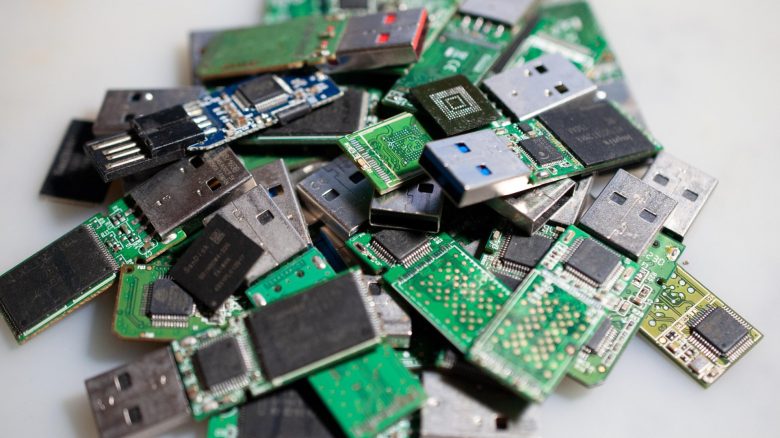
A programmer discovered after a shopping trip that all the USB sticks he purchased were fake. A good reason for him to take action.
In the multitude of online offers for hardware, it can happen time and again that one realizes after purchasing a product that it is a deviating or even counterfeit product.
This experience was also shared by programmer Steve Gibson. During testing of a new version of a program he developed, he came across a USB stick whose stated storage capacity was incorrect. He then conducted a self-experiment and purchased 12 inexpensive devices from Amazon, all of which were supposed to have 1 TB or 2 TB of storage.
12 USB-Sticks, One Software
What results does his test yield? After the memory sticks arrived, he tested all 12 samples and came to a shocking conclusion: Not a single one had the storage capacity as indicated on Amazon.
When the devices were connected to a PC, the operating system displayed the size at which the sticks were sold. However, in most cases, the actual size was only 64 GB.
The crux of the matter: Gibson discovered that even after the first 64 GB of data, further data could still be transferred to the sticks. However, it was no longer the files themselves that were stored, but only information such as the names of the files and their size on the devices.
This means that the files are empty when copied from the device to a computer. The actual content is not transmitted. The operating system also does not show an error, as it does not test whether the data has been successfully written to a stick. It relies on the storage medium to report any problems with the transfer of files — which it of course did not do.
A program aims to remedy this: Gibson then decided to develop a program called Validrive
to test the real capacity of USB sticks and prevent data loss caused by such manipulated devices.
The tool randomly tests whether the space stated by the seller is actually available on a storage medium. Test data is written to different locations on the stick and directly checked to see if the data can be read back.
After the test, a report is generated that clearly indicates whether a device has the stated storage capacity. ValiDrive is not the first tool of its kind. However, since the program only randomly checks the available capacity, it can save considerable time in reaching a conclusion.
The program can also be used without a prior installation. It only needs to be downloaded and can be run portably. The graphical presentation of the final report, which can also be seen on the developer’s page, allows the results to be interpreted quickly even without extensive technical expertise.



Tips for buying USB sticks: If you are looking for a USB stick yourself, there are various tips you can follow to minimize the risk of acquiring a counterfeit version right from the start:
- Pay attention to the price. If it’s significantly lower than comparable products with the same capacity, then something might be wrong.
- Buy from reputable brands and sellers.
- Read product reviews.
Not only for USB sticks is the storage capacity an important criterion. There are also different versions of modern consoles that come with various capacities. A console could even be the cheapest way to play GTA 6 at release, but it’s becoming somewhat more expensive now.

Your opinion is important to us!
Do you like the article? Then let us know!