
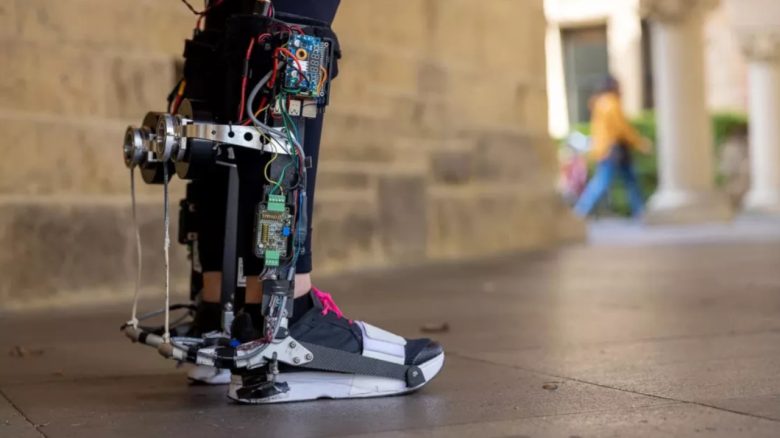
The Raspberry Pi is one of the most popular computers in the world. Researchers have now developed an exoskeleton with such a system. In the future, it will also be available for purchase.
A group of people at Stanford University has developed an exoskeleton. An exoskeleton is a type of external support structure that is mounted around specific body parts. This part of the body is then supported.
With such a development, people aim to help those who have difficulties walking or need to transport heavy objects. The first tests were recently successful. Particularly exciting is that only a small Raspberry Pi is inside the system.

What has the group done? The people at Stanford University have integrated a Raspberry Pi 4 into an exoskeleton. Thanks to its boot shape, it is able to adapt to the lower leg area and thus provide a comfortable option for the user.
In addition, the team explained that this experiment is the result of years of work with emulators that have enabled them to present this machine learning model, a tool they hope to market soon.
- The exoskeleton takes about 1 hour to “learn” the user’s walking pattern.
- After just 15 minutes, the first benefits are supposed to be noticeable.
- People are said to be able to walk 9% faster and consume 17% less energy. The developers equate this with “taking off a 10-kilogram backpack.”
You can watch the entire experiment in the following YouTube video. Here you can also see how large the model is.
The device is not yet market-ready
What problems still exist currently? The current device is still quite bulky. If you watch the video, you will notice that the construction is still quite large and not easy to wear. Here, the team explained that in order to have a market-ready version, they have to redesign the appearance and especially hide the cables and mechanical parts.
However, their biggest wish is to find a partner for marketing. In particular, a partner from whom they hope to gain assistance for people with movement disorders.
In the future, however, the device could represent an improvement in the daily lives of many people:
- People with walking problems, whether genetic or age-related.
- Persons who have to carry heavy loads and would be relieved by such a module.
Not all questions have been resolved yet. It is still unknown what such a system will ultimately cost.