


Statisticians have researched in Pokémon GO whether different PokéStops house different KM Eggs. After extensive investigations, it seems that this is indeed the case.

The Pokémon mathematicians of the Silph Road have once again clarified matters in the Pokémon GO universe. They have already researched whether trainers can influence the movesets of Pokémon. This time, they have addressed the question:
“Do some PokéStops drop more 10 KM eggs than 2 KM eggs?”
Gathering the necessary data for this investigation was not easy, and the statisticians literally had to go the extra mile to answer this question. A few things remain uncertain, but the statisticians are confident that some PokéStops actually drop more 10 KM, 5 KM, or 2 KM eggs than others.
26 Silph scientists took on the challenge: The researchers collected 50 eggs each from the same PokéStop to analyze whether different PokéStops drop different eggs. Almost all 26 researchers managed to gather the required 50 eggs, with some even collecting up to 180. A total of 1,841 eggs were hatched for the study, and their contents were recorded and analyzed.
This is how the egg analysis was conducted
First, the distribution of egg distances (2 KM, 5 KM, 10 KM) for each egg from each individual PokéStop was examined. It was important to start with this analysis because the distance for hatching the eggs is already determined at the PokéStop, and the location of hatching consequently cannot have an impact. This graphic shows the distribution of eggs from each researcher:
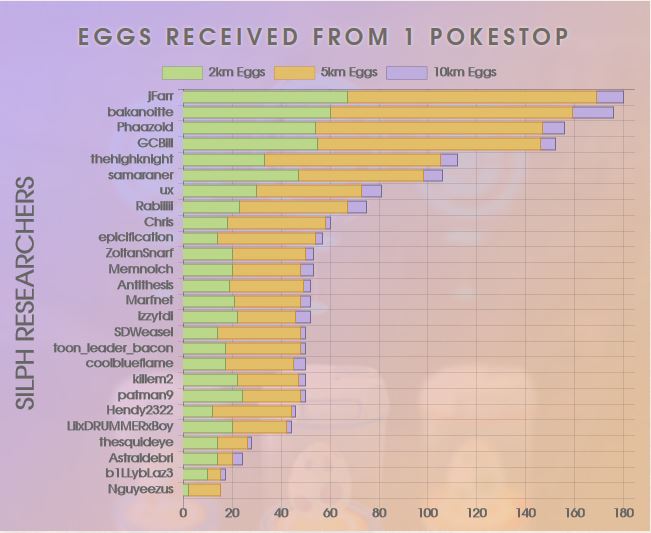
After analyzing the data, the statisticians agreed that it is very likely that the distribution of egg KM distances does indeed differ among the various PokéStops.
To evaluate the data more accurately, the statisticians conducted a chi-squared test. In mathematical statistics, this can be used, among other things, to perform a test of independence. It was statistically calculated whether the KM distance distribution of the eggs is independent of the PokéStops. In this calculation, the 10 KM eggs were not included, as too few were collected.
The first step of the test was to calculate the expected number of 2 KM and 5 KM eggs from each researcher, based on the total number of hatchings and egg distribution. Then, it is checked whether the expected number significantly differs from the actually observed number. For the math enthusiasts among you, the exact calculation of the chi-squared test is located at the end of the post.
The result of the test: The assumption that the KM distribution of the eggs is independent of the PokéStops has been disproven!

Pokémon GO: There really are “better” PokéStops for stronger eggs
Conclusion: In fact, this investigation found that researchers received eggs at their respective PokéStops with different KM distributions. It could theoretically be the case that this is caused by other factors besides the location of the PokéStop. Factors to consider might include the timing of collection or the trainer’s level, etc. The Silph mathematicians will further investigate the correlations between KM eggs and PokéStops.
Because it is already a significant discovery that they can confirm that PokéStops drop different KM eggs.
What this means for Pokémon trainers: For trainers, it is worth visiting the PokéStop that previously gave them the desired KM egg more often.
Great respect to the researchers who may have walked a mile or two. If you are now getting the KM eggs you want, this guide to hatching eggs will certainly be helpful.
The calculation of the chi-squared test:
An example
Researcher jFarr hatched a total of 169 eggs (10 KM eggs are not included). The expected calculation is: 169 x 669 / 1715 = 65.925 2 KM eggs and 169 x 1046 / 1715 = 103.075 5 KM eggs. Next, the difference between the sum of the expected and observed numbers is squared and divided by the expected number. jFarr has 67 2 KM eggs and 102 5 KM eggs, so the values obtained are: (67 – 65.925)^2/65.925 = 0.0175 and (102 – 103.075)^2/103.075 = 0.0112
These values reflect how much the expected and observed numbers differ from each other.
The values of all trainers are added up to reach a total of 43.905. If the egg distribution were independent of the PokéStops, the total sum would yield a chi-squared distribution with 25 degrees of freedom.
The number of degrees of freedom is calculated as follows:
(#Researchers – 1) x (#Egg-KM-Type – 1) = 25 x 1 = 25
Now the p-value can be calculated. The smaller the p-value, the more reason there is to reject the null hypothesis.
p = 0.0111
This is less than the critical level of 0.05 significance, and therefore the hypothesis that KM eggs and PokéStops are independent of each other can be rejected. Thus, there is a correlation.

Your opinion is important to us!
Do you like the article? Then let us know!