

Hatching eggs is important in Pokémon GO – But which Pokémon are behind it and are there tricks to speed up the process?

The new Pokémon GO is already captivating many aspiring Pokémon trainers – The game is now available for download in Germany. To give you an idea of what to expect, we explain what the different types of eggs are, how they are hatched, and which Pokémon can eventually hatch from these eggs.
You can find an updated version of this egg list for Pokémon GO here.
Hatching eggs in Pokémon GO
In Pokémon GO, you can not only catch various Pokémon in the wild, but also take the little monsters as eggs into your care and wait for them to hatch. To hatch an egg, you have been provided with an egg incubator at the start of your adventure. Eggs that you can receive at PokéStops can be placed in this machine to start hatching.
You can carry a maximum of 9 of these eggs at the same time. Because not every PokéStop guarantees an egg as a reward, you will need to visit these Stops multiple times to replenish your egg supply. To start hatching, you need to open your Pokémon overview in the game menu and then click on the “Eggs” category. You then select an egg to place in your egg incubator. Now you will see the required number of kilometers you need to walk for the egg to hatch.

To hatch multiple eggs at the same time, you can purchase additional incubators in the in-game shop for 150 PokéCoins – However, these only have 3 charges before they break. Free incubators can be obtained by reaching Level 6, 10, and 15 – These machines also only have 3 charges.
Pokémon GO – Hatch eggs faster
Using tricks such as driving in a car, bus, or train usually doesn’t count to hatch eggs faster in Pokémon GO. You can, as already learned from previous versions of Pokémon, use a bicycle if you prefer not to walk – However, you must also travel slowly (this method does not always work). By the way, here is a trick on how to hatch eggs without moving.
Interesting: Pokémon GO: Lucky Egg – Level up easily with double experience points
Egg List – Which Pokémon hatch from the eggs?
The various Pokémon eggs are categorized based on the required number of kilometers. Some eggs require only 2 kilometers of walking to hatch, others 5 kilometers, and the tough ones even need a full 10 kilometers before they decide to hatch – Such hard work should also be rewarded.
The higher the number of kilometers required, the greater the chance of obtaining a rare Pokémon – However, from a 10 kilometer egg (with some luck) a small Caterpie might hatch, which is actually found in the 2 kilometer eggs. This list is more of an orientation, as it is difficult to visualize the luck factor.
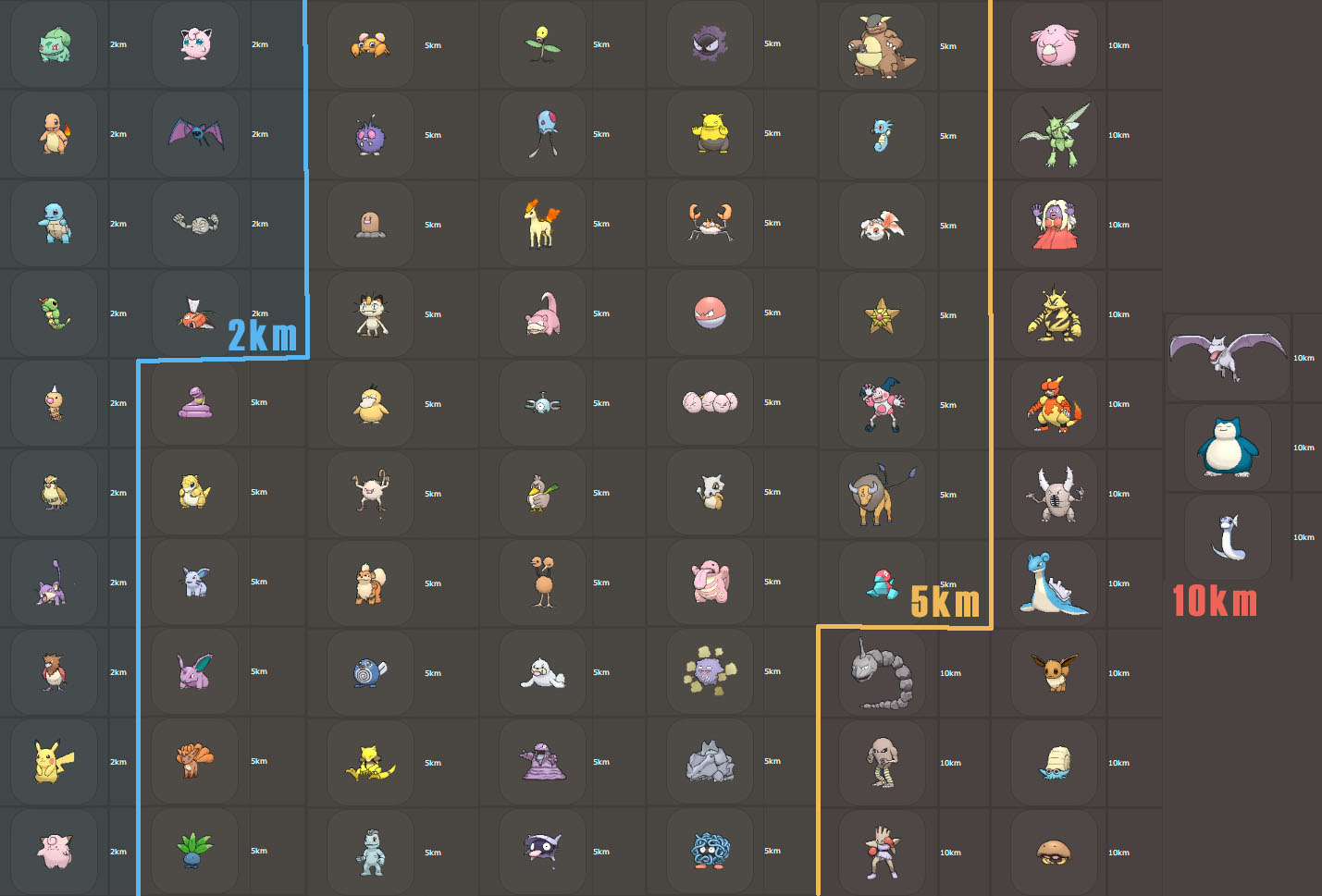
For your convenience, here’s the egg list in writing:
2 Kilometer Eggs
- Bulbasaur, Charmander, Pidgey, Caterpie, Magikarp, Onix, Clefairy, Pikachu, Jigglypuff, Rattata, Weedle, Squirtle, Pidgeotto, Zubat
5 Kilometer Eggs
- Abra, Gloom, Diglett, Doduo, Psyduck, Seel, Growlithe, Goldeen, Jynx, Kangaskhan, Weepinbell, Krabby, Machop, Magnemite, Meowth, Mankey, Shellder, Oddish, Gastly, Nidoran (M/F), Diglett, Paras, Ponyta, Farfetch’d, Porygon, Quagsire, Ekans, Rhydon, Sandshrew, Snorlax, Tentacool, Staryu, Tangela, Tauros, Tentacruel, Trubbish, Voltorb, Vulpix
10 Kilometer Eggs
- Aerodactyl, Omanyte, Chansey, Dratini, Electabuzz, Eevee, Kabuto, Hitmonlee, Lapras, Magmar, Hitmonchan, Onix, Farfetch’d, Pinsir, Snorlax, Roselia, Scyther
Have you ever hatched eggs in (Pokémon GO)? If yes, what are your experiences?
Exciting tips and tricks for Pokémon GO can be read here.

Your opinion is important to us!
Do you like the article? Then let us know!