
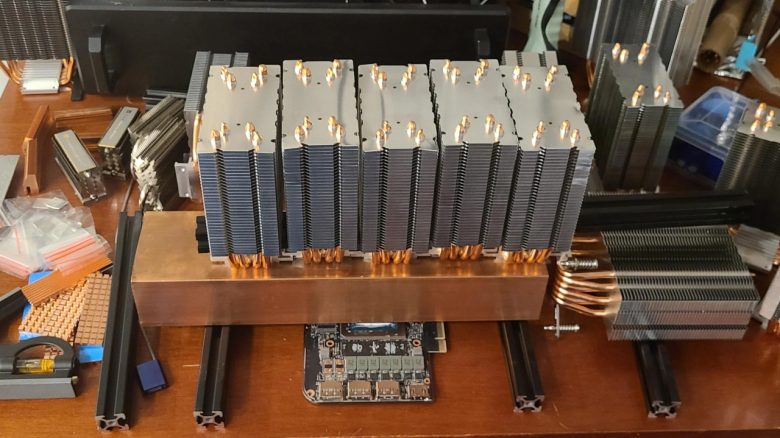
A player showcases a project on how he wants to passively cool his GeForce RTX 3080 with a huge copper block. However, some users point out that the project will not work, or that he might not be satisfied with the cooling performance.
What is the player’s plan? The player’s idea is to cool the RTX 3080 with a large copper block that he intends to mount on the graphics card. He wants to use several passive coolers to dissipate the heat from the metal block. The metal block should completely cover components such as the VRAM and graphics chip and cool them in this way.
His goal is to passively cool an RTX 3080 Founder’s Edition and a Ryzen 7600x. He primarily wants to focus on the GPU. You can see this with the huge metal block sitting above the graphics card.
Community fears that the copper block for cooling is way too large
What are the concerns? Some users speculate that the copper block the player wants to use is far too large, meaning that the block will only get hot without properly dissipating the heat. Then the cooling performance would only be average, and he could revert to normal active air cooling.
Another explains that the entire action would surely work, “but considering thermodynamics, materials, ambient temperature, etc., you will likely have at best mediocre passive cooling with heat spikes.”
Another user advises him to create an entirely custom system. He would need to design copper pipes or similar to efficiently conduct the heat away. “Using a massive block,” he adds, “will in this case be a heat radiator and not a cooler.”
Mineral oil cooling as an alternative, but it is costly and complicated
What alternatives exist? One user recommends that he opt for cooling with mineral oil: here, you submerge the entire gaming PC in a basin of oil and use that as cooling.
With its high thermal conductivity, reduced noise levels, and aesthetic appearance, this cooling method is often used by enthusiasts or experts.
However, it not only has advantages but also comes with some pitfalls:
- The maintenance effort is significantly higher compared to other cooling types. The effort may not be worthwhile for most gamers.
- Those wishing to replace or maintain components will find that oil-based cooling involves much more effort than water or air cooling.
- If something goes wrong, oil is sticky and difficult to clean properly. This also applies if you want to resell components. Freeing a graphics card from oil is not an easy task.



More about Gaming: A new gaming PC is likely a small highlight for anyone. Because new hardware typically means a noticeable performance increase. However, a father has recently bought a gaming PC at the request of his son. But he likely won’t enjoy the gaming PC much.