

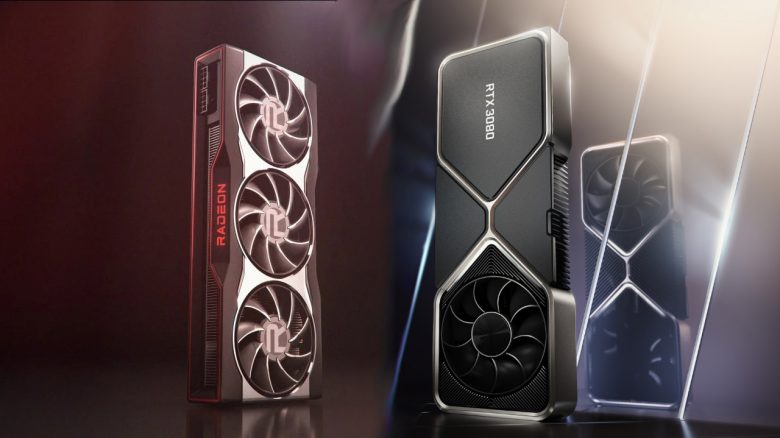
Many users looking to buy a graphics card are currently opting for Nvidia. Here, you get more features. But that could change now, as AMD is making a significant leap forward in terms of software.
Those who want to buy a graphics card often go for Nvidia. Nvidia offers several features that can significantly increase your FPS in games. We are talking about DLSS, DLAA, and more – features you have had to search for in vain at AMD so far.
But now AMD is releasing an update for its FSR technology, which significantly reduces the gap to Nvidia. MeinMMO explains what it is about and what it means for you as a gamer.
Nvidia graphics cards have previously offered technology that outperformed AMD
What technology is it about? With DLSS (Deep Learning Super Sampling), low frames are scaled to higher resolutions using AI. The frames that are missing during upscaling are then calculated by the graphics card.
This improves performance at high resolutions even further when the graphics card is already under load. According to Nvidia, a frame rate increase of up to 50% is mentioned (via nvidia.com).
DLSS is also a technology that uses Tensor cores optimized for AI mathematics, which are only built into Nvidia graphics cards. This is why DLSS has been Nvidia’s strongest argument for why one should prefer not to buy a graphics card from the competition. For instance, in the test overview of the GeForce RTX 3060, it shows that you can increase performance in games by around 30% thanks to DLSS.
While AMD’s RX 6000 series now also offers ray tracing, AMD has long been unable to provide an alternative to DLSS. The first attempt with “Fidelity Super Resolution,” short FSR, could not keep up. But that is exactly what is changing now.
What is FSR actually? The idea behind Fidelity Super Resolution (FSR) is the same as with DLSS: low textures are scaled to higher ones without the game looking worse.
With FSR 2.0, however, AMD has changed quite a bit. The latest version relies on a new sampling method to obtain the data. With FSR 2.0, AMD works with temporal upsampling like Nvidia, whereas FSR 1.0 still employed a spatial upscaler.
The particular twist is that AMD’s FSR also works with Nvidia graphics cards. Unlike DLSS, you do not need Tensor cores for FSR. Such Tensor cores are only found in RTX graphics cards.
What has been the problem so far? AMD’s FSR 1.0 did not match DLSS. AMD knew this and therefore worked on a second version. The update to 2.0 has apparently paid off significantly. Many testers declare that the new version is a tremendous leap forward.
Initial tests indicate: AMD is extremely close to Nvidia
The testers of the online magazine TechPowerUp describe FSR 2.0 as a “DLSS killer” (via techpowerup.com). The new technology has made a significant leap forward and offers a noticeably better performance than FSR 1.0. And the gap to Nvidia is getting significantly smaller. In their conclusion, the testers from TechPowerUp write:
AMD has achieved the unthinkable – the new FidelityFX Super Resolution FSR 2.0 looks fantastic, just as good as DLSS 2.0, actually DLSS 2.3 (in Deathloop). Sometimes even a bit better, sometimes a bit worse, but overall this is a big win for AMD.
The testers from Computerbase see the improvement very similarly, but are a bit more reserved (via computerbase.de). Both technologies have their weaknesses, and in terms of performance, neither DLSS nor FSR is really better. However, AMD has the advantage that its upsampling method also works on competitor graphics cards. Sometimes one technology performs better, sometimes the other.
If you want to see the differences between FSR 2.0 and DLSS 2.0, check out the video from Digital Foundry. Here you can clearly see the differences or similarities in the video:
Interestingly, all testers agree on one thing: there need to be more games that also support FSR 2.0.
There is still one problem: While FSR 1.0 could be used simply, FSR 2.0 now has to be actively implemented by developers. However, according to AMD, this should be very simple when the game already supports DLSS 2.0. AMD therefore has to ensure in the near future that more games support FSR 2.0. Otherwise, the software cannot be used in practice.
You should definitely know this about the next generation of graphics cards before you buy a new one

Your opinion is important to us!
Do you like the article? Then let us know!