
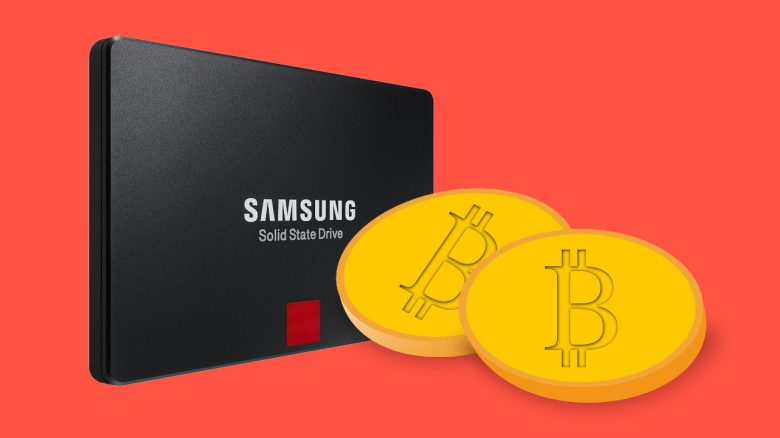
The cryptocurrency Chia causes a high wear and tear on hard drives. Especially SSDs are affected. A 500 GB SSD is said to be broken after just 40 days.
Cryptocurrencies play a significant role in the current time. For “mining” most currencies, graphics cards are absolutely necessary. Manufacturers like Nvidia even go so far as to significantly hinder mining with graphics cards.
With the still relatively young currency “Chia,” things look a bit different. Because here HDDs and SSDs are required to mine the valuable currency.
However, this process is very intensive and causes significant wear on SSDs. Although the SSDs are not completely useless immediately, their write performance noticeably declines.
Currently, there are more than 4,500 different currencies, but the most important ones are Bitcoin and Ether (via wikipedia.de).
Chia is a particularly write-intensive cryptocurrency
What kind of currency is this? The currency Chia deals with so-called plots. A plot is a mining attempt. These plots must be written to a storage device.
The process (plotting) takes about 6 to 12 hours, depending on the hardware and settings. Due to the long duration, multiple plots are often created in parallel.
In principle, both an SSD and a slower HDD can be used for this. However, using an SSD significantly speeds up the process.
The more plots you own, the higher the likelihood that you will be chosen for the next block. Therefore, performance plays an important role here.
What is the problem? The lifespan of an SSD is limited by the number of write accesses. The unit of measurement used here is TBW (Total Bytes Written). For an SSD, the lifespan here is lower than that of an HDD.
However, a lot of data is written during plotting. A single plot is approximately 100 GB in size, but it takes about 1.5 TB of write performance to create a single plot.
Cheap consumer SSDs also use cheaper flash memory. While TLC memory cells offer a lot of storage, they have significantly fewer write accesses. Here, it ends at 300 – 1000 write cycles (via storage-insider.de)
The writeability varies depending on the quality between several hundred and several thousand write cycles. If the value is exceeded, the flash cell can no longer be properly erased, leading to decreased performance. Therefore, a technique is employed that distributes write operations across all available memory cells.
However, to mine the currency “Chia,” a lot of write accesses must be performed one after the other, placing a strain on the hard drive. These operations are carried out continuously, as data is written to the hard drive with each mining attempt (plot).
A standard 500 GB SSD fails with Chia after about 40 days
How is this calculated? Normal consumer hard drives can be purchased by anyone from Amazon or various retailers. The important information here is how many terabytes can be written to the hard drive.
The well-known Samsung SSD 870 EVO is one of the most popular hard drives and is one of the bestsellers on Amazon among internal SSDs.
In the case of the Samsung 870 EVO, the maximum write performance is 300 TBW for the 500 GB version of the SSD. This means that at least 300 terabytes of data can be written before performance noticeably decreases. This represents a minimum write performance and not an indication of the “end of life” of the device, i.e. until it is completely broken.
For most gamers, who will likely install their operating system and a few games on their SSD, such write performances are more than sufficient and will only be reached after many years.
This is how long an SSD lasts: The online magazine PC Gamer shows how long an average SSD lasts before it is no longer usable (via PCGamer.com) and the numbers are surprising:
- A normal 512 GB SSD is broken after about 40 days
- A 1 TB SSD can last about twice as long.
- A 2 TB SSD lasts about 160 days.
The numbers refer to common consumer SSDs like the Samsung 870 EVO and come from a Chinese site (via mydrivers.com).
Are there SSDs with longer durability? Most manufacturers offer pro models with higher durability, but they cost significantly more than regular models. While the Samsung 870 Evo costs around 70 euros, you’ll pay 110 euros for the Samsung 860 Pro. The durability here is 1200 TBW for the 500 GB version. The pro models are aimed at professional users, not gamers or office users.
Cryptocurrencies currently play a significant role, as they are seen by many as a good source of income. However, mining currencies poses several new problems. Mining Ethereum and Bitcoin consumes enormous amounts of energy. In China, discussions are underway about whether to ban Bitcoin mining due to environmental pollution.