
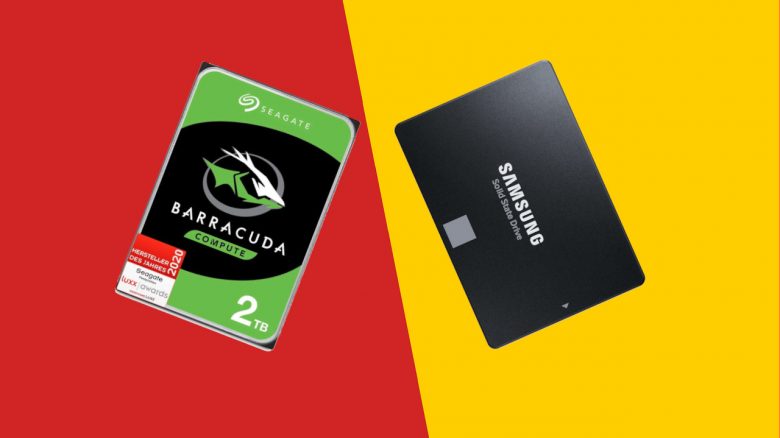
The manufacturer Seagate has introduced an HDD that is said to be not only the fastest HDD but also as fast as an SSD. However, most gamers will not buy this hard drive because it is designed for servers and data centers. MeinMMO introduces you to the hard drive.
Games like Call of Duty: Warzone require enormous amounts of storage space on your PC and PS4 hard drive. Now, the manufacturer Seagate has introduced an HDD that features 14 TB of storage capacity, primarily distinguished by its enormous speed.
What kind of hard drive is this? The introduced HDD is technically named “Seagate Mach.2 Exos 2X14” and offers a solid 14 TB of storage (via Seagate.com). The storage is divided into two logical sections.
Seagate promises a transfer rate of 524 MB/s. This comes close to the speeds of a SATA SSD. The well-known Samsung SSD 870 EVO is one of the most popular hard drives and ranks among the Amazon bestsellers of internal SSDs. Samsung promises a read speed of 560 MB/s and a write speed of 530 MB/s.
The transfer rate is important for data transfer, especially when moving files back and forth. Gamers would hardly benefit from the transfer rates of the hard drive.
Blazing fast HDD primarily targeting servers and data centers
That’s why the HDD does not fit into your computer: The new HDD from Seagate uses SAS 12 GB/s. SAS (Serial Attached SCSI) is a computer interface for data transport. In many gaming PCs, SATA 6 GB/s is typically used, which is found on the motherboard.
You cannot operate a hard drive with a SAS connection over a SATA connection (via blog-ipc-computer.de).
Additionally, SAS drives are generally much more expensive than SATA hard drives. This is likely to deter many users from installing such a hard drive in their home desktop PCs.
Fundamentally, we would still recommend an SSD if you are looking for fast storage for your console or PC. The best SSDs for the PlayStation 4 are presented in this article:

HDD or SSD – Which is better for gaming?
Both HDDs and SSDs are mass storage for data such as your operating system, games, movies, or documents. HDDs are traditional mechanical hard drives that are generally completely sufficient for gaming.
In a mechanical hard drive, parts rotate and move to read and write data. An SSD operates entirely without mechanics. This mechanic makes HDDs slower than SSDs. Additionally, HDDs are more susceptible to shocks and other environmental influences. However, HDDs generally cost less money and offer more GB per Euro. For the price of a 1 TB SSD, you can get about 6 to 8 times as much storage space on an HDD.
When is the purchase of an SSD worthwhile? It is primarily about loading times. For large and demanding games that have longer loading times, purchasing an SSD is worthwhile. However, you should keep in mind that not all games equally benefit from the speed of an SSD.
The biggest difference between SSD and HDD can be found in IOPS (input/output operations per second). This value describes how many input and output operations the storage medium can perform per second. Here, the SSD clearly outperforms the HDD: While an HDD offers several hundred operations, the IOPS value of an SSD is in the hundreds of thousands of operations. For gamers, the read values are generally more important than the write values, as large texture packs need to be read.
You can watch the direct comparison of loading times between SSD and HDD in this YouTube video, which we have embedded for you:
It is even recommended to combine a traditional hard drive with an SSD: The HDD is used for large amounts of data that you do not need to access as often, such as movies, images, or other data. The operating system and important games, on the other hand, are installed on the faster SSD.
But not only in gaming are fast SSDs needed: For the still relatively new currency “Chia”, mass storage like SSDs and HDDs are required to mine the valuable cryptocurrency. However, the new mining method Chia is so intense that it can destroy your SSD in 6 weeks. Alternatively, you can also use HDDs, but they do not offer such high speeds.