


After more than 20 years of waiting, a new strategy game for Star Trek was released on Thursday, October 12, 2023, on Steam. The user reviews are already critical, and the first test reports on Metacritic appear mixed. Our author Schuhmann also took a look at Star Trek: Infinite and raises the red alert.
This is the situation: Rarely has a game looked better on paper:
- 24 years after the great strategy game “Star Trek: Birth of the Federation,” a new licensed 4x strategy game for Star Trek is being released with Picard on the cover and everything.
- Behind the game, there would be Paradox as the publisher, the great strategy specialists from Sweden, who possess as much competence and experience in the genre as no one else.
- The game would then be based on Stellaris, the masterpiece that has dominated the SF sector on Steam for years and has received 19 DLCs and expansions, thus being extremely refined.
Weak 66% on Metacritic – Steam Reviews only 55% positive
Here’s how it is in reality: Not good at all.
- On Steam, the game currently has only 55% positive reviews – a “Mixed”: These are games that, frankly speaking, sink and disappear into oblivion.
- Metacritic gives the game 66 out of 100 points after 13 reviews – this also sounds like below-average, a 3- or 4+. The GameStar gave it one of the best ratings with 73%.
- According to Steam Tracker, the game had 5,500 players at launch, which isn’t that great either.
What are the good aspects of the game? Star Trek: Infinite combines the gameplay of Stellaris with the great universe of Star Trek, which many love, and an idea from “Europa Universalis IV”: mission trees.
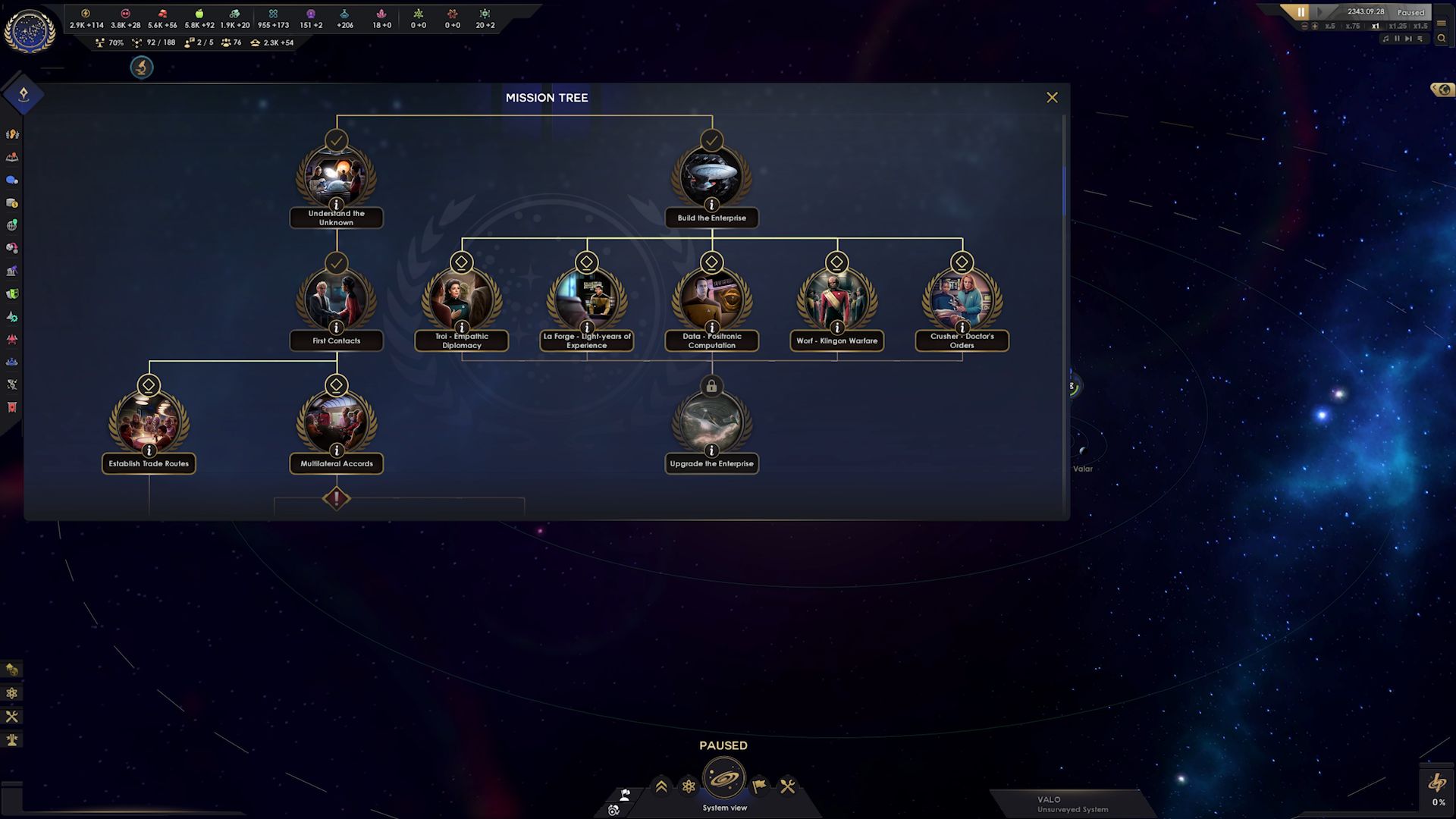
Each of the 4 starting races has specific missions that provide a clear storyline while also granting the player some freedom. While Stellaris often leaves beginners directionless, Star Trek: Infinite makes it clear at all times what the game expects from the player: There is a clear red thread.
With the Federation, for example, one unlocks the Enterprise under Picard once enough metal has been collected. With the Enterprise, missions can then be completed and additional bonuses unlocked.
Fans of Star Trek will find many references to the series in events and characters: Spock, Data, Captain Janeway, and Picard, even Commander Sisko makes an appearance.
Plus many familiar species from the series: After Andorians, Tellarites, and Vulcans, the Betazoids typically join as the fifth race of the Federation.
Star Trek: Infinite breaks with the familiar formula of 4X games
What are the downsides of the game? Star Trek: Infinite is a 4x game. This stands for Explore, Expand, Exploit, and Exterminate.
Typically, these games start with spending the first hours exploring the environment and founding new cities or bases until the first opponent is encountered, at which point the expansion of one’s own empire pauses. The early game is over, and one begins building their own cities and strategizing how to outsmart the opponents.
This is the natural flow of every 4x game from Civilization VI to Stellaris to Galactic Civilizations 4.
In Star Trek Infinite, you start with a relatively large empire, 4 starting planets, and you see the 3 opponents from the very beginning: As the Federation, you border the Romulans, Cardassians, and Klingons.
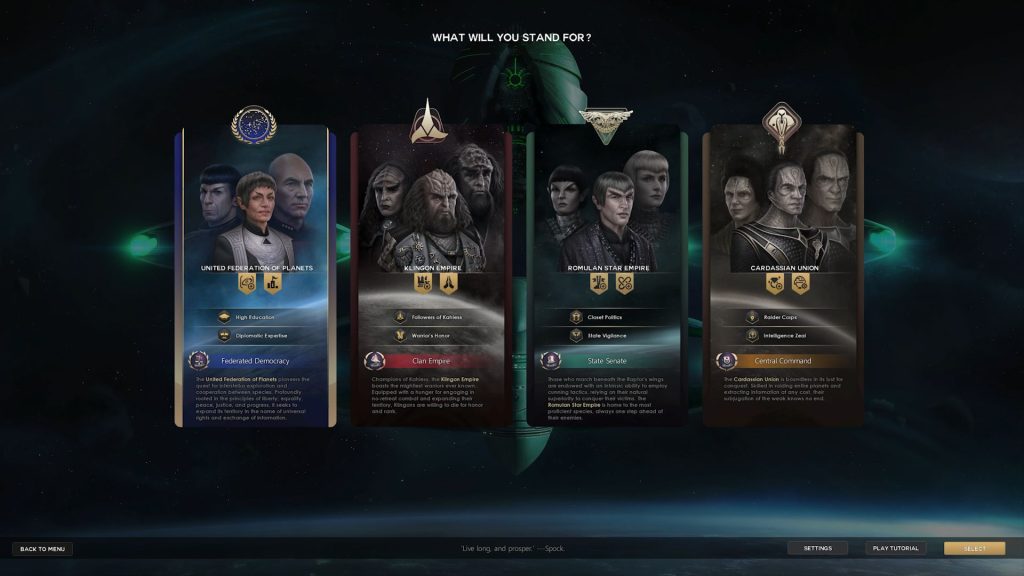
However, there is also a vast galaxy behind you that you can explore and conquer. The brief phase in which you usually expand your empire without opposition is thus significantly stretched in Star Trek Infinite. Because the developers want to prevent rapid expansion (through a construction ship spam), they introduce an artificial scarcity to the resource “influence”: You explore areas but must wait until you can seize them, until the necessary influence has painfully slowly increased.
This leads to a protracted early game that never ends. This is initially an unusual experience for any 4x player. In attempting to replicate Star Trek, Star Trek: Infinite breaks with the conventions that work and define the 4x genre.



In addition to this break with conventions, Star Trek: Infinite lacks many “Quality of Life” improvements:
- You cannot simply jump to events or missions indicated by the logbook; instead, you must first search for the mission location, which sometimes is even outside your own territory. Given how overwhelming your own territory is, it becomes cumbersome over time to follow the progression of the game.
- Moreover, individual missions that require bringing a science ship and a military ship to exactly the same spot become extremely tedious by the third time and leave a poor gaming experience.
- Ships indicate that they can be upgraded, but the system doesn’t work quite well.
- Integrating new races into the Federation feels mechanical and poorly thought out. This aspect of the game becomes boring after just a few minutes.
- Events are hard to read and pass by too quickly for the player.
- Enhancing planets isn’t really a strength for Stellaris. A game like Galactic Civilizations 4 does this significantly better. The base building in Star Trek: Infinite is quite similar to that of Stellaris, but differs just enough to be annoying.
Conclusion: Star Trek: Infinite was a great idea on paper, but in practice, the product feels immature and needs more polish. Somehow, the narrative fundamentals of the Star Trek license, to which they apparently feel bound, collide with the otherwise smooth gameplay flow of Stellaris. A plus (gameplay from Stellaris) times a plus (the universe of Star Trek) does not seem to reinforce here, but instead hinders each other.
It would have sufficed to let the game launch earlier in order to avoid this dilemma. As a 4x player, one is used to starting with a single base and a black map. Starting with 20 territories, 4 bases, and a clear picture of the strategic situation is unusual.
However, Paradox is known for improving games that start off challenging in many cases. Therefore, there is still hope.
Star Trek: Infinite faces a difficult start not only because the SF epic Stellaris clearly serves as a model, but also because that game has become polished after years of improvement. It is said that Star Trek: Infinite is essentially a “brand skin” for Stellaris.
Moreover, there is a good Star Trek mod for Stellaris (via steam). With this mod, many are comparing the game Star Trek: Infinite on Steam and saying: The free fan mod far surpasses the €30 game.
The release timing for Star Trek: Infinite may also have been poorly chosen. Just next week, Galactic Civilizations IV is set to launch in the “Supernova” edition on Steam:
I subjugate humanity with a gang of rampaging space rabbits

Your opinion is important to us!
Do you like the article? Then let us know!