

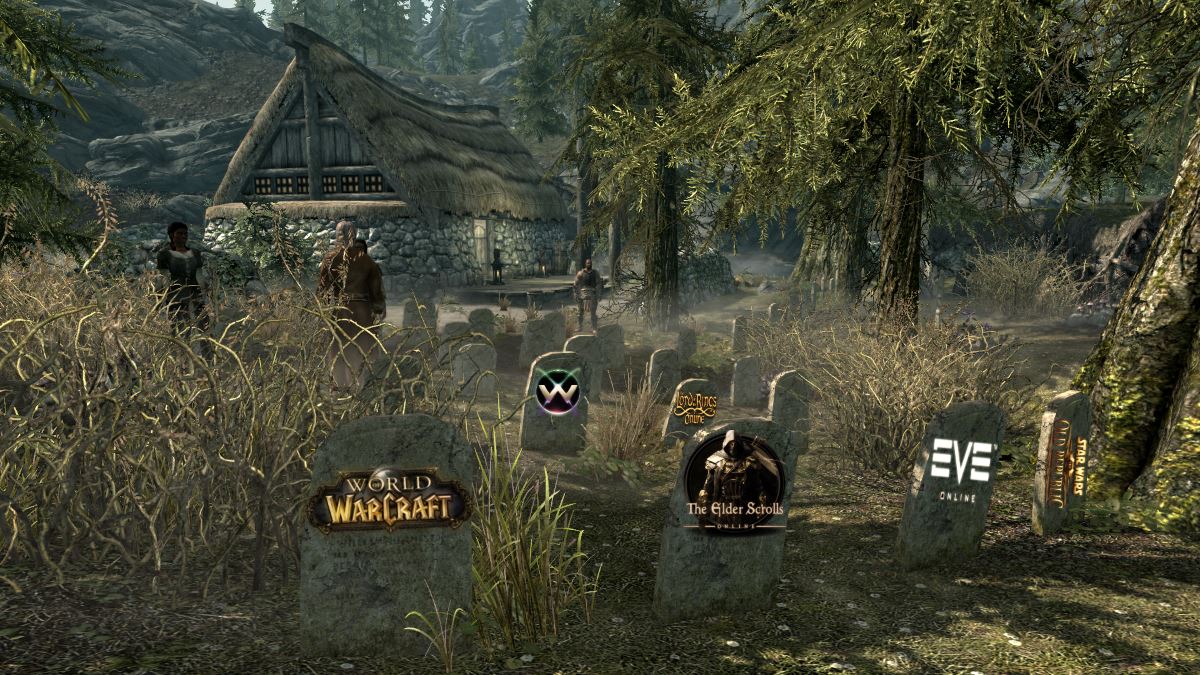
Every MMO is actually dying constantly. Every game loses users over time, players are disappointed, everything is going down the drain. Whether it’s World of Warcraft, The Elder Scrolls Online, WildStar, or EVE – everything is doomed.
Actually, all MMO players should wear black. Always. Because their game is dying! From the very first moment it is doomed. Just like pretzels start to get soggy the moment you take them out of the package. You have to imagine it like the doctor just delivered the baby, proudly holds it up, and the nurse makes a face and says: “That’s nothing special. It’s bound to go free-to-play soon.”
You read in columns that everything is dying. Always. WoW – with 6.8 million players? Doesn’t matter. Almost dead. The trend is going downward. The Elder Scrolls Online significantly improved after three patches and blessed with fiery supporters? A fringe phenomenon! A few forever stuck in the past cling to the illusion, refusing to accept any reality. And WildStar? Pah, we don’t even need to talk about that. A bizarre niche game, doomed to fail from the start. So it is said in many corners of the internet.

When Guild Wars 2 came out, I made the mistake of being the only one in my circle of acquaintances who continued playing World of Warcraft. I was constantly nagged about the superiority of the new one: “What? You’re in a queue? How 2006 is that! I’m in an overflow server!” – “What? You’re waiting for a tank? How 2006 is that? We don’t need that!” – Clearly: WoW was practically dead. Anyone still playing it was committing some sort of desecration – with a clothespin on their nose. That the game is still fun, those few players probably had to convince themselves in their delirium.
It’s well known that predicting the demise of WoW is one of the most popular pastimes in the MMO world, a sort of evergreen among self-proclaimed MMO experts. But even EVE Online, the little game that has grown and thrived against all odds for years, has been said to be dying for more than 10 years. EVE was nice for a while, but now it’s time for something new. And we won’t even talk about all the games that were predicted to switch to free-to-play two minutes after their announcement. It’s sad that some free-to-play games even ended up doing better afterward, but that’s another topic.
And who’s to blame? The Swiss! No, just kidding, actually everyone
What is actually causing all of this?
The Course of Events
On one hand: MMOs are indeed always dying. Almost every MMO goes up sharply and then down. Many more people buy an MMO than there are players who continue playing after two months.
Is that a problem? Well, not really. It’s normal. The developers know about it and have models in place that assume that not everyone who buys a game will still be playing it in the second, third or eighth month. No one cares that there are such models and that the developers expect player losses from the very beginning.
Players believe that if an MMO’s curve is pointing downward, that’s a sure sign: It’s a total flop. But that’s simply the reality of games. A drastic collapse is something different. When a game falls so far short of expectations that a stable player count cannot be found, then it’s a problem. But usually outside the sacred halls of developers, people don’t know the numbers and calculations. They don’t know the player count a game needs. They can’t form a judgment. But does that stop anyone? Of course not. The idea is: “If a game is emptier in the second month than in the first, then it’s a flop.” It may seem that way, but it’s simply nonsense.
Whoever makes winter coats also has a calculation that anticipates they won’t sell that well in summer. Without knowing the budget and expectations of the companies, you simply cannot say if a game is “doing well,” if it is “dying,” or if it is “fading away.”
If you have the business plans and see the numbers, you have a rough idea; beforehand, you don’t. In most recent MMOs, no one really knows how they are doing and whether they are meeting expectations or not. It’s all just an impression that intensifies into a sort of “self-fulfilling prophecy.” An MMO is struggling because everyone says it is struggling.
And why does everyone think an MMO is struggling? Because they see fewer players in the game, in their guilds, in their friend lists, in the second month than in the first. Here the circle closes.
How much perception can deceive was recently shown by numbers about the profit of games that offer the option to subscribe or have a quasi-subscription. There, two MMOs, Star Wars: The Old Republic and Lord of the Rings Online, lively competed for the top spots, which have been considered dead for at least four years based on all predictions and expert opinions.
The Press
The second problem is the press, I must say. New titles are attractive, the publisher buys advertising, the game sells out on Amazon, there are discounts, special magazines are printed about the game, specials are written, internet traffic booms, and the interest is huge. For most titles, the press follows the “Barney Stinson” formula: New is always better.
Most MMOs are only treated with indifference two months after their launch; PR news continues, but not much else happens. Because then they are already on the verge of the next game that has to be pushed. The testers who intensively cared for the game and wrote guides are now needed for something else. The normal coverage is taken over by news writers, who often have no relation to the game.
Interest in the MMO that was eagerly awaited three months ago has faded. This creates the very strange impression that everything that is coming is great. Everything that was already there must be old news. “Is anyone still playing that? No. No one talks about it anymore.”
Many games have more previews than reviews.
The Industry
And yes. Of course, studios are often partly to blame for the problems. They miss innovations, develop away from their players, make compromises where they shouldn’t, are only interested in their profit, and sometimes have a really bad idea. But most of all, they have a huge credibility problem.
No one publicly announces, “Our game is not doing well.” Lay-offs and departures from key positions are sold as “normal rotation.” The community managers smile outwardly as if they were models, flight attendants, or… community managers. The lead developers might be in deep trouble, but externally they present a confident demeanor and promise: We’re doing fine, everything will be okay, we’re working on the content, it’s great. Because these statements are often passed on to players, unaffected by the press, fans no longer trust such statements. The people involved seem like football coaches in a relegation zone, who have just been expressionlessly offered a handshake from the board, assuring them that they are “fully supported.” And some community manager or press officer would have assured the drowning on the Titanic that everything was fine and that cocktails would soon be served. The incoming floodwaters might be regrettable, but they’re working hard to have that under control soon.

How does a real “We are doing well” differ from a false one? If the person who says it is a professional (and they are): Then not at all. As a player, you simply believe no one anymore but rely on your approximate feeling and the echo in the resonant body of the forums, the trolls, the fans, and it screams: “The end is near!” So an MMO is practically always dying.
And this is indeed where one of those nasty vicious circles kicks in that people fear. Because if a game falls short of expectations and investors lose faith in the game, they turn off the money tap: Content becomes less frequent, servers get merged, communication with fans dries up – but still, not a single word is heard that the game is struggling. Therefore, MMO players no longer listen to what the industry is saying and assume that the sun-kissed beauty is actually coughing up blood, especially when she smiles particularly photogenic into the cameras.
The Players
And of course, the players themselves are to blame for every MMO always dying in perception. Today, there are far more games, even in the MMO niche, than anyone could ever play. You constantly feel like you’re missing out on something. Therefore, one somewhat justifies to oneself that the game everyone is talking about isn’t right for them. That it would be a waste of time to get involved.
And it’s also fun to see through things. An informed player and reader stands out by not believing everything they read somewhere.
You don’t have to be a prophet to give every single game the thumbs down, predicting that it will only reach niche title status at best. And if others get upset about it? The more the better. A bit of pessimism in MMOs is like predicting that the sun will rise the next day: “I predict that it will fall short of the highest expectations and will not reach the success of World of Warcraft.” Oh really? No shit, Sherlock? I predict that too.
Because just as there are pessimists regarding an MMO, there are also hopeless romantics who describe the game in the most beautiful colors. To say that they are wrong and that the game will never be as good as the fanboys believe – you don’t need to be the reincarnation of Nostradamus for that.
And of course, there are also players who declare a game dead for purely selfish reasons. Because especially in MMOs, there is a competitive mindset among players like in Highlander. There can only be one MMO, to dominate them all. A game that as many as possible should play, to rule over the others, so that their games wither away and not their own.
By the way – I used to tell myself back during the times of Guild Wars 2 and World of Warcraft that my acquaintances just wanted to ruin WoW for me because they wanted me to play Guild Wars 2 with them. Well. No one is safe from false perception.
I have learned from experience, even if it sounds like a Sunday sermon: There are no dead or living games, only good or bad ones. And the most important thing is whether they are enjoyable or not. The rest really isn’t that important, is it?

Your opinion is important to us!
Do you like the article? Then let us know!