

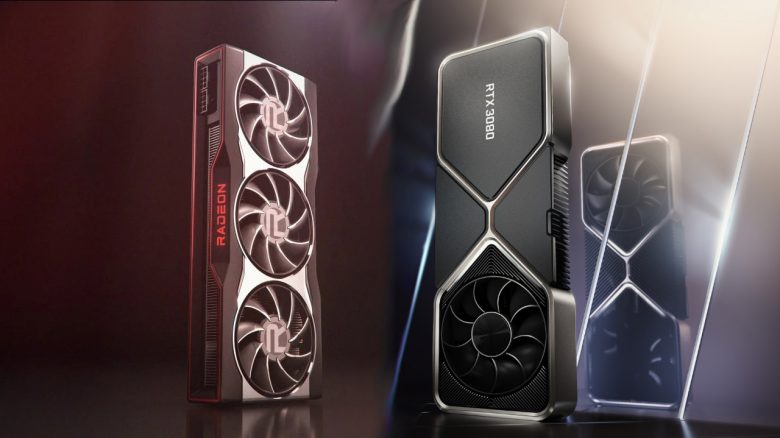
There are now first rumors about the new Radeon RX 7000. But instead of a new graphics card, AMD needs a technology that Nvidia has been offering for a long time, says MeinMMO author Benedikt Schlotmann.
The AMD rumor now suggests that the new “Radeon RX 7000” graphics cards are supposed to provide significantly more performance than the current high-end models such as the RX 6900 XT or the RTX 3080/90 from Nvidia. At least that is reported by a well-known leaker (via GameStar.de).
But instead of a new powerful graphics card, interested graphics card buyers mainly need a DLSS alternative. Because Nvidia is still ahead of AMD here, thanks to the successful technology DLSS.
And this technology is so good and offers such added value that I wish for such a technology for AMD graphics cards in the long term as well.
For me, it is clear: If AMD wants to become a real competitor to Nvidia in the graphics card sector again, they need the DLSS feature.
Nvidia’s DLSS offers a significant performance boost for graphics cards
What is DLSS anyway? With Nvidia DLSS (Deep Learning Super Sampling), the game is calculated internally at a lower resolution and scaled up to a higher resolution such as 4K using a AI algorithm to increase the FPS.
With the upgrade to DLSS 2.0, the technology has experienced an enormous boost. Our colleagues at GameStar are quite taken with the advantage (via GameStar.de)
What does DLSS bring? With DLSS, there is a simple way to significantly increase the FPS while maintaining quality. This is especially helpful when the graphics card is already heavily loaded. With the RTX 3060, the performance gain is up to 30%.
You can see how big the performance differences are in this YouTube video, for example. The gain is sometimes 20 – 30 FPS:
DLSS is especially worthwhile when high resolutions are to be reached, while the frame rate is below 60 FPS.
Even when very high FPS are wanted for competitive gaming or fast monitors, it is worth turning on DLSS.
Laptops with RTX graphics cards also benefit from DLSS. Because the mobile graphics chips are weaker than the desktop graphics cards.
That’s why DLSS is an important factor: This additional performance gain is especially important for gamers interested in ray tracing.
Ray tracing makes shadows and lighting look much more realistic. However, the technology also requires accordingly more performance from the graphics card. Here, DLSS can compensate for the performance loss due to ray tracing. For example, an RTX 3060 or an RTX 3060 Ti benefits from this.
DLSS is also important for the future, as more games want to support this ray tracing, making the technology increasingly relevant in the long term. With Nvidia, you already get DLSS and ray tracing support with the smallest RTX 3000 graphics card (RTX 3060).
Gamers benefit without ray tracing: Even games without ray tracing achieve significantly higher FPS with DLSS than without:
- Outriders does not offer ray tracing, but players benefit greatly from the DLSS feature (via GameStar.de)
- Some players use the advantage of DLSS in CoD Warzone to benefit from higher FPS.
Additionally, DLSS is already supported by some game engines. Nvidia had released a plugin for the Unreal Engine, allowing any developer to integrate DLSS into their game (via GameStar.de).
The Unity Engine is also expected to receive DLSS soon (via GameStar.de). Games like Valheim or Fall Guys, which are based on it, will benefit from this.
AMD has introduced an alternative – release date unknown
What is AMD’s solution? AMD wants to offer a similar technology with FidelityFX Super Resolution to close a gap. Because so far, buyers interested in ray tracing performance and DLSS have to purchase an RTX graphics card.
FidelityFX Super Resolution is supposed to support more than 40 games, including World of Warcraft: Shadowlands.
When is FidelityFX Super Resolution coming? AMD stated a few months ago that FidelityFX Super Resolution will likely not arrive until the end of 2021 (via GameStar.de). Therefore, there is still no official release date for the feature.
Additionally, we currently do not know how powerful AMD’s DLSS alternative really is. So far, there are no independent tests or benchmarks that provide reliable data.
That’s why this is important for AMD: In the combination of DLSS and ray tracing, Nvidia is currently unmatched. Anyone who wants to use ray tracing to its full extent currently cannot avoid Nvidia.
However, if AMD can provide a corresponding alternative that can convince gamers, then interested buyers will indeed have alternatives on the market. Already with the RX 6800 (XT) or the RX 6700 X, AMD has shown that it is competitive in the graphics card sector. Because AMD’s success in the hardware market is therefore particularly beneficial for PC gamers:
- AMD is again offering GPUs in the high-end range, giving interested parties more options.
- The success of AMD means competition for Nvidia again. This should also lead to falling prices in the long term.
In the processor market, AMD is already putting pressure on competitor Intel. Sales data, for example on Amazon, show how in demand Ryzen processors are currently. If AMD manages to find a strong solution for ray tracing, then two brands would again compete for dominance in the graphics card sector. This would certainly be good for gaming hardware.

Your opinion is important to us!
Do you like the article? Then let us know!