
There are rulebooks for D&D that deal exclusively with risqu topics. Especially in the world of magic, there is much that is entertaining …
Let’s be honest for a moment. If magic were to exist in our world and one could learn it from other wizards or at the appropriate schools, then the order of priorities in questions would surely be this:
- What do I need to learn to pass the training, the next exam, or the magical studies?
- What spells help me in everyday life to ease my work or protect me from dangers?
- How can one use magic to simply have more fun?
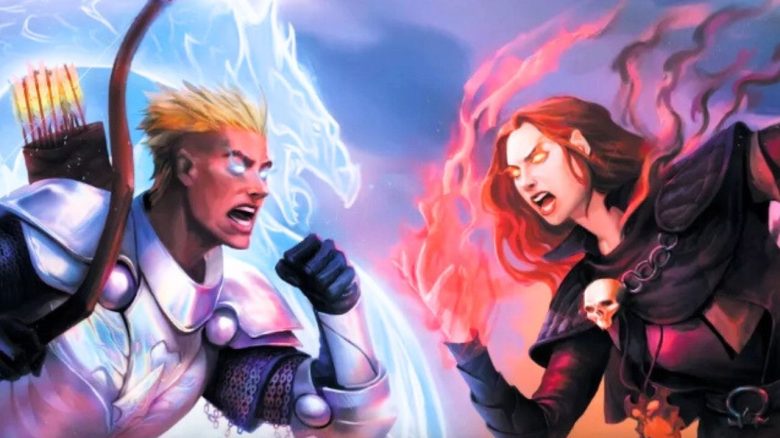
This last question is exactly what the D20 rulebook “Encylopaedia: Arcane Nymphology – Blue Magic” from 2002 is dedicated to, which basically works for all D20 systems, but particularly well for Dungeons&Dragons (or the old Warcraft pen&paper).
This rulebook
is what I want to tell you about today.
Role-playing fans can look forward to many things:
Arcane Nymphology – The Pen&Paper Questions Everyone Asks but No One Dares to Ask
The rulebook makes it clear right at the beginning that it is intended to be somewhat humorous and with a wink. Nevertheless, all descriptions of spells, characters, and items are well-developed and can be incorporated into a D&D session. Many clichés from D&D campaigns are parodied and taken a bit further.
I would like to present a few examples from it.
To start, let’s take the spell “Bardic Hiding”. It refers to the fact that bards can seduce just about anything and anyone. Whether it’s the pretty bard woman, the mayor of the town, the demonic prince, or the great dragon in the cave.

“Bardic Hiding” comes into play whenever there is a danger of being caught red-handed. I will quote from the description:
Since bards have absolutely nothing that resembles any useful combat ability, many wonder how they have survived so far. It is usually due to their quick feet or because they have already planned an escape route in advance – or simply because they possess a spell for that.
When cast, this spell allows the caster to effectively hide in private quarters by jumping into wardrobes, slipping under a bed, or completely ineffectively hiding behind a thin lamp. No matter where they stand or hide, as long as they make at least minimal effort to hide, they receive a bonus on their stealth roll based on their caster level, allowing them to evade all but the most jealous partners.
I know. You’re hooked. I have one more for you: Quick Disrobing. This one is even useful in combat!
With a word and a gesture, the clothing simply falls off the target, leaving them naked except for the shoes they are wearing. This includes all armor but no helmets, hats, or jewelry.
The original intent of this spell was for fun and jokes and to save time when a spontaneous encounter takes place behind a tavern. Since then, it has also been misused by adventurers to strip their targets of their armor, making them easier prey, but the original purpose remains popular.
And yes, be assured: I have primarily listed the spells here that our editor-in-chief won’t have to cut half of them out later with a “Bonk! You go to horny jail” meme. Some of the descriptions in the book are much more suggestive, questionable, and morally reprehensible.
The book contains not only spells but also classes that specialize specifically in this Blue Magic, such as the Pain Mage
, the Seducer
, or the Mystical Pimp
, who can summon all sorts of creatures for pleasure …
Who Are These Rulebooks Actually For?
It is clear that these additional rules, spells, items, and places probably won’t find much use in most pen&paper sessions. Sex is usually an aspect that takes place mostly “off-screen” in P&P – and that’s probably for the best if you ever want to look your friends in the eye again later.
However, I found the spells simply interesting from the perspective of asking: If a world offers so much magic – why shouldn’t one use it for sex and everything that relates to it?
- Are there wizards who specialize in this kind of magic?
- What are the consequences of this magic and what are the dangers?
- What kind of rumors about “interesting” spells might magic students discuss in hushed tones?
For me, it simply sheds light on an aspect of D20 (or D&D) that may never have gameplay significance but does contribute to making the worlds more thought-out and entertaining.
Together with a fellow player in WoW, I once used many of the spells from the book as inspiration to create very questionable “love potions” for a witch’s shop in role-playing, which were used for many years in the RP (and promptly used against my character by the witch).

And yes, this rulebook also contains some things and phrases that might be phrased differently in 2025. But I believe that the book must be viewed as a work of its time – and under this aspect, it is pretty funny and has served me and a friend well when it came to developing new ideas for absurd alchemical potions in role-playing.
I find rulebooks like these, which deal with topics that one would rather rarely or never actually play out in pen&paper, quite interesting. Even if most spells are unusable for one’s own character, they can still be interesting for NPCs – for example, a wizard who has become a bit too lost in the physical pleasures of this magic or for a brothel in a wizard city where people only gossip about all the strange things you can see and feel there.
By the way, the old “Arcane Nymphology” is just one of several books that deal with rather unusual topics in pen&paper. Those who search will stumble across many curious works that can make worlds more exciting and lively. There could also be these 5 magical items that are so crazy you want to use them.
Of course, it can also be a little more blunt. Because sex is naturally just a means to an end. And the goal can also be summoned simply. Welcome to “Power Word: Orgasm”:
With a single utterance that is so incredibly obscene, shocking, and pornographic that even the gods of love would blush upon hearing it, the wizard ensures that the target becomes a melting pool of pleasure.
Any creature with a stamina value of less than 10 is effectively stunned and must writhe on the ground for 3d6 rounds. Creatures with a stamina value between 10 and 20 are stunned for 2d6 rounds, and creatures with a stamina value over 20 for 1d6 rounds.
Being hit or injured in any way immediately dispels the spell; otherwise, the target is limited to writhing in pleasure on the ground and soiling their own clothing. Targets are considered “prone” for the duration.
Power Word: Orgasm is a powerful but dirty way to guarantee a retreat from combat, a sure way to satisfy a partner, and a good method to ensure that they are not just pretending.

I know. You’re hooked. I have one more for you: Quick Disrobing. This one is even useful in combat!
With a word and a gesture, the clothing simply falls off the target, leaving them naked except for the shoes they are wearing. This includes all armor but no helmets, hats, or jewelry.
The original intent of this spell was for fun and jokes and to save time when a spontaneous encounter takes place behind a tavern. Since then, it has also been misused by adventurers to strip their targets of their armor, making them easier prey, but the original purpose remains popular.
And yes, be assured: I have primarily listed the spells here that our editor-in-chief won’t have to cut half of them out later with a “Bonk! You go to horny jail” meme. Some of the descriptions in the book are much more suggestive, questionable, and morally reprehensible.
The book contains not only spells but also classes that specialize specifically in this Blue Magic, such as the Pain Mage
, the Seducer
, or the Mystical Pimp
, who can summon all sorts of creatures for pleasure …
Who Are These Rulebooks Actually For?
It is clear that these additional rules, spells, items, and places probably won’t find much use in most pen&paper sessions. Sex is usually an aspect that takes place mostly “off-screen” in P&P – and that’s probably for the best if you ever want to look your friends in the eye again later.
However, I found the spells simply interesting from the perspective of asking: If a world offers so much magic – why shouldn’t one use it for sex and everything that relates to it?
- Are there wizards who specialize in this kind of magic?
- What are the consequences of this magic and what are the dangers?
- What kind of rumors about “interesting” spells might magic students discuss in hushed tones?
For me, it simply sheds light on an aspect of D20 (or D&D) that may never have gameplay significance but does contribute to making the worlds more thought-out and entertaining.
Together with a fellow player in WoW, I once used many of the spells from the book as inspiration to create very questionable “love potions” for a witch’s shop in role-playing, which were used for many years in the RP (and promptly used against my character by the witch).
And yes, this rulebook also contains some things and phrases that might be phrased differently in 2025. But I believe that the book must be viewed as a work of its time – and under this aspect, it is pretty funny and has served me and a friend well when it came to developing new ideas for absurd alchemical potions in role-playing.
I find rulebooks like these, which deal with topics that one would rather rarely or never actually play out in pen&paper, quite interesting. Even if most spells are unusable for one’s own character, they can still be interesting for NPCs – for example, a wizard who has become a bit too lost in the physical pleasures of this magic or for a brothel in a wizard city where people only gossip about all the strange things you can see and feel there.
By the way, the old “Arcane Nymphology” is just one of several books that deal with rather unusual topics in pen&paper. Those who search will stumble across many curious works that can make worlds more exciting and lively. There could also be these 5 magical items that are so crazy you want to use them.