
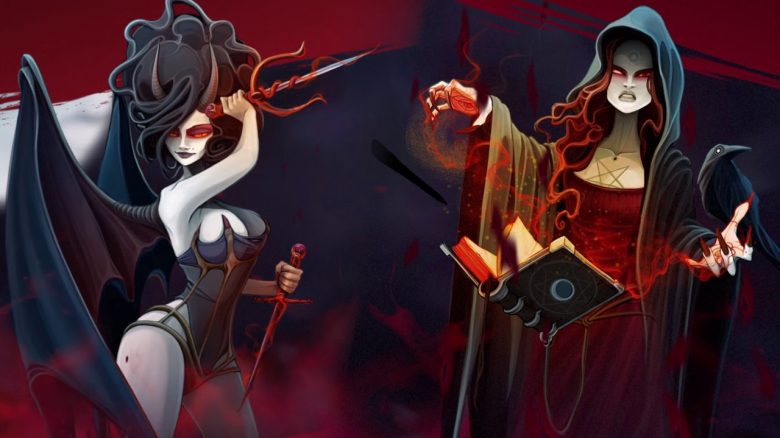
RPG demon Cortyn has fallen for a rogue-like. Why Rogue Lords is a must-buy will be revealed in this article.
Since there is currently a bit of a content drought in World of Warcraft, I finally had enough time to dive deeper into some other games. Last weekend it was “Rogue Lords”.
As the name suggests, this is a game from the “rogue-like” category, but it has some pretty ingenious tricks and twists. To win in Rogue Lords, you have to cheat – that is a core part of the gameplay mechanics.
What is Rogue Lords?
Rogue Lords throws you into a medieval fantasy setting. You are the devil, and you were defeated years ago by humans and their demon hunters. After years in hell, you are now ready to once again overshadow the world of mortals with terror. To prepare for your arrival, you send out servants, the so-called Eleven, who must push your agenda and acquire powerful artifacts.
The Eleven are well-known figures from legends and horror stories. They include:
- Dracula
- The Bloody Mary
- The Headless Horseman
- The White Lady
- Lilith
- Baron Samedi
- Hecate
- Dr. Frankenstein and his monster
Each character plays completely differently and even has distinct play styles. After all, each Eleven possesses 18 different abilities and spells, but a maximum of 8 can be used at the same time.
Additionally, each character has its own stats similar to a traditional tabletop RPG: seduction, terror, occult, cunning, and stealth.
How does gameplay work?
You group three of these characters together and send them out to master a “story” of Rogue Lords. A story is a cohesive map and narrates the quest for one of the artifacts.
On the map, you progress from station to station, making decisions along the way and experiencing different adventures. Often, there are forks in the road, and you must choose one of the paths. Do you prefer to take the left path that leads to a quest, a merchant, but also an elite fight? Or do you take the right path, which has only 3 simple but rather safe battles?
Fights are just one of the events you can encounter.
There are also “story events” where you send one of your Eleven as an actor into a short side mission. There, a social task must be completed, and the chance of success depends on the character’s stats, like “occultism”, “seduction”, or “stealth”:
- Should Lilith try to seduce the merchant to make a pact with the devil (seduction)?
- Or should I send Hecate, who tries to curse the merchant’s goods to harm the demon hunters in the long run (occultism)?
Depending on which character I send and what abilities they possess, the events can turn out differently.
If Lilith seduces the merchant, he gives me a powerful artifact that increases Lilith’s damage the more souls I possess – a bonus that counts immediately.
If Hecate curses the goods, it results in special “terror” effects, as the fear of the devil and his Eleven grows in the world. These are bonuses like additional souls, more diabolical essence, or easier social tests, but only active at a certain distance away.
Depending on how you proceed, your group members also react to the situation. The White Lady, for example, is pleased that Lilith succeeded in seduction and praises her – this grants both a small bonus to health points.
Hecate, on the other hand, believes that anyone could have done it – she comes off as vain and receives a penalty on seduction.
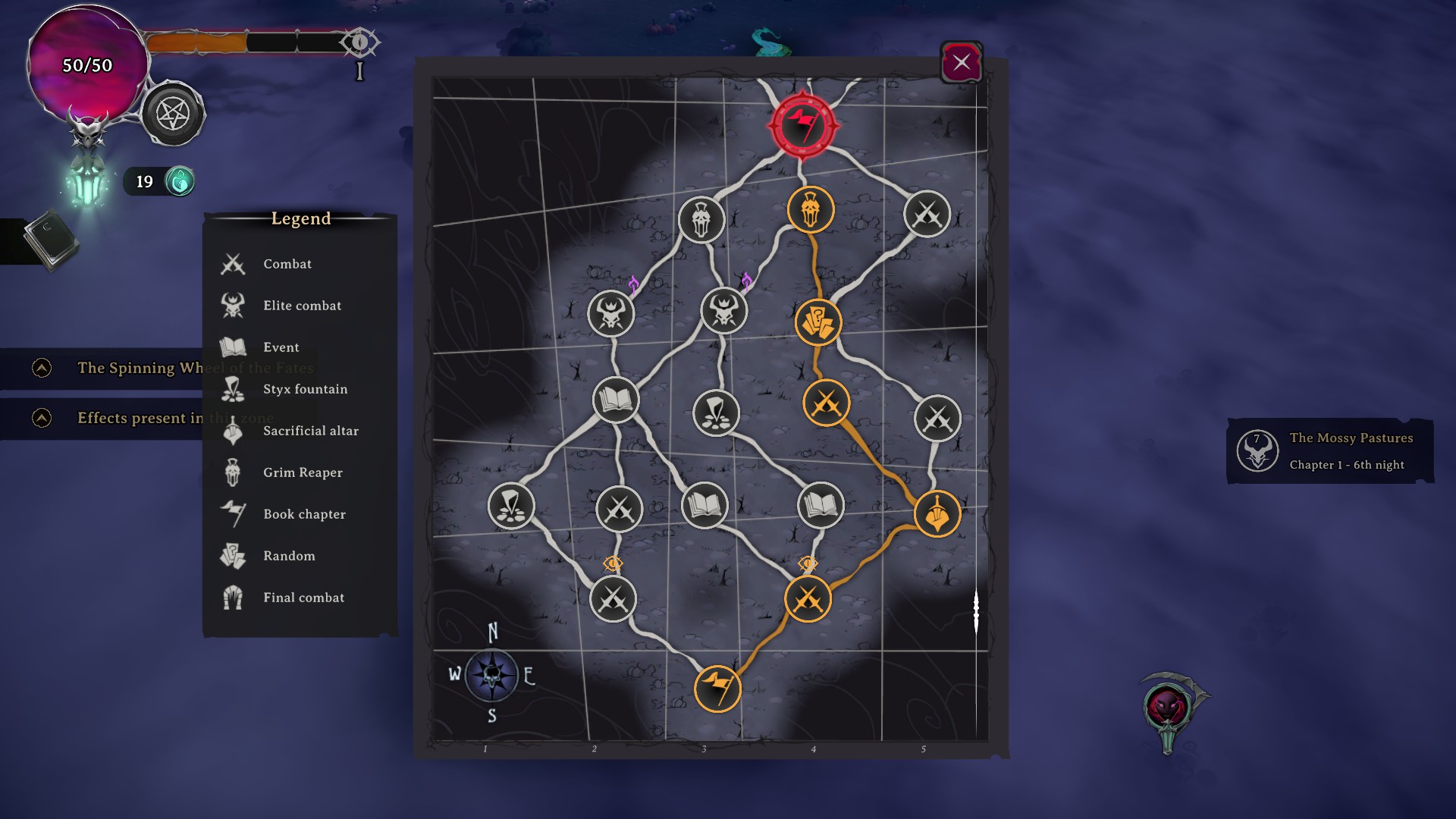
Other fields include:
- “The Grim Reaper”, who sells you abilities and relics for souls.
- Altar of Sacrifice, where you permanently sacrifice one of your abilities to discover a new one and have more abilities available at the same time.
- Styx springs that grant diabolical essence or purify negative traits.
- Fights where you earn souls, abilities, or a terror effect.
- Elite fights where you can obtain powerful relics.
- Book chapters that drive the story forward.
Often there is also a second, optional activity at each station. This could be a saving Styx spring, a small side quest, or a challenging elite fight.
Diabolical power – the license to cheat
But now let’s move on to the special mechanic of Rogue Lords. Since we play as the devil himself, we have some tricks up our sleeve.
Our Eleven do the dirty work, but we wouldn’t be the devil if we couldn’t occasionally intervene in the affairs of the world to change reality and remove seemingly insurmountable problems for our protégés.
The power of the devil is represented in Rogue Lords by “diabolical essence”. This is a resource that we can use in almost all gameplay aspects, whether it’s combat, passing social tests, or simply jumping on the map.
Diabolical essence allows us to cheat.
Depending on how significant the change is, it costs different amounts of diabolical essence. For example, opening a portal to another location costs 6 essence, while moving a buff or debuff costs 5 essence. Increasing the success chance of a social test by 30% also costs 5 essence.

The essence can be partially replenished at certain stations – the Styx springs.
The catch with this cheating is, however: diabolical essence is simultaneously the life force of the devil. If it ever reaches 0, then the journey ends in defeat – and immediately. After that, you have to start the entire current story over from the beginning.
The trick is to use and manage the diabolical essence so carefully that you can get the best possible outcome from the situation with some “cheats” without entering the danger zone of defeat.
This also allows for a lot of tactical depth and planning, which makes it exciting.
You see a difficult social test right in front of a Styx spring? No problem, increase Lilith’s stealth in the social test using diabolical essence to the maximum, ensuring she succeeds and then heals you at the spring.
There is a lucrative merchant on the right path, but immediately after that, a too tough elite fight? Nothing easier than that for the devil. Go to the merchant on the right and then open a portal to the left path to bypass the elite fight.
This cheating becomes even more important in battles. Because there, the devil can not only move buffs and debuffs around, but also simply refill or deplete health points or soul points at will.
The battles – complex tactics for brain acrobats
Despite all the different fields and activities, the battles are the heart of Rogue Lords. Almost all actions aim to make your Eleven deadlier in combat – because at the end of a story, there is almost always a rather tough boss fight waiting.
The battles are turn-based, and during your turn, you can already see the enemies’ intentions. You see whom they want to attack or heal and how much damage that will cause.
Per round, you only have a certain amount of action points (AP) that you must distribute among all fighters. Once they are used up, it’s the enemy’s turn, and they take their actions.
Moreover, (almost) all abilities can only be used once before you need to recharge them through a special action – which typically also costs AP.
If you use the abilities haphazardly in battles, you’ll be overrun by the enemies quite quickly. Because Rogue Lords has not only a rather challenging difficulty level but also requires a lot of thought and tactical planning, at least in battles.
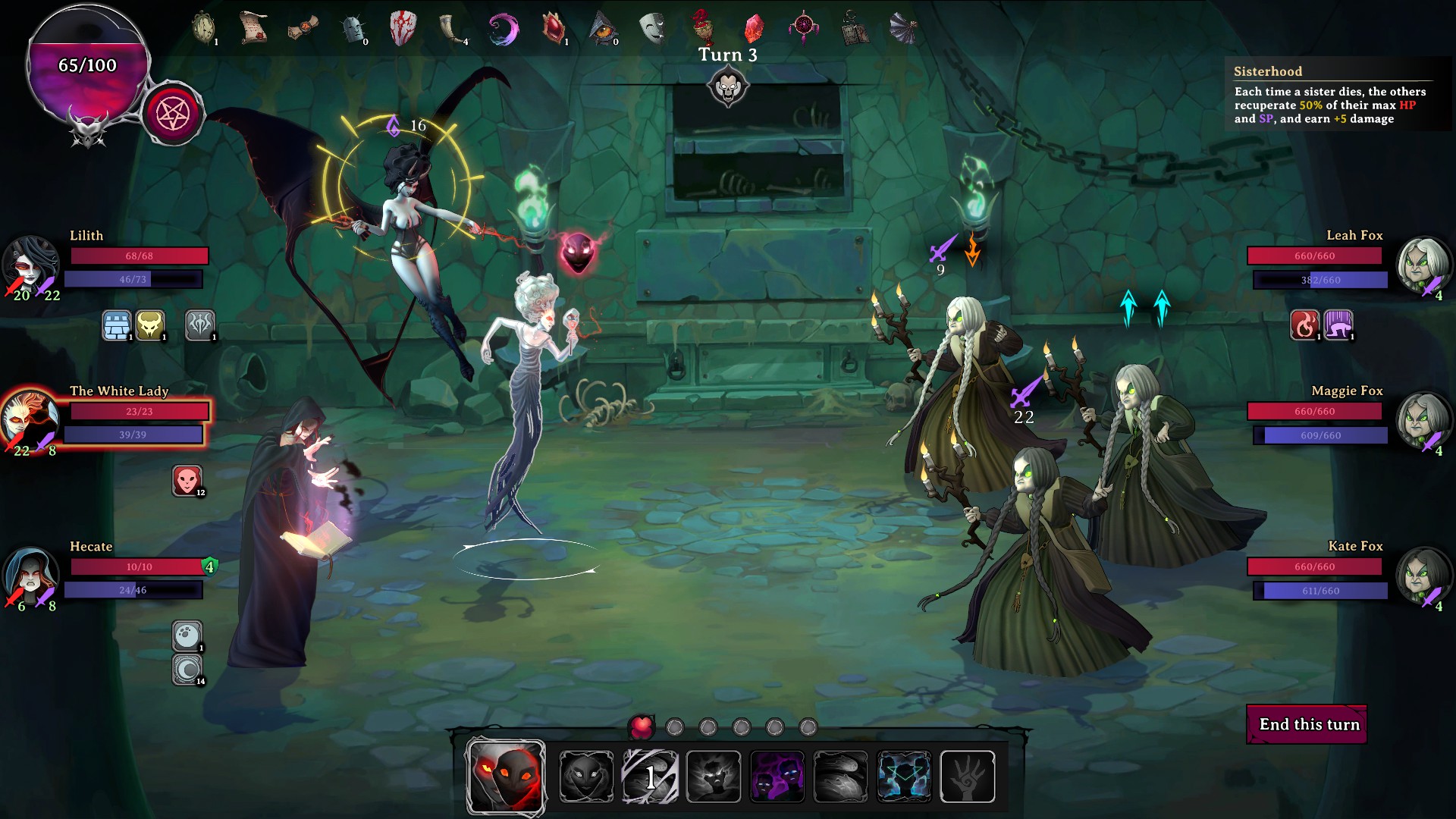
As a little example, a combat situation I experienced yesterday:
The health points (HP) of my team are all significantly damaged, each is below 10. However, my fighters have over 40 soul points (SP) each.
In planning, we can already see that the enemy boss is preparing a powerful attack that will inflict 2×20 HP on all my fighters and also has life steal – that would mean immediate defeat if the attack hits.
I could now use all my resources to heal my team to withstand the attack – but that would only delay my downfall. So I choose a different path.
First, I inflict the enemy with the effect “Shared Mind” – which ensures that the damage dealt and received by the boss affects the SP and not the HP.
Then I inflict the enemy with one of Hecate’s spells into the “Zombie” state. This will mean that healing on the boss is instead converted into damage.
Finally, I use my diabolical essence to take the boss’s buff spell “Aegis” away, which reduces damage taken – I simply move the effect onto one of the other, less significant enemies.
The end result is: The boss performs his attack and inflicts 120 SP damage to my team. That’s a lot, but not deadly. Due to life steal, the boss simultaneously heals about 120 SP, but “Zombie” reverses this healing into damage, causing the boss to take a solid 120 damage and thus kills itself.
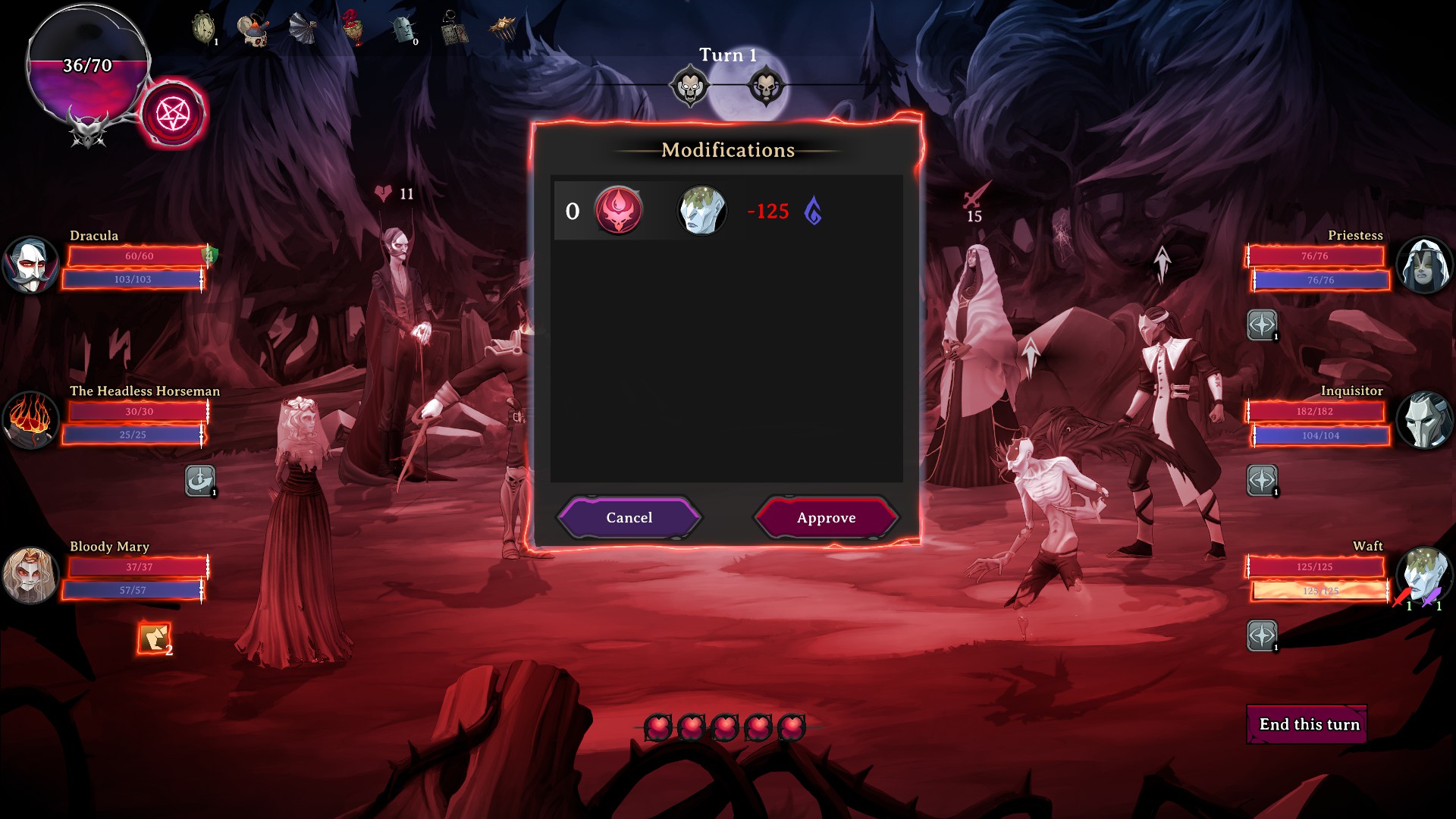
Such methods of “thinking outside the box” are always needed in Rogue Lords. Every battle raises the question: How can I make the best use of my resources in the fight? How can I “cheat” with diabolical essence to turn the situation to my advantage? What abilities can I combine to stay a step ahead of my enemy?
The battles are for tacticians and resemble smaller and larger puzzles, whose mastery proves to be immensely satisfying.
The battles operate on an “all or nothing” principle. You can freely expend your resources (except for diabolical essence). If you survive the battle, HP and SP are then replenished, and you start with full energy into the next conflict.
However, if you fail, your journey ends, and the whole book counts as failed. Like in any rogue-like, you must then begin a new journey from the start.
Genre weaknesses, but overall more than convincing
Of course, Rogue Lords also “suffers” a bit from the weaknesses that other rogue-like titles sometimes bring with them. Sometimes, the random factor simply isn’t on the side of the player devil and when only junk is offered as relics or simply that one specific skill you need for the combo doesn’t appear, it can be a bit frustrating.
However, Rogue Lords has consistently made me want to try again or push through and perhaps discover a new combo that I hadn’t thought of before.
Because even a defeat grants experience points and brings me closer to the next level-up, which unlocks new abilities or relics that can be earned throughout a chapter. This motivates me immensely and ensures that even after the 7th failed run of chapter 6, I start a new journey.
Rogue Lords is fun, mixing rogue-like with RPG elements, extremely tactical battles, and a cheat mechanic that I haven’t encountered before. If you have 25 euros lying around and are looking for a game that makes you think “Just one more run, then I’ll go to bed” and find yourself closing your PC at 7:00 AM – I can only recommend the game.