


MeinMMO author Schuhmann is currently investing hours in Stellaris (PC, Xbox One, PS4), the strategy game by Paradox from 2016. He is only playing one species there: the Tebrid Homolog. In principle, they are like the Borg from Star Trek, but with more tentacles.
What kind of game is this?
- Stellaris is one of the extremely deep strategy simulations from the Swedes at Paradox Entertainment: It is similar to Civilization, a so-called “4x” game: It revolves around Explore, Expand, Exploit, and Exterminate – exploring, spreading, exploiting, and exterminating.
- Stellaris was released in 2016 on Steam and is a typical example of a game that is continuously developed like an MMO: It has received 15 DLCs so far. The latest major expansion “Overlord” was released in May 2022. If you want to get all of that, you’ll pay €230 on Steam.
- The game has 88% positive reviews on Steam – current reviews are even better, with 90%. A sign of excellent development and longevity.
The game is known for its enormous variety of selectable civilizations and playstyles: I, however, favor the Tebrid Homolog. They were introduced in 2017 with the DLC “Synthetic Dawn Story Pack”.
Stellaris: “Assimilate, Adapt, Improve”
What is special about the civilization I play? Good 4x games are characterized by the fact that when choosing a species, a preliminary decision is already made about the play style:
- If you play a Viking in Crusader Kings 3, you plunder, raid, and are looking for a brawl.
- If you choose the cuddly monsters in Galactic Civilizations IV, they multiply so quickly that they overrun the galaxy.
- If you go for the Chinese in Civilization VI, you are focused on wonders, wonders, and wonders – especially at the beginning of the game.
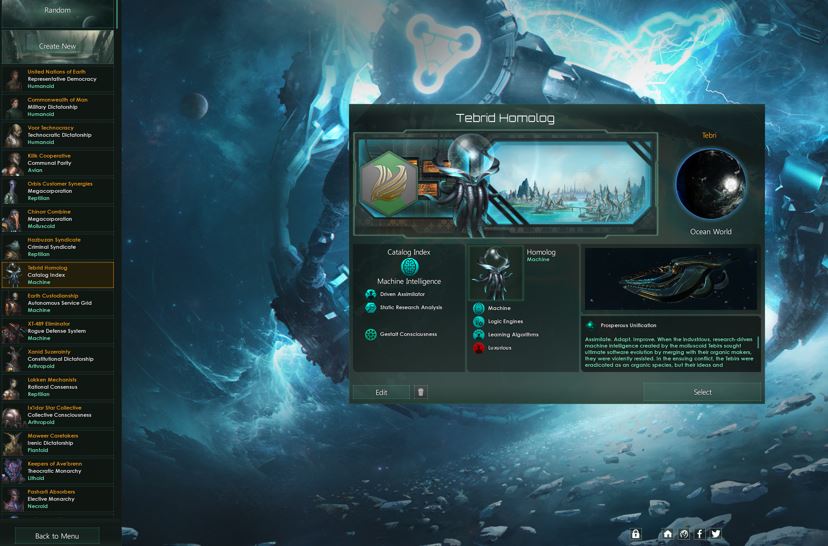
The Tebrid Homolog in Stellaris are 2 different species: the host bodies, essentially human-sized snails, and a parasitic robotic swarm intelligence. The Homolog transformed the Tebrid on their home planet into remote-controlled cyborgs. Now they plan to assimilate the rest of the universe.
Their motto is “Assimilate, Adapt, Improve”. Resistance is futile.
The “Tebrid Homolog” is essentially two species in one:
- The robot Homolog – that’s the parasite.
- Their cyborgs, Tebir, made obedient through a cyber implant – the host body.
The Homolog themselves are practically immortal and do not age. However, they can become useless due to a malfunction. The Tebrid live significantly longer than normal fleshly bodies thanks to cybernetics.
Homolog eliminate some annoying game mechanics in Stellaris
What makes this civilization so appealing? The “Tebrid Homolog” eliminate some game concepts of Stellaris through their peculiarities:
- Normally, to wage war, one requires claims of ownership or a valid cause against opposing empires – the Tebrid Homolog do not care about that; they want to assimilate the others anyway, turning them into mindless drones.
- Traditionally, opposing peoples that are subjugated put up fierce resistance. You deal with uprisings continuously, always facing trouble. The Homolog implant a chip in their brains, and they are assimilated.
- Human peoples generally need certain luxury goods to feel comfortable – that is unnecessary for the people, the robots, and their servants; it is all about self-replication for them.

Start weak, bunker up, and then overrun everything
This is the special charm of the people: At the beginning, the Tebrid Homolog start weak and vulnerable: It takes time for the robots to spread, complex factories must be built, and the next Homolog is painfully slow to assemble.
Apparently, cyborgs also don’t seem to have as much desire for sex as movies about sex-cyborgs would have us believe. Even the Tebir reproduce frighteningly slowly.
Thus, at the beginning of the game, one quickly finds oneself at a disadvantage.
I have repeatedly found myself in situations where enemies were already attacking with a fleet of strength 1000, while I still had my 3 starting corvettes with a strength of 150: such a galaxy conquest ends quickly when playing at higher difficulty levels.
Additionally, nearly every other people you encounter wants to wipe you out as soon as they see a weakness: it’s probably not a good idea to greet strangers with “Resistance is futile – you will be assimilated.”
This is how you survive the first few decades in Stellaris
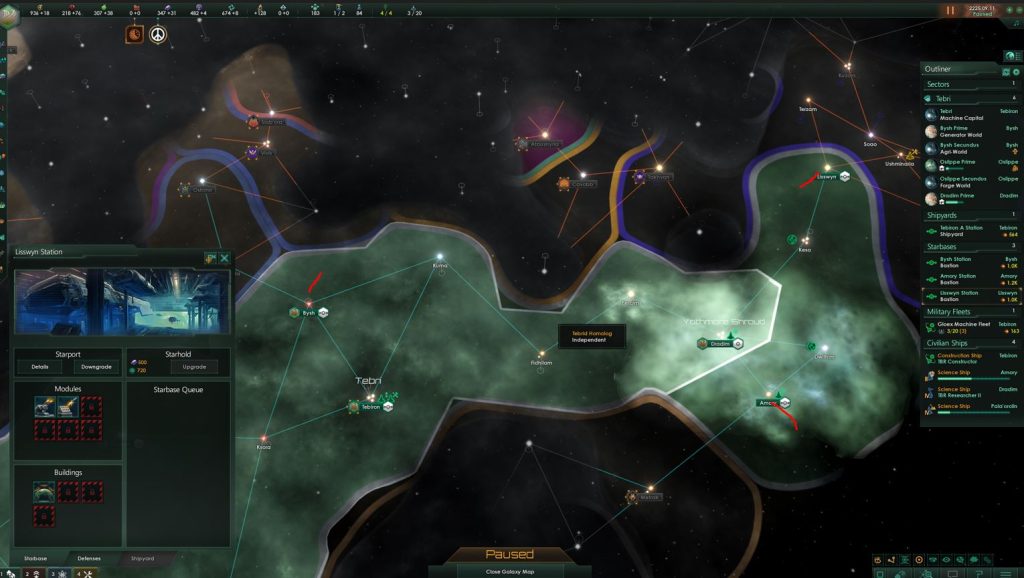
The trick is to enclose your realm as much as possible and erect huge star fortresses at chokepoints to neighboring empires that repel any invasion.
If idiotic aliens insist on attacking, one can analyze the wrecks of their fleet with a research ship and thus gain technical advancements: Adapt and Improve.
As you isolate yourself, you try to maximize the area you occupy – for instance, with “Habitats”, small stations that grow slowly and are expensive to develop, but our drones are hardworking and don’t cause trouble. They are brain-controlled, after all.
What happens next? The Homolog actually adopt a turtle strategy. They remain quiet for many years, digging in and strengthening their defenses while slowly working on building up their fleet, industry, and invasion army.
Then they look for the weakest enemy nearby and mercilessly attack: the advantage is that the Homolog are outstanding at assimilating an opposing people.
Then the new people become a “part” of the swarm; through implants, bitter enemies become obedient host bodies, and you can grant them rights to colonize planets or serve in the army.
Through “Ascension Perks”, you can also adapt your playstyle to your needs and gain valuable bonuses here.
This playstyle leads to the Homolog spreading across the galaxy like a virus – with one of the newer DLCs (“Nemesis” from 2021), it’s even possible to develop them into the crisis against which the rest of the universe must contend.
What’s behind it? Soulless machines whose only goal is to “absorb” all other beings in the universe and thus enhance “their own pool” is the idea of the Borg in Star Trek, perhaps one of the most fascinating concepts in the science fiction series.
The Borg represent a cold, efficiency-oriented world where the needs of the individual do not count and individuality is suppressed.
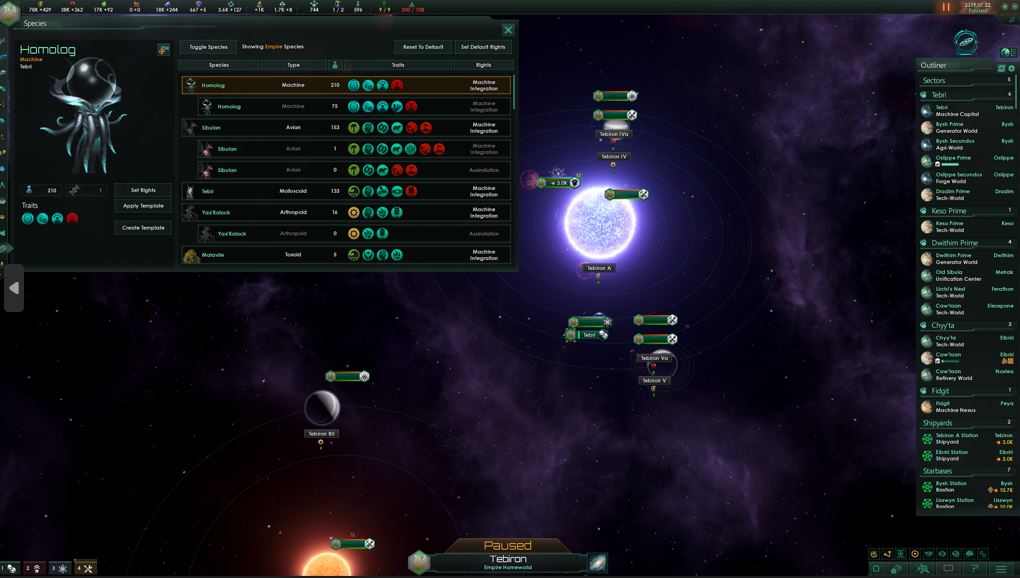
Replaying this concept in Stellaris and trying out this lurking turtle technique fascinates me in Stellaris. After a while, you can look around the game and be amazed at how many different servant races have since taken on the implants … a strange set of molds.
Even if Stellaris, like many large strategy games, tends to become quite exhausting in the endgame because you can easily micromanage 7 worlds, it becomes frustrating with 70.
This is actually the exact problem I have with Victoria 3:
You can conquer the world as Germany in Victoria 3 – but it’s not fun even on a PC worth €3,800

Your opinion is important to us!
Do you like the article? Then let us know!