

In school, we learn for life, as they say. MeinMMO author Irina Moritz definitely did not expect that her German advanced course would become useful in the MMORPG Final Fantasy XIV.

Let’s briefly recall: How often did you, back in school, feel bored in class and think “I will never need this later”? Yet throughout your life, there suddenly were situations where the old, dusty knowledge from school turned out to be surprisingly useful.
I had such a moment in the MMORPG Final Fantasy XIV. In the middle of a raid boss fight, I was hit with a wave of memories from my German advanced course.
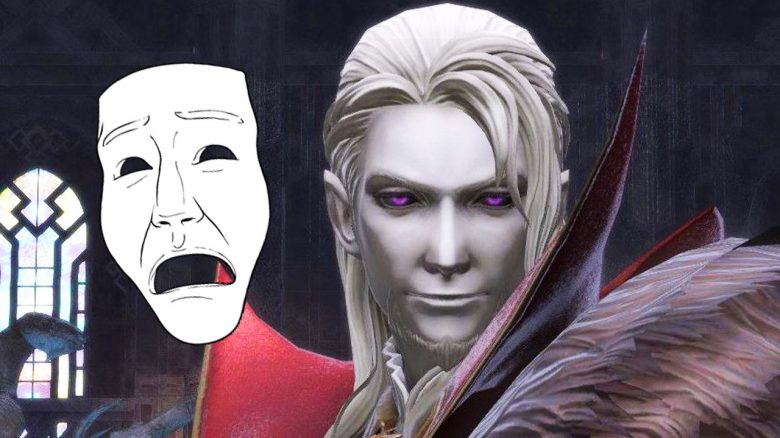
This is about Hesperos, the 4th boss in the new Endwalker raid Pandaemonium. Or more precisely, his epic form.
Raid progress through a Greek tragedy
Even back when the normal version of Pandaemonium was released, I had the uneasy feeling that everything there seemed somehow familiar. Somehow, I was familiar with the boss fight against Hesperos.
The names, the structure, everything evoked memories, but I couldn’t pin down exactly why. Until a lightbulb went off.
The entire fight is built on the principles of Greek tragedy. And I had thoroughly studied that a long time ago in my German advanced course, and it still resonates today.
The piece in the raid is called “Akanthai”, which translates from Greek to about “thorn flower” or “thorn bush”. The mechanics of Hesperos are divided into 5 acts and one invocation, as befits a proper tragedy.
The funny thing was that even the mechanics adhered to the strict structure. A tragedy always takes place in the same setting and has a unified plot. In the fight, these rules were upheld by the developers executing many different versions of a mechanic.
The boss placed thorns on the battlefield that always looked the same, but had different functions and mechanics in each act. And they need to be executed as perfectly as possible, because otherwise, the group faces a wipe or enrage.
Additionally, Hesperos also threw around a whole range of terms from Greek tragedy. Often quite literally in the form of mechanics:
- Pinax refers to a wall made of wood or bronze, on which the background image of a tragedy is painted. Essentially a type of backdrop.
- In the raid fight, Pinax was a mechanic that changed the floor of the arena, that is, the backdrop.
- Kothornos is a special type of shoes with a high sole that were worn by actors in Athens to appear taller.
- Kothornos Kick is an attack where Hesperos deals strong physical damage to a player with a kick.
- Periaktoi were also responsible for the backdrop in Greek theater. These devices could be rotated, presenting the audience with different sides featuring painted images.
- In the raid fight, this is a heavy AoE attack. The battlefield is divided into 4 areas by Pinax and Periaktoi kills all players who are not standing in the one correct area that was previously signaled.
And time and again, the boss Hesperos tosses his “Chlamys” on the ground or uses it to shove players around. This special cloak wasn’t specifically used in the theater, but it originally came from Greece.
Antiquity is a popular theme in video games
Greek antiquity and its myths are a popular element often used in games. Developers like to draw from events or personalities that emerged from it. God of War and Assassin’s Creed are probably the best-known examples.
There is also a ton of such references and elements in FFXIV. The new expansion Endwalker is packed with names from Greek legends such as Elpis, the hope from the box of Pandora.
Some are obvious. Others are well hidden, like the tragedy in the fight against Hesperos in the epic Pandaemonium raid, which I only noticed because I paid attention in school a long time ago.
So, Ms. Körner, if you are reading this (which is very unlikely), I thank you for your German lessons. Rest assured, I will remember Antigone for the rest of my life.
A player has soloed one of the bosses in Pandaemonium by the way:
Final Fantasy XIV: Player solos new raid boss as a warrior – “Please delete this”

Your opinion is important to us!
Do you like the article? Then let us know!