

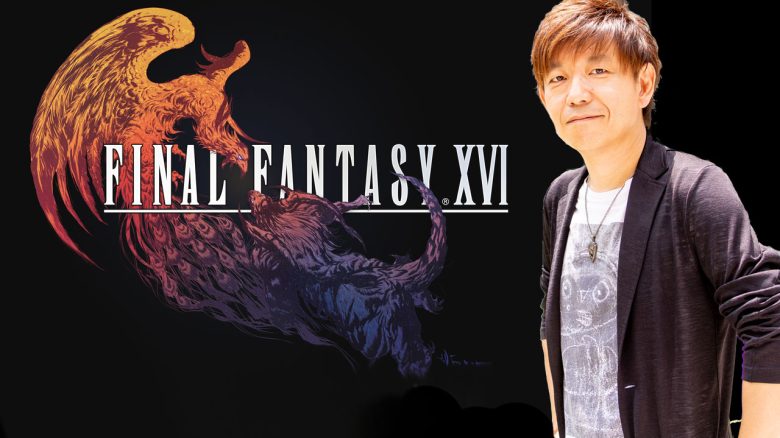
At a preview event for Final Fantasy XVI, community manager Irina Moritz from MeinMMO was able to ask the developers some questions about their RPG. They spoke about their reasons for the dark atmosphere, the story’s moral, and their experiences during development.

The next big RPG from Square Enix, Final Fantasy XVI, is set to release on June 22, 2023. As part of this, the publisher held a preview event where attendees could try the first demo of the game and talk with the developers.
In an interview, producer Naoki Yoshida, director Hiroshi Takai, lore lead Koji Fox, and battle director Ryota Suzuki revealed more about FFXVI and shared their experiences during development.
You can read the preview articles for FFXVI by MeinMMO and GamePro here:
- “Final Fantasy XVI” demo played: I immediately feel that the team behind MMORPG FFXIV is involved
- GamePro preview report
“If you want realism, you have to show it”
Already with the release of the first trailer, it became clear that Final Fantasy XVI would be a serious game with a dark atmosphere. The story revolves around war and betrayal, with a bloodied child sitting on the ground, while the colorful and carefree scenes all take place in the past.
Additional trailers confirmed this impression: FFXVI is, compared to many of its predecessors, a dark game that does not shy away from depictions of raw violence. In an interview, my colleague Linda Sprenger from GamePro and I asked why the developers made this choice.
Naoki Yoshida: It was not our intention. We did not approach the game with the thought “Let’s create something dark and brutal!”
If you look at the world today, there are many things that people do not want to see. They turn away from it. But that does not mean it does not exist.
We wanted to create a story that feels real and resonates deeply. And that means showing things that people look away from. Bringing this to the PlayStation 5 makes it look real.
For example, if you depict war and then do not show when someone’s heart is struck by an arrow, is that still real? It’s war. People die. If you want realism, you have to show it. Now that it’s on the PS5, it looks very realistic and more violent than the earlier games.
As a result, we have these beautiful scenes, which are very peaceful and loving. On the other hand, there are also these visceral and brutal scenes because you want to show something realistic while using such a powerful console.
Hiroshi Takai: We talk about these many characters and want to show you their complete stories, especially the Dominants. Players should feel that they know who these characters are, what is in their souls and hearts, and what drives them.
In the demo, you saw a scene that was very brutal. Clive loses control here, and Benedikta has a very violent background herself. But that does not mean we don’t have heartwarming scenes. There are very big spoilers, and we cannot talk about them yet. Just trust us (laughs).
Naoki Yoshida: And if you feel bad, just pet [the dog] Torgal, and then everything is fine (laughs).
“We don’t want players to feel lectured”
The wars and conflicts in Final Fantasy XVI are a direct consequence of the core concept of the story. In the past, Final Fantasy games have carried a message in their stories or addressed certain philosophical concepts such as the meaning of life, inherited guilt, or nihilism, as in the case of FFXIV: Endwalker.
FFXVI continues this tradition, but with a new approach.
Naoki Yoshida: When we originally set the core concept of the FFXVI story, I spoke with the main writer Maehiro-san and told him that there was one thing I would like to take a closer look at.
In our modern world, everyone has Twitter or other social media, and they can essentially say “I think X, and this is right, and this is wrong.” Everything is either black or white. They say “This is right, and if you claim otherwise, you are wrong.”
It has become very easy to share one’s opinion with the whole world. That’s why there are many conflicts, as everyone has their own values and the ability to impose their opinions and values on others.
So, we wanted to see how this concept translates to the Dominants. We have these characters who all believe that what they believe is right. Whether it actually is? Who knows. But they believe it.
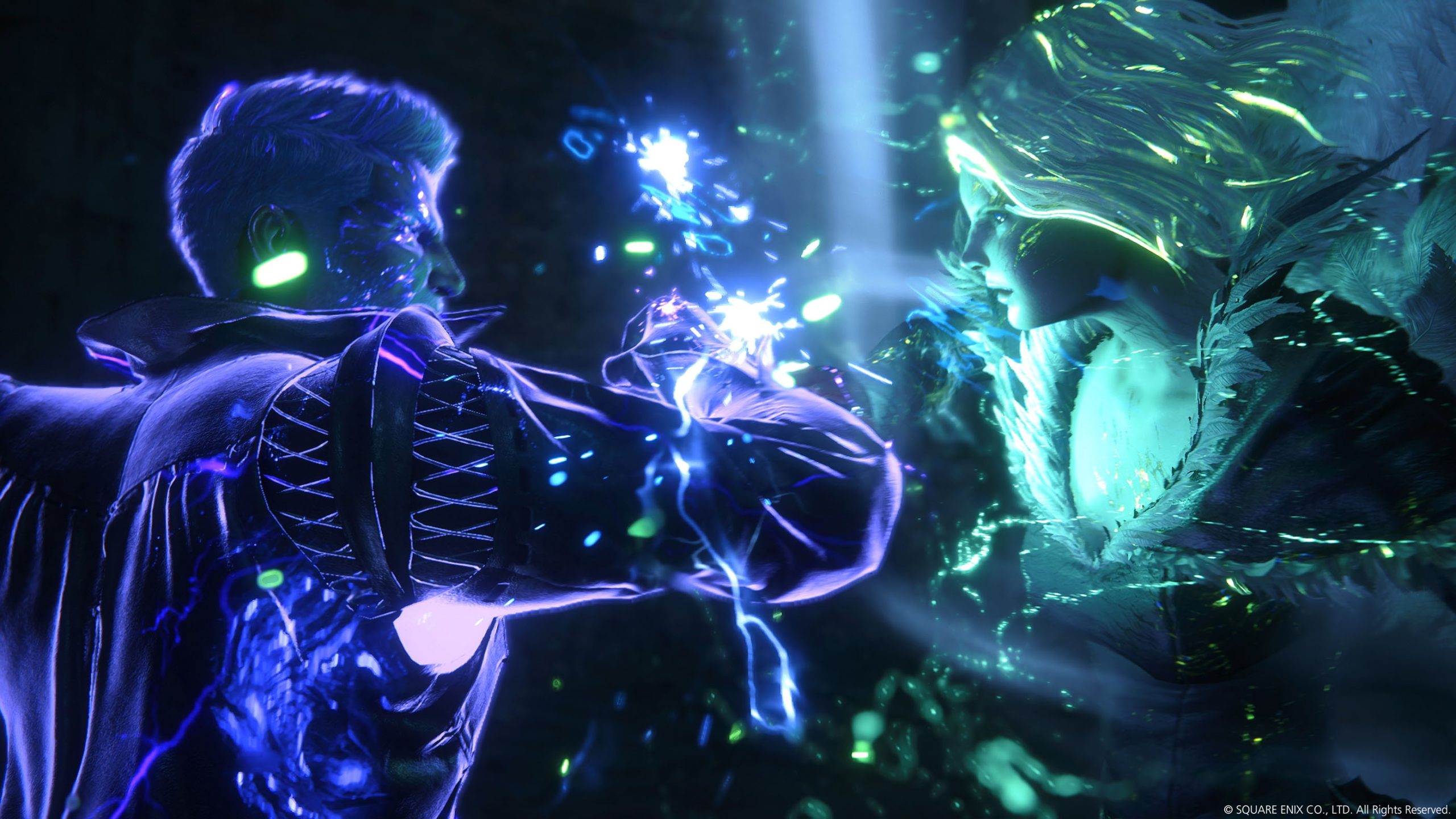
Each of them is different. And what happens now when these opinions clash? How does it affect the story? Do they manage to come together, agree on something, and put their differences aside in the end? That is our main narrative concept.
However, we do not want to impose this on players. We don’t want players to feel lectured: “You have to do it this way.” If players think while playing “Ah, okay, this is the message they want to convey” and feel at the end “That made me think,” then that is all we want. We do not want to impose [the opinions] on the players.
Hiroshi Takai: People often ask if I could describe the theme of the story in one word, and that is really very difficult. I don’t think I can. I think many people will go into the game with the mindset “This is what I consider right, what I associate with happiness.”
Then they will see Clive and understand what he considers happiness to be. But whether they agree or not will be different for everyone. I think that’s the good thing about the story.
“I never want to do that again”
At the end of the interview, the developers spoke about the experiences they had while working on Final Fantasy XVI. Battle director Ryota Suzuki previously developed games like Devil May Cry 5 for Capcom, so for him, this was his first Final Fantasy game.
Naoki Yoshida, Hiroshi Takai, and Koji Fox have previously worked together on FFXIV, sometimes even in parallel to FFXVI. Here is what they told us about it.
Naoki Yoshida: I will answer the question as I feel right now. This is how I feel today. This opportunity to work on two main Final Fantasy games, one as a producer and the other as a producer and director. That is something I never want to do again.
And my advice to anyone considering it: Never try to do the same thing. However, when June 22 comes and the game is released, the fans play it, love it, and say “We want you to make the next game too.” Then I would probably think again about it.
But the game is not out yet. There is too much pressure; I can’t handle it (laughs). So in this moment, in my current state: I never want to do that again.
Koji Fox: As far as I’m concerned… Phew… it didn’t go that way that you work on FFXIV, then stop, and then work 100% on FFXVI.
- There was a kind of transition phase where I mostly worked on XIV and a little on XVI.
- Then about equally on XIV and XVI.
- And in the end a little on XIV and a lot on XVI.
So there were overlaps, and I am still working on both games. They merged at some point.
You mentioned earlier the quote “What are you?” which appears in both games. And I thought “No, that is completely new and different,” but part of me is still connected with FFXIV, and that is the result of it.
And I always had to remind myself: “No, I am not working on FFXIV today; I am working on FFXVI. I need to focus.” This constant switching back and forth was quite a challenge and not something I want to do again.
Ryota Suzuki: As you know, I did not have the opportunity to work on both games. But it was still a big challenge and a lot of pressure to work on the FFXVI project at Square Enix.
It is a series with a very long history, and for me, two things were the most challenging:
- The first was that I had to develop a combat system for players who had never played action games before. I had to ensure they enjoyed it and wanted to play it. That was really difficult.
- The second thing was that while there are many great developers at Square Enix, there is not much knowledge about developing action games. When I was at Capcom, I could say “I want to do X,” and they [the team] could implement it immediately. But at Square Enix, the question came, “What do you mean by that?” and then I had to explain for a long time before it was clear what I wanted to do.
Hiroshi Takai: For me, it was the difference in technology when you developed something from the PS4 and PC and then switched to the new technology of the PS5. I had to learn how to do things on the go, what to do, what our limits are, and what we should do.
If I look at the work on XIV and XVI, there was one thing that was both an advantage and a problem. When I wanted to bring more people onto the XVI team, there was no one available because everyone was working on XIV. But if I really needed someone urgently, I could pull someone from the XIV team.
We thank the team for the interview and wish them a successful launch on June 22.
The 7 best MMORPGs with action combat systems in 2023

Your opinion is important to us!
Do you like the article? Then let us know!