

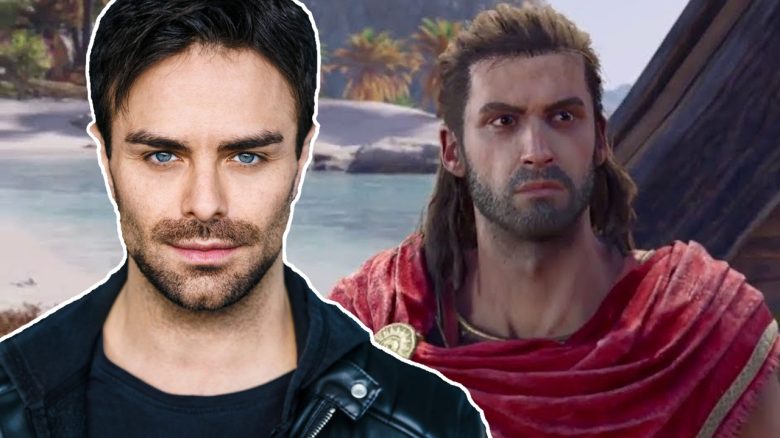
In an interview, voice actor Marios Gavrilis tells us about the nuances of his work and his opinion on current trends in voice acting. Marios is particularly known in gaming for his roles as Alexios in Assassin’s Creed: Odyssey and Batman in Arkham Knights.
Thanks to modern technology, many AAA video games have become true cinematic spectacles that rival many films. For some of them, high-profile actors are also hired to lend their voices to the characters.
Marios Gavrilis (via Twitter) is one of the most well-known German voice actors and actors, whose voice can be heard in gaming as well as in anime, TV series, and films. As gamers and series fans, you have likely already heard his voice. We at MeinMMO asked him to tell us more about his craft.
“Voice acting is teamwork”
MeinMMO: Hi, can you please introduce yourself to our readers?
Marios: Yes, hi, my name is Marios Gavrilis. I am an actor and voice actor, and I have lent my voice to many characters in various games.
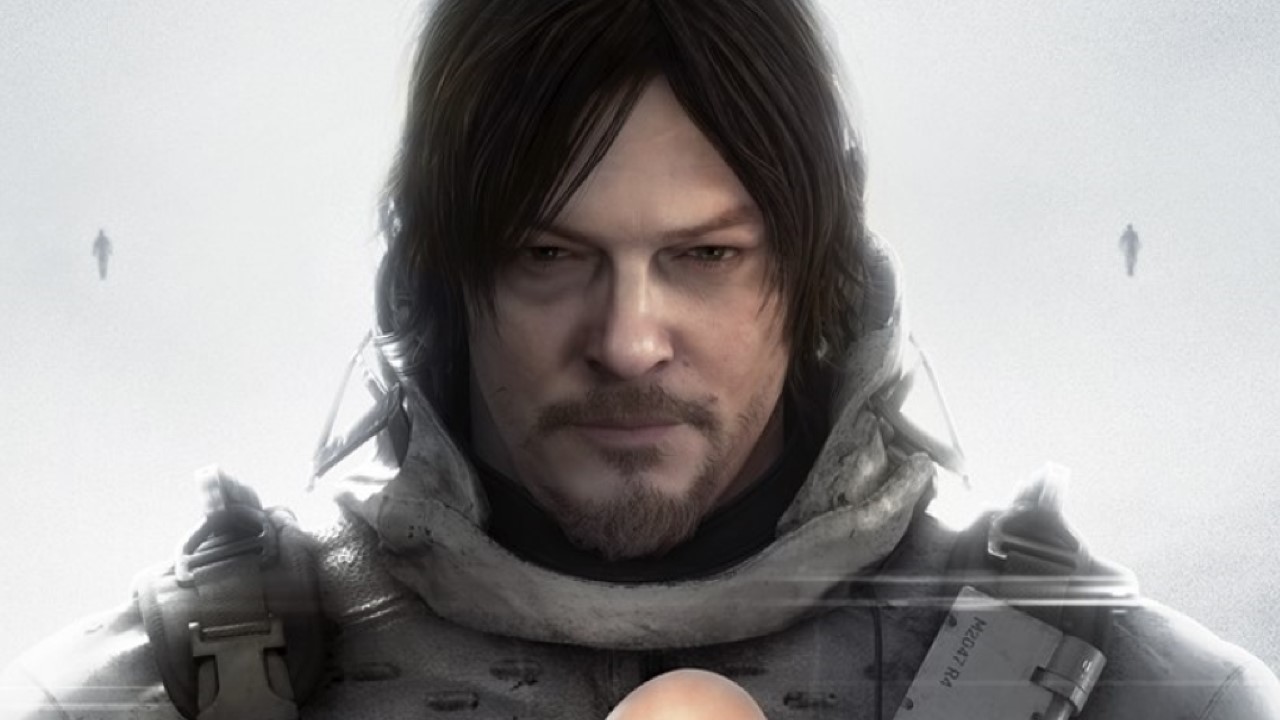
Including lead characters, Alexios from Assassin’s Creed: Odyssey is probably the most famous example. Sam Porter Bridges in Death Stranding, Dani in Far Cry 6, Batman in Gotham Knights. Currently, Hammond in Dead Space, as Isaac Clarke’s sidekick, as well as various other roles and NPCs. Some larger NPCs, some smaller.
I started speaking during my acting studies. Working with my voice has always suited me, and I especially started with games back then.
That’s why voice acting in gaming has always felt like a homecoming for me. Back then, I dubbed my first Call of Duties, smaller roles but still important ones. There are no unimportant roles.
I have been working in the profession for about 15-16 years. I am an actor in front of the camera, for film and television, and a voice actor for live-action and anime. People might also know me from Money Heist as Denver.
MeinMMO: Voice acting is an area that normal consumers have relatively little insight into. Tell us how a recording day went for your role as Alexios.
Marios: Voice acting is teamwork. Just like classical theater work. It’s never a one-man or woman show. Before the microphone, sure, I’m alone, but there is a sound engineer who oversees everything technical during the recordings. There is a director who gives artistic instructions and makes sure that the various roles fit together.
In the gaming sector, we are usually a team of 3 people. In the dubbing of series, there are four of us. There is also an editor who ensures that we are lip-syncing. This is a bit different in gaming.
Then we go into the studio and start working on the lines. We hear the original sound, the actor in the original language of the game, played through our headsets.
Then we have a “wave form” of the original actor’s audio on the screen, and depending on whether it is a cinematic cutscene or an in-game gameplay scene, we must match this wave form.
In a cinematic, that’s very strict. We must really hit this wave form precisely, because these cinematics are played differently than an in-game line, where you see the character speaking. There you generally have a bit more tolerance regarding timing.
And then it starts. We work our way through line by line. For example, with Assassin’s Creed: Odyssey. That was by far the largest gaming project I have had so far. Not only in gaming, but especially there, we had easily 200 to 300 recording hours spread over 1.5-2 years, so very, very much.
MeinMMO: That’s a lot of work. There is this notion that voice acting is not a very physically demanding job, but 200-300 hours sound tough.
Marios: Yes, especially when working on the more energetic and action-packed scenes. There are sessions where you need real endurance, it’s not easy.
Also in the anime sector. The characters are often “over the top,” so exaggerated and have very intense energy. And you have to handle all that too. Therefore, it is indeed a physically demanding job.
MeinMMO: You mentioned the term wave form. Can you briefly explain what that is?
Marios: The wave form is basically the waveform of the audio recording of the original speaker. If we were to record our conversation now and load it into a recording software, the audio track of the recording would have a certain waveform.
Afterward, we have to align ourselves while speaking. We have the recording, the waveform, and we need to try to accurately hit the waves, match the pauses. That way we are in sync.
“A gaming character must be felt and played just like a live-action character”
MeinMMO: Up to your role as Alexios, you primarily worked in the film and series sector. How did you return to a role in gaming?
Marios: I have always voiced games, but not such major lead characters as Alexios. Alexios was then the first major role in a AAA title.
Go with the flow. I never said I didn’t want to voice games, it just happened as it did. I was asked for the casting of the role and I won it.
But I have always managed well by doing my tasks well. One job leads to another. If I do my work well, it will attract attention elsewhere, and then I will be invited to castings, asked for roles, and so on.
I try not to force things too much, but to do the best I can with what I have, and through that, recommend myself for other jobs.
MeinMMO: How does voice acting in series differ from gaming? Is there something you might like more or less?
Marios: The craft is basically the same; it’s all acting. A gaming character must be felt and performed just like a live-action character.
From an acting craft perspective, there is no difference between being the voice of Norman Reedus in Death Stranding or voicing Mahershala Ali in True Detective 3.
Technically it’s a bit different. In live-action, we have to be really lip-synced. We look at an image. In gaming, we typically don’t have an image.
This means that we don’t work lip-sync but “wave form” sync. That’s the crucial difference. But from the perspective of performing authentically, that you must be credible, true, feel the character, clearly play the postures, that’s exactly the same.
“Especially in the anime sector, good craftsmanship is all the more important”
MeinMMO: The trend of AIs has also seeped into voice acting, for example in the form of audiobooks. What’s your opinion on that?
Marios: Exciting topic. So my standpoint is the following: I believe the question is not whether it will be possible in the future for an AI to completely replace us. It will. That’s beyond question. It’s already happening and will only get better. And it will someday be so good that the technology will advance to the point that you won’t hear a difference between a human and a non-human voice anymore.
That’s not the question I’m asking myself. The question is not whether we can do it but whether we want to do it. This is an ethical and moral question. Do we want AI to replace humans? Yes or no? Just because we can, doesn’t mean we should.
The human or humanity is something very beautiful that should be preserved, with all its flaws. All those flaws and quirks. And the fact that a human is not perfect is what defines us. AI might even be able to integrate that imperfection, simulating what it means to be human. And that still leaves the question of whether we want that or not.

There are also dangers of misuse. Look at the whole deepfakes. It’s already like that. I believe that each of us has seen this deepfake of Tom Cruise on TikTok; it’s the most well-known example.
It can become a huge trap that we set for ourselves with technology. And I find that series like Black Mirror, one of the best series, address exactly these dark sides of technological progress.
MeinMMO: The German dubbing often receives harsh criticism, especially in the anime sector. What do you think is the reason for that?
Marios: There are dubbings that are indeed not as good as others. But it’s not consistently bad. There are always differences, but that’s true everywhere. Just like in film: there are good actors and there are not-so-good actors. There are good movies and there are less good movies.
It’s no different in dubbing. It’s a cross-section of all possible forms at every quality level. In anime, many established voice actors that you know may not have wanted to do anime. I believe that is changing slowly now.
Even as an established voice actor in the live-action sector, you have to be into it. Not everyone is excited about anime. I can understand that. Look at how the Japanese do it. It’s really intense. That’s also physically and vocally very demanding.
Many colleagues have no desire for that. But especially in the anime sector, good craftsmanship is even more important. Because you’re voicing characters that are sometimes larger than life, and you can’t just speak them artificially. It has to be authentic.
Perhaps the budget for anime dubbings just hasn’t been as high in recent decades as for a blockbuster. I don’t know much about that. But I believe that’s also changing. Anime is increasingly moving into the mainstream in public perception and becoming more successful.
Look at the huge anime community that exists. I feel it myself and always watch what’s happening on social media. It’s really amazing. Therefore, I believe it’s slowly changing and anime rightly receives the quality standard it deserves.
MeinMMO: You sometimes say in your tweets and videos that something sounds like “voice acting.” What do you mean by that?
Marios: My acting coach always says “Stop acting like an actor. Be a real human being.” And that’s what it’s about. When you hear it’s voice acting, it means certain characters, melodies, and ways of speaking are being employed that make you think, “Ah, sounds like a voice actor.”
Then, I think we’re not doing our job right. We have the task, at least that’s how I see it, to create the illusion for the viewer that he really thinks “The character is speaking, not the voice actor.”
Otherwise, it sounds forced and artificial, and I don’t buy it from the actor. Because then, they use certain melodies that are so typical for voice actors. And the actors that I really admire, they all don’t sound like that.
They sound like people. And then I think, “Wow, amazing voice, amazing performance.” He or she has literally become the character.
MeinMMO: If you could freely choose a character, who would you voice?
Marios: If I could freely choose? It’s a difficult question because I have already voiced Batman. What could possibly come after Batman? For me, he is the ultimate comic hero. Even though I believe I am more of a Joker type.
I want to answer the question differently. I think if I simply do my job well with the roles I already have, the roles that suit me will come automatically.
We thank Marios for the interview and look forward to hearing more from him in upcoming games.

Your opinion is important to us!
Do you like the article? Then let us know!