

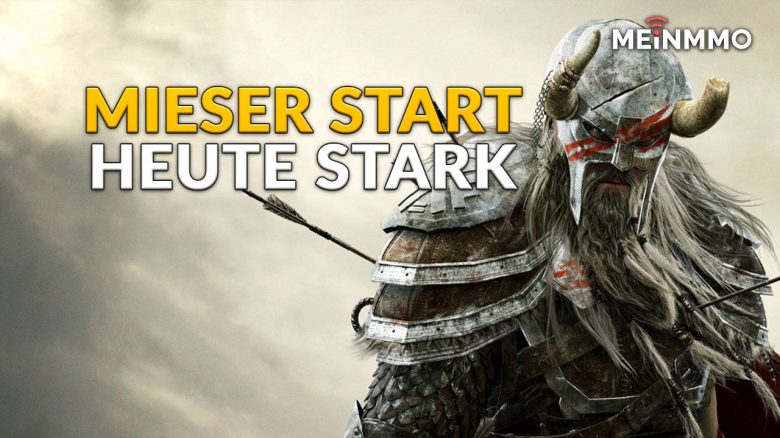
The Elder Scrolls Online released in April 2014. And even though it is now one of the best MMORPGs on the market, it looked quite different at the beginning. There were reviews that only gave it a 4/10. What was the problem back then and what does it do better today? MeinMMO editor Alexander Leitsch takes a look.
How did the ESO release go? Mixed. On one hand, the developers cleverly distributed the mass of players through a staggered head start. This prevented larger queues and server downs. On the other hand, ESO still went through many of the known teething problems that you know from other MMORPGs:
- After launch, more and more bugs were discovered. In various areas, there were long loading times, crashes, or lags. The PvP area Cyrodiil caused crashes for many players.
- The server technology was even worse, so many areas had to be loaded constantly. Landscapes suddenly popped up that were not visible before.
- In front of bosses and quest mobs, huge crowds of players formed who had to defeat this enemy or wanted to farm an item from it.
- Some quests were poorly explained or had no markers, leaving players at a loss.
- There was a large number of gold sellers and bots.
- There was a large dupe that seriously harmed the economy and nearly led to a rollback. Subsequently, thousands of exploiters were banned.
But it wasn’t just these teething problems that made ESO a weak MMORPG. It lacked an incredibly large number of features that are now hard to imagine without. In addition, there were problems with phasing, the main story, and strict separation between factions.

ESO struggled with problems in phasing, dungeons, and a lack of endgame
What were the major issues? The original world of Tamriel had strict level restrictions. You could only enter the areas and content that matched your level. However, this led to curious situations.
Because I personally chose the Daggerfall Covenant back then, but two of my friends chose the Ebonheart Pact. And we could not play together. This had two reasons:
- On one hand, our areas were too far apart. I would have had to walk through level 50 zones just to reach them.
- On the other hand, players from different factions could not play together properly. You could not form a joint group.
Contacts were a problem anyway in the early days of ESO. Because quests in the open world often led to you switching to a “different phase” or instance. If I was further along in the story than others, it could happen that we stood at the same place and yet could not see each other.
What makes ESO today, you can find out here:
What also really put me off at the start were the upgrades of equipment. Just like today, there was also back then a chance of success with the upgrade, which could be increased by using more materials.
If an upgrade failed, however, the equipment item was destroyed – just like you know from many Asian MMORPGs. Fortunately, this mechanic was abolished, because today you only lose the materials used.
What was the state of the main story? At the launch of ESO, most players followed the story. However, it was not as smooth as it is today. It was previously interrupted by sometimes very long waiting phases, and when you leveled up, an NPC would suddenly appear next to you and continue the story.
Most of the time, you would then complete a mission and shortly after have to switch back to side quests or grind in Cyrodiil. As mentioned at the beginning, there were also many quests that were not clearly understandable and I often had to turn to Google to find a solution.
Easy dungeons and too few endgame contents
What was the endgame like? ESO mainly offered dungeons to dive into and Cyrodiil as endgame content. The dungeons were way too easy at the beginning and offered almost no challenge. Additionally, it was difficult to find players at all – also because there were always bugs here.
Contents like housing, PvP arenas, collections, or champion points that could be skilled after reaching max level didn’t exist. Not even the area of Craglorn could be accessed at launch.
I actually don’t remember exactly how I grinded back then. I remember that reaching the first veteran levels and buying the first mount took an incredibly long time. This is exactly where I stopped and didn’t touch the game again until 2019 when I joined MeinMMO.
Today, you have a huge selection of activities like dungeons, trials, PvP, antiquities, or most recently the collectible card game that was released with High Isle. At launch, ESO did not offer nearly as much.

Praise for graphics, voice acting, and story
Was everything bad at release? No, absolutely not. Back then, there was mainly praise for the atmospheric world, the good stories in the quests, and the brilliant voice acting. The character editor was also positively highlighted by many.
The combat system divided opinions a bit. On the one hand, many found the action-packed battles good and it brought fresh air into a genre still dominated by tab targeting. But just like today, there were also voices back then who felt the combat system was not responsive enough.
ESO relied on a subscription model – could still excite many
What was the payment model of ESO? Initially, ESO was a pay-to-play game, like WoW or FFXIV. You had to buy a version of ESO and then had 30 days of free game time. After that, you had to subscribe for 13 euros to access the content.
What were the player numbers at release? In various beta phases, about 5 million players are said to have tried ESO. At launch, it was expected that there would be about two million players. In June 2014, approximately 770,000 people were said to have had a subscription for ESO.
Despite the problems, ESO was able to excite many players at first. But afterwards, the numbers declined and ZeniMax began to make fundamental changes to ESO.
Tamriel Unlimited, One Tamriel, and the console versions brought the turnaround
How was the turnaround initiated? The first turnaround came on March 17, 2015, almost a year after release. With Tamriel Unlimited, the game switched to buy-to-play with an optional subscription and shop. This made it more accessible to new players.
Moreover, the update brought many adjustments for endgame:
- The champion points were introduced to give players more character progression after level 50.
- The tutorial was revised.
- The justice system with pickpocketing was introduced.
- Many animations and the appearance of the equipment were overhauled.
- The collections for mounts, costumes, and companions were implemented.
In August 2015, with Imperial City, the first official DLC was released. This brought a new zone, new dungeons, new story content, and especially new content for PvP fans. The foundation was thus laid.

However, the real major turnaround came with One Tamriel in the fall of 2016, more than two years after release. With this patch, the level limits were removed and you could start wherever you wanted right after the tutorial. The restrictions between the alliances were also lifted.
At the same time, important changes were made, including veteran modes for dungeons, a duel function, item drops became more transparent, and there were 30 new sets that you could earn. Furthermore, the groundwork for housing was laid, which should appear in a later patch.
What was another important step? Besides the many changes that made ESO the MMORPG it is today, the console versions played an important role. However, their release was postponed several times due to issues.
On June 9, 2015, the MMORPG was released for PS4 and Xbox One. This gave it access to a new target audience that had recently become aware of the “MMO” genre through games like Destiny. Many Skyrim fans, who were also using consoles, joined as well.
As a result, ESO could reach a larger number of players than WoW or Guild Wars 2 could even today. A total of over 18 million accounts are said to have been created.
In June, the new expansion High Isle was released for ESO:
ESO is among the top MMORPGs, even if routine has set in
Where does ESO stand today? ESO is among the best MMORPGs on the market. According to Google Trends, interest in Germany for Final Fantasy XIV and ESO is roughly equal. Only WoW and currently Lost Ark generate more interest in the last 12 months.
The game is repeatedly praised for its consistent updates, good story, and brilliant voice acting. ZeniMax consistently delivered good quality, even during the COVID-19 pandemic.
The only downside for many is that routine has set in. All updates are tightly scheduled and clearly structured:
- At the beginning of the year, a DLC with two dungeons and a story prologue comes
- In the summer, the big expansion with new areas, more story, a trial, and a new feature arrives
- In the fall, a DLC with two dungeons is released
- In winter, an area DLC related to the current chapter and the end of the connected story is released
ESO does not surprise its players and also struggles with performance issues in PvP. Even today, not everything is perfect, but it is nothing compared to the MMORPG I tried in 2014 and found to be bad.
How have you experienced ESO over time? What were issues or moments that stood out to you? Are there things you wish to return from earlier that are no longer included in ESO?

Your opinion is important to us!
Do you like the article? Then let us know!