

After significant technical effort, the world’s first MMO is back online and live: Habitat. It originated in 1986.
Today, it is common for us to connect with thousands of other players at the push of a button, embarking on adventures together in a graphically represented world. Amazing: Players could do this back in 1986 too.
An MMO built with sticks and stones
Creating such a world was achieved by the game “Habitat” – with digital tools that could be compared to “sticks and stones”. Habitat was so far ahead of its time that it could only realize a tenth of its potential, according to a press release from MADE.
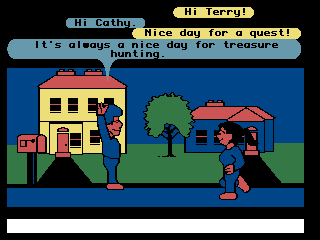
The Museum of Art and Digital Entertainment (MADE) has now brought the 30-year-old classic Habitat by Lucasfilm Games back to today. Habitat is considered the first graphically represented Massive Multiplayer Game.
The world’s first MMO ran in 1986 on Quantum Link, the online service of the Commodore 64 (C64). People had to dial in with a modem and it was charged per minute.
Habitat did many things for the first time
Habitat is “the first MMO” in many ways. The term “avatar,” as a virtual alter ego for the player, was used for the first time in Habitat. Additionally, this was the first time there were sickness, murder, an in-game currency, and player housing.
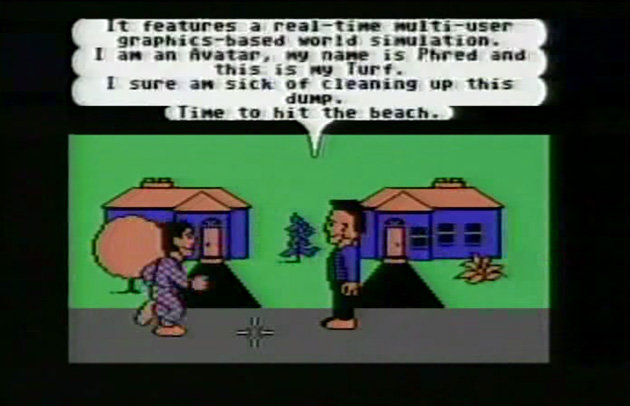
To bring the game back to life in 2017, the help of volunteers and supporters was necessary. Many people contributed to making Habitat playable again.
Little miracle
MADE emphasizes the great effort it took to recreate the world and game logic of Habitat in Java. It took four years.
Randy Farmer, the programmer of the original C64 client and first operator of a virtual world, describes it as a “little miracle.”
Since June 2, the public can now also participate in the Alpha of Habitat.
If anyone is interested, they can read a guide on how it all works (with a C64 emulator) at this link – on neohabitat.org. The source code of Habitat is also available online on the gitHub page.
1986 is a long time ago – we have looked at what the term “MMO” means today in this article:
What does MMO mean today? Games-as-a-service

Your opinion is important to us!
Do you like the article? Then let us know!