

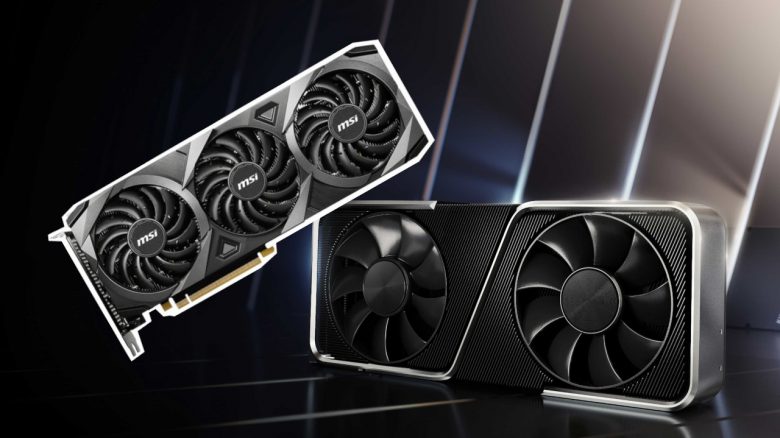
You currently have the choice between the RTX 3060 and the RTX 3060 Ti for Full HD graphics cards. However, you should pay attention when choosing, as there are clear differences between the graphics cards.
By now, you can purchase the RTX 3060. The first independent tests of the RTX 3060 describe it as a successful mid-range graphics card for gamers who want to play in Full HD with high frame rates.
Interested parties now have the choice between the RTX 3060 and the RTX 3060 Ti. But at this point, you should be cautious.
What is the problem? While the RTX 3060 is equipped with 12 GB of video memory, the RTX 3060 Ti only has 8 GB.
One might first think, “12 GB is more than 8 GB, why should I forgo 4 GB and pay more for it?”
But that is a misconception that we want to explain to you in our article. The Ti variant is still the faster and better graphics card.
RTX 3060 Ti – when are 8 GB better than 12 GB?
What is the difference in memory? The most important difference is the memory interface. This is responsible for quickly transferring data to the rest of the computer. The faster the memory controller, the more data can be transferred and subsequently processed. Via the PCI-Express interface, data goes from the computer to the graphics memory and is then processed by the GPU.
What does this mean? While the RTX 3060 uses a 192-bit interface, Nvidia has implemented a 256-bit interface in the Ti version. This also shows in the bandwidth:
- The RTX 3060 achieves 360 GB/s with its 192-bit interface.
- The RTX 3060 Ti achieves a significantly higher performance of 448 GB/s thanks to its 256-bit interface.
Therefore, the 8 GB of the Ti version are faster connected to your system than the 12 GB of memory of the RTX 3060. The reason the RTX 3060 has more memory is solely due to the technology used.
What is the disadvantage of the RTX 3060? 12 GB of video memory may initially sound like a lot, but it is not fully utilized.
The GameStar shows in their test of the RTX 3060 that the graphics card does not need 12 GB of video memory and does not fully utilize it.
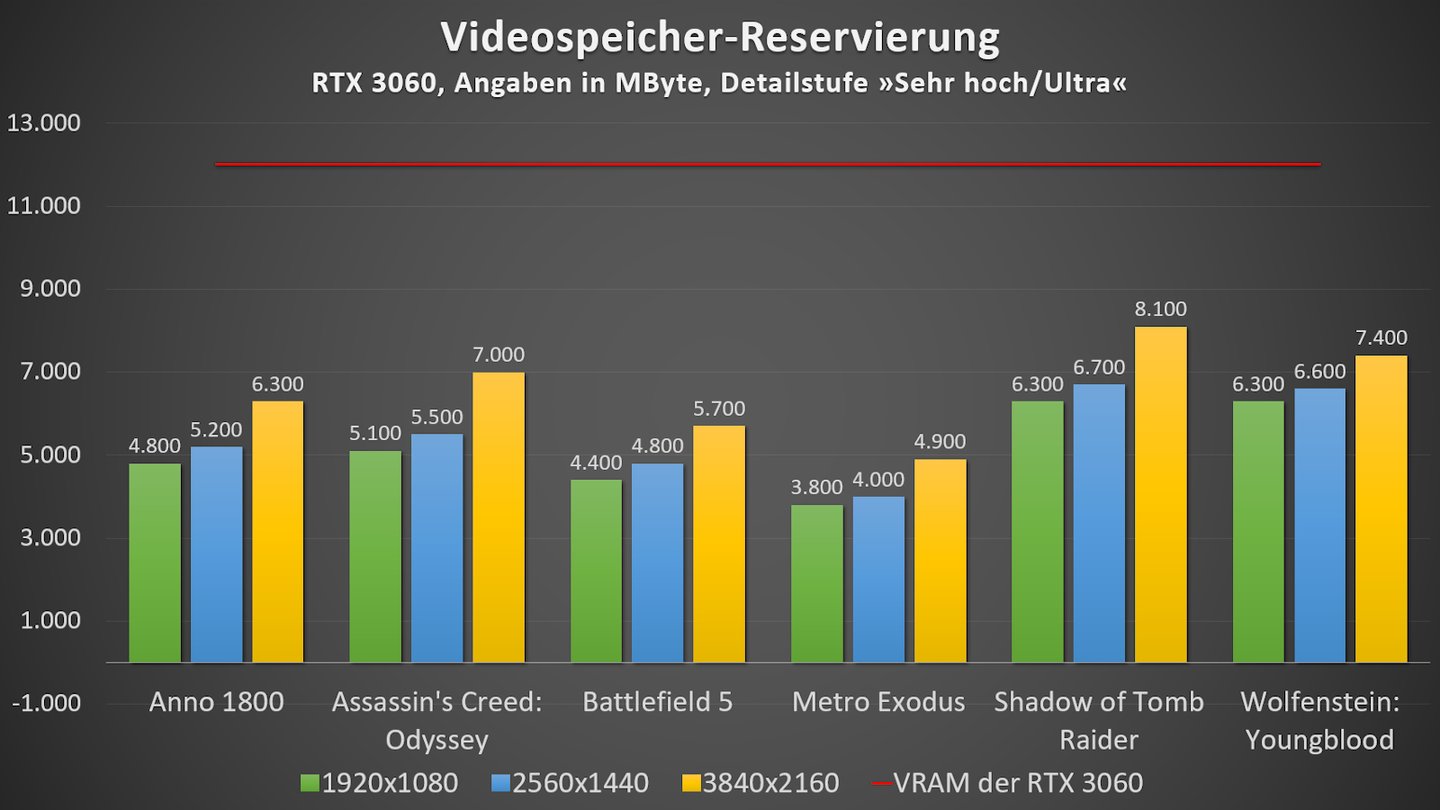
In the GameStar benchmark, memory usage is consistently well below the limit, and Nils Raettig from GameStar suspects that performance may become a problem for the graphics card in the long term rather than video memory.
RTX 3060 vs RTX 3060 Ti – further differences
However, the differences go beyond the size and speed of the memory. Technically, the RTX 3060 is initially weaker than the Ti model.
- The RTX 3060 offers significantly fewer shader units (3584 vs 4864)
- The memory bandwidth of the RTX 3060 is lower (360 GB/s vs 448 GB/s).
- The theoretical computing power (calculated in teraflops) is 12.7 TFlops and thus lower than that of the Ti version (16.1 TFlops).
On the other hand, the power consumption of the RTX 3060 is, of course, lower than that of the Ti version. In practice, however, this should not make a big difference.
What does that mean? In summary, the RTX 3060 offers you less performance than the RTX 3060 Ti, even though the 12 GB of video memory initially sound tempting.
If you want to see the performance differences in comparison, you can watch this (English) YouTube video (110,000 views) where the RTX 3060 and RTX 3060 Ti are compared:
RTX 3060 vs RTX 3060 Ti: What about Raytracing?
More video memory is generally better for raytracing, as the memory is utilized more heavily here.
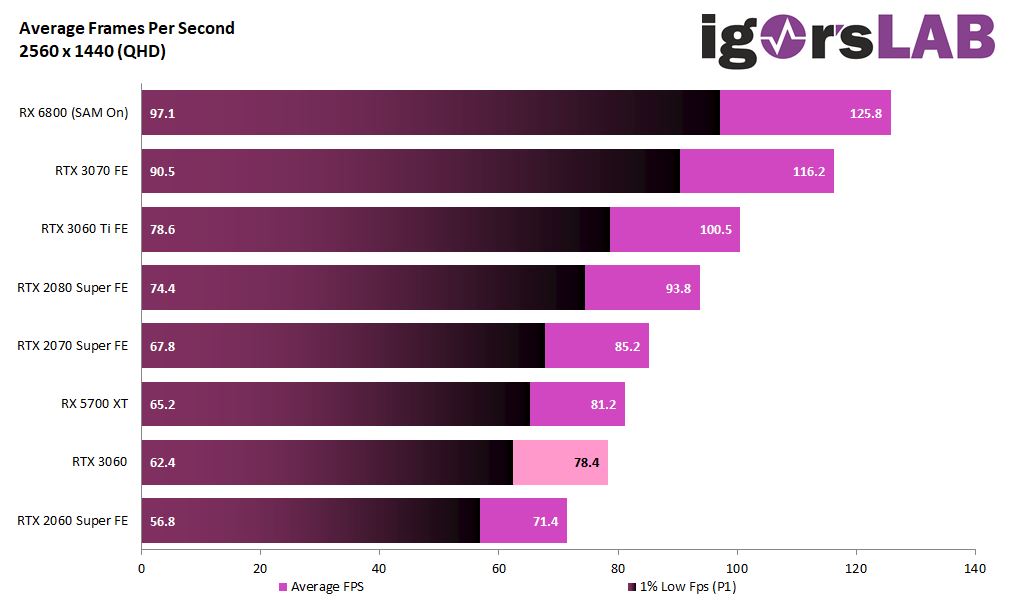
However, the problem lies in the basic performance of the RTX 3060. Igors Lab points out that the gap between RTX 3060 and the Ti version with raytracing enabled is significant. The tester writes, “The gap to the GeForce RTX 3060 Ti is significantly. It renders 27 percentage points faster in Full HD, with DXR and in WQHD then still about 28 to 32 percentage points faster.”
According to ComputerBase, the GPU does not reach 60 FPS in Full HD, so you should rather opt for the RTX 3060 Ti. However, the 8 GB may become a bottleneck in the long term.
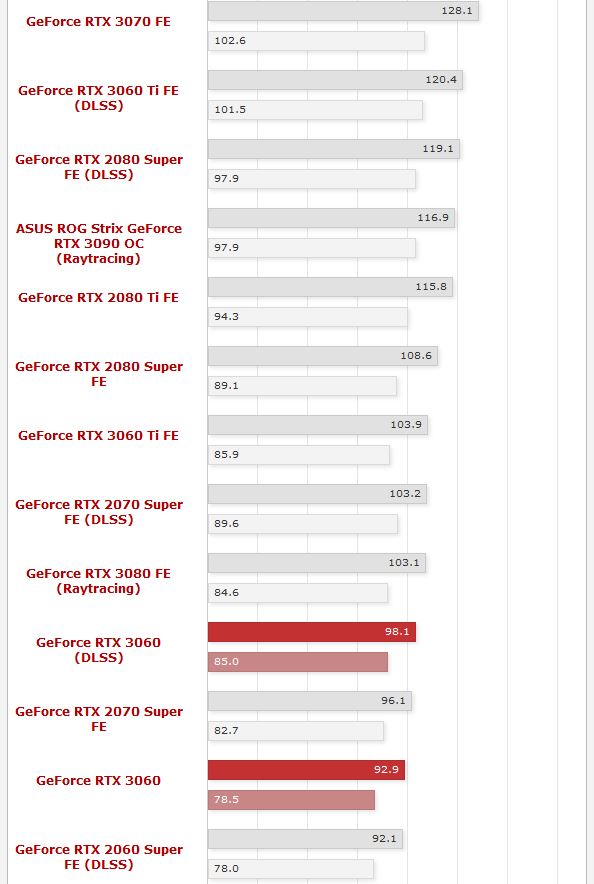
Call of Duty: Black Ops Cold War, WQHD, Source: HardwareLuxx.de 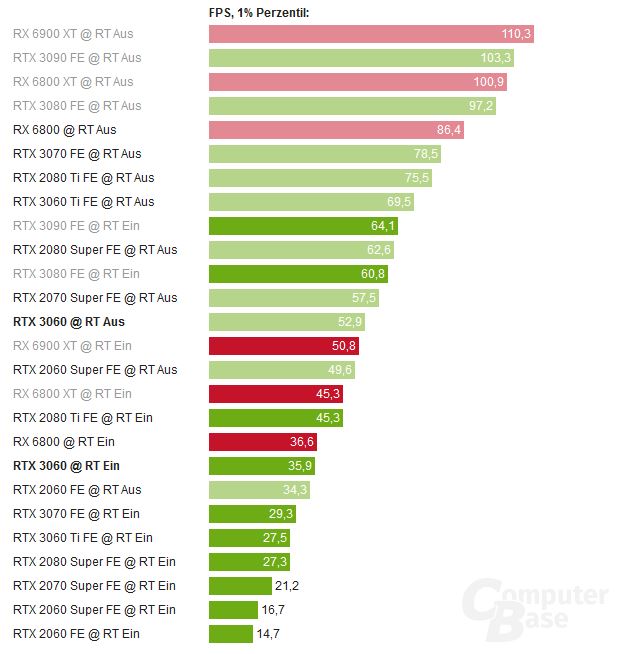
Call of Duty: Black Ops Cold War, WQHD, Source: ComputerBase.de 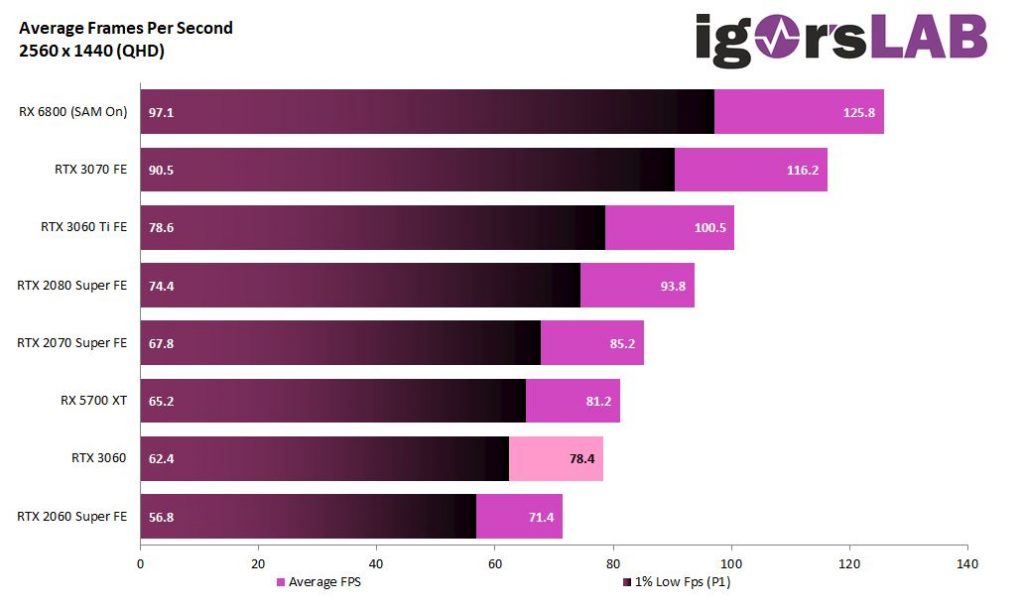
Average FPS in WQHD, Source: Igorslab.de
For those primarily interested in raytracing, the RTX 3070 may therefore be the better long-term alternative compared to the RTX 3060 Ti, as it not only has more memory but also more performance reserves. With raytracing enabled, it can provide (depending on resolution) an additional 8 to 15 FPS.
RTX 3060 vs RTX 3060 Ti in technical comparison:
| Model | GeForce RTX 3060 | GeForce RTX 3060 Ti |
|---|---|---|
| GPU | Ampere | Ampere |
| FP32 Shader Cores | 3584 | 4864 |
| Base Clock / Boost | 1320 / 1780 MHz | 1410 / 1665 MHz |
| Theoretical Computing Power | 12.7 TFlops | 16.1 TFlops |
| Memory Type | 12 GB GDDR6 | 8 GB GDDR6 |
| Interface | 192 Bit | 256 Bit |
| Power Consumption (TBP) | 170 Watts | 200 Watts |
| Price (MSRP) | 329 Euros | 399 Euros |
If you are interested in the direct comparison to the RTX 3080, then check out this article: Here we present the RTX 3060 in comparison to the new high-end of Nvidia:
RTX 3060 Availability – hardly anyone will get a graphics card
When can you buy the RTX 3060? Since February 25, 2021, Nvidia’s new graphics card has been available, but very few users have likely actually managed to get one.
Our colleagues from GameStar already report that the RTX 3060 can currently be purchased for around 700 – 800 Euros on eBay and other online marketplaces.
AMD alternative to the RTX 3060: Currently, the RX 6700 (XT) is being discussed as an alternative from AMD. For the successor to the RX 5700, there have already been leaks, but it is still unclear when this graphics card will even be released. Some suspect that there will be an initial announcement in early March 2021. Whether availability will be better with AMD is still another question.

Your opinion is important to us!
Do you like the article? Then let us know!