

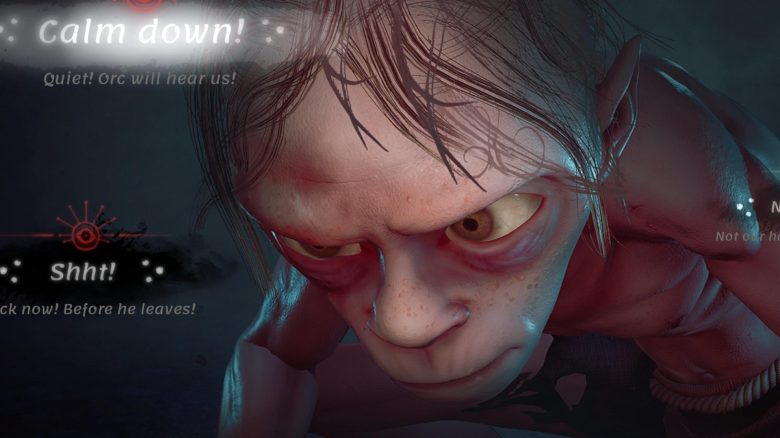
The stealth adventure The Lord of the Rings: Gollum is considered one of the worst games of 2023. The game flopped so badly that there will be no more games from the popular Hamburg studio Daedalic Entertainment. A report shows what went wrong behind the scenes of the game development studio and why Gollum was doomed to fail.
The Lord of the Rings: Gollum was supposed to be something very special: an AAA game from Germany, which the Hamburg studio Daedalic was to make internationally known with the strong “The Lord of the Rings” license behind it.
When the action game was finally released in May 2023 after several delays, it quickly became a contender for the worst game of the year. Gollum failed in the international reviews and our GameStar colleague Sascha Penzhorn also struggled in his test (paid PLUS article) to say anything positive about the “license lemon.”
Gollum flopped so badly that Daedalic publicly apologized and soon announced it would no longer produce its own games and only act as a publisher. In a nearly 40-minute report, Game Two’s editorial team now investigates how it could have come to this. You can watch the entire video here:
Crunch and starvation wages at the supposedly family-friendly indie studio
What went wrong? To answer this question, the report traces the history of Daedalic Entertainment.
- After establishing a name for itself with humorous point-and-click adventures like the Edna and Deponia games, the Hamburg studio tried to gain a foothold in other genres.
- In games like Silence and A Year of Rain, the development that the studio made was already evident: ambitious projects for which there was a lack of experience and possibly also budget, which ultimately flopped painfully.
- Behind the scenes, the work environment is said to have been stressful: former employees report in the report of an “atmosphere of fear,” and it was also assumed that overtime was required without pay or an option for compensation.
- While its own production was struggling, Daedalic celebrated successes, especially as a publisher, such as with Shadow Tactics: Blades of the Shogun from the Munich developer studio Mimimi.
When the left hand doesn’t know what the right hand is doing
When Daedalic was able to secure the LotR license in 2018 after long efforts, they had big plans. The following year, The Lord of the Rings: Gollum was announced as an action game with AAA ambitions and was compared to blockbuster franchises like Uncharted and Tomb Raider.
The report from Game Two paints a picture of a studio that took on too much and got lost in big ambitions. There is also the impression that the management of the studio made promises that the actual team could not keep.
Many mechanics are said to have been planned that sounded great on paper, but then had to be discarded. Other elements made it into the game, but barely found application. However, due to this focus on details, some fundamental aspects fell by the wayside:
- until the end, they had to refine Gollum’s movement on all fours, as they simply had no experience with that
- the inner struggle between Sméagol and Gollum looked promising in previews, but was not finished and was ultimately only implemented as a quick solution
- the approach of first writing a story and then building a game around it had worked well with the classic adventures, but did not work anymore with Gollum
No AAA game without AAA budget
As Daedalic explains in a statement, they did not receive the necessary support to provide the game with a larger budget or more manpower. With a budget of 15 million euros and – according to the credits – 85 people involved, the project ultimately fell far short of the original AAA ambitions.
To complete the project for its – now twice postponed – release, the infamous crunch occurred with plenty of overtime. However, according to Daedalic, this was compensated. The team seems to have made a great effort to save Gollum, despite all the difficulties.
All the harder should the employees have been affected by the devastating criticisms at release. 25 of them are said to have lost their jobs shortly thereafter with the closure of the development department.



The report strikingly shows that a toxic work environment and crunch are not problems of the large and often perceived as “soulless” AAA studios.
Addendum 09.10.2023, 18:30: We have now received a statement from Daedalic Entertainment and are adding it here:
“All of us at Daedalic are very saddened that the undoubtedly below-expectation release of Gollum is now being used as a reason to question the 17-year history of Daedalic with its numerous successes and awards as a whole. We gladly accept legitimate criticism and, for example, will review the allegations regarding internal communication between management and team in detail. However, linking the current quality problems of Gollum with general occurrences that are partly years old is far too simplistic. A prime example is the difficulties that almost all companies had when the minimum wage was introduced at the beginning of the year 2015. At that time, Daedalic tried to find a fair solution for each case and keep as many employees in the company as possible. That was over 8.5 years ago, when Gollum was not yet planned – nevertheless, this is now being constructed as one of the reasons for the failure of the game (Title Game Two: “Why Gollum had to fail”). At Daedalic, it is always important to respond transparently and openly to questions. Therefore, we are also transparently forwarding the original questions from Game Two along with our responses, which unfortunately, in our opinion, have not yet been sufficiently considered.”
How one can fight back after such a disastrous project was recently shown by CD Projekt Red with Cyberpunk 2077:
Players start direct comparison in Cyberpunk 2077 before and after 2.0, showing what they wish for

Your opinion is important to us!
Do you like the article? Then let us know!