


With an indicator from the economy, one can explain how fair the weapon meta in Call of Duty: Warzone is. MeinMMO shows you how the meta has developed since the release and what thoughts are behind the calculation.

What’s it about? Call of Duty: Warzone has become much more data-heavy compared to the release. Warzone experts like “TheXclusiveAce”, “JGOD”, or “TrueGameData” have spent a lot of time in recent months documenting the values of each weapon in detail and making them accessible to all players.
The statistics website “wzranked.com” also helps players get an overview of the meta. However, the site takes a different approach: wzranked analyzes the chosen weapons of the players and shows, for example, which weapon is the most played and with which setup.
But the site does much more. You can also examine the fairness and strictness of the meta since the release in a diagram:
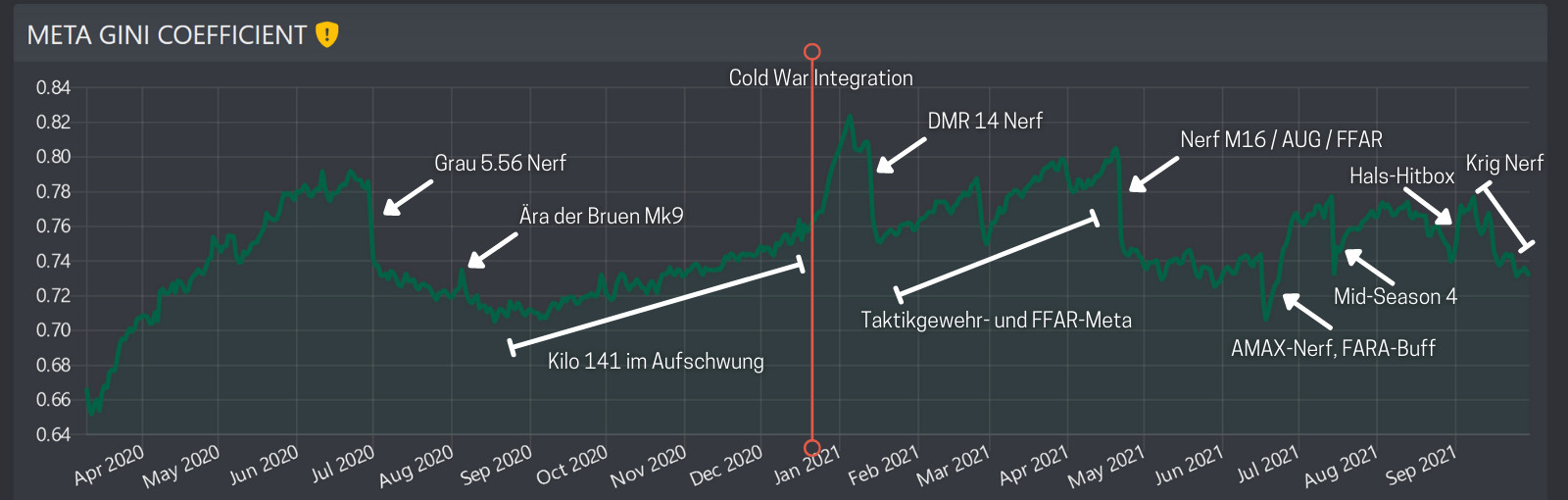
The diagram shows how the loadout usages of weapons are distributed among the players and at what point. If many players only use a specific weapon, the green graph in the diagram rises. If more weapons are considered strong and playable, the value drops and the green graph sinks.
To determine the value of fairness of the meta at a specific time, wzranked uses the metric “Gini coefficient”. MeinMMO shows you how the value is derived and what conclusions can be drawn from it.
I have never understood economics as dry mathematics, but as a tool to understand the world around us. I find it fascinating that there are calculation models that deal with whether I should order pizza or döner for dinner. And I find the data spectacle in Warzone equally exciting.
Gini coefficient – Metric shows whether the meta is broken
What kind of metric is this? The metric is used, among other things, in economics and describes the distribution of something with a value between 0 and 1 – such as money.
If a small proportion of the population earns a lot of money, then the value is high. A lower value, on the other hand, indicates that a large part of the population also earns a large share of the money.
In Warzone, this means: If the value is at 1.0, all players use the same weapon. If the value is at 0, all weapons are played and each weapon would have the same number of players. The value thus shows how evenly the players are distributed across the individual weapons.
What does this say about the Warzone meta? You can see whether there is currently one or only a few weapons that a large part of the players are using. However, since weapon classes such as assault rifles generally have an advantage over other classes like shotguns or pistols due to their versatility, the base value in Warzone is already quite high.
Even shortly after the release, the value was already above 0.65. The weapons were already known from multiplayer at the release, and long-time performers like the M4A1 also did well in Warzone.
The highest value so far and thus the most unfair meta occurred shortly after the integration of Cold War into Warzone. The DMR 14 was so overpowering that the value rose to 0.82.
Experience has shown that a value up to approximately 0.76 represents a healthy and diverse meta. We are currently at about 0.73, and after the significant nerf of the Krig 6, the trend continues downward (via wzranked.com As of October 1, 2021).
Click the board down if you want to know how to calculate the Gini coefficient in Warzone.

Required data
- Number of weapons
- How often each weapon appears in a loadout
Formulated calculation method
All weapons are sorted according to the number of their usages and receive their respective value based on their rank. The weapon with the fewest usages gets the value 1, the one with the 2nd fewest usages gets 2, and so on. The weapon with the most usages therefore also has the highest number.
The number of a weapon is the value of i and the number of usages is the value of x. x(i) is the number of usages for a specific weapon and n is the total number of weapons.
To solve the first sum above the divider, you need to multiply each weapon by its number i and its number of usages x(i). You add the new values of the weapons together and then multiply the total value by 2. We call this value (1).
For the sum under the divider, you only need to multiply the total number of weapons n with the summed-up number of total weapon usages. That is the value (2).
Now calculate the total number of weapons plus 1 and divide this value by the total number of weapons. The last value is (3).
Now divide (1) by (2) and subtract (3) from it, and you will get the Gini coefficient for Warzone.
The metric allows for long-term insights
What does it bring? As a practical application for players, the metric helps quickly identify whether there is currently an OP weapon that you should take a look at. Especially in the range of 0.79, you can be sure that one or at most 2 weapons are considered very strong and dominate the meta. But the visible trends also allow for conclusions.
- Even a healthy meta eventually needs a nerf
In September 2020, the meta was very stable after some balance adjustments. Over months, however, the metric slowly rose higher and higher, without any significant outbursts upwards. During this time, the assault rifle Kilo 141 rose to the top and gradually took over more and more loadouts.
The weapon was never really considered strong, but particularly initially rather as a compromise. Yet more and more players used the weapon until it was regarded as the best weapon.
This could mean that even a healthy meta becomes increasingly narrow and thus unfair over time. Players who perform particularly well with the meta weapons are at an advantage. If the meta is too tight, even a well-balanced weapon can end up getting a nerf.
- The massacre of the DMR 14 was the most unfair meta
When Cold War was integrated into Warzone in December 2020, no one suspected the Christmas gift. But the meta bomb was already lurking in the loadouts.
The DMR 14, a single-shot rifle, was so easy to control and had such high damage that hardly any player missed it during that time in Warzone. The weapon dominated everything, caused a lot of frustration for nearly 3 weeks, and even led to small protests in the real world.
Moreover, better shooters benefited from the strengths of the single-shot rifle. After that, the tactical rifles and the FFAR 1 from Cold War prevailed and ruled the battle royale for almost 4 months.
- The integration of Cold War severely damaged the meta
Aside from the extreme outlier that was the DMR 14, the introduction of weapons from Cold War into Warzone didn’t go well. It took nearly 5 months until the distribution of weapon usages recovered, and even after that there were still stronger fluctuations.
The comparison between the Cold War and Modern Warfare era isn’t entirely fair. At the end of February, Call of Duty closed a data interface that wzranked used to read the loadouts of all players. Since then, only players who manually open their data interface are included in the calculations. According to its own statements, wzranked currently uses around 2 – 6% of globally deployed loadouts.
Nevertheless, it seems that the meta is stabilizing again at a level similar to before the integration of Cold War. Many weapons are currently considered solid, and no weapon is seen as overpowered.
Although data provides a good foundation for deciding on a weapon or playing style, remain true to your own gaming feeling. Not every meta weapon can be predicted by high damage or great stability. There are always anomalies that even the toughest data nerds cannot explain.
Did you enjoy this little Warzone data lesson? Is there perhaps a value in the game that we should explain for you as well? Feel free to leave us a comment with your thoughts.

Your opinion is important to us!
Do you like the article? Then let us know!