

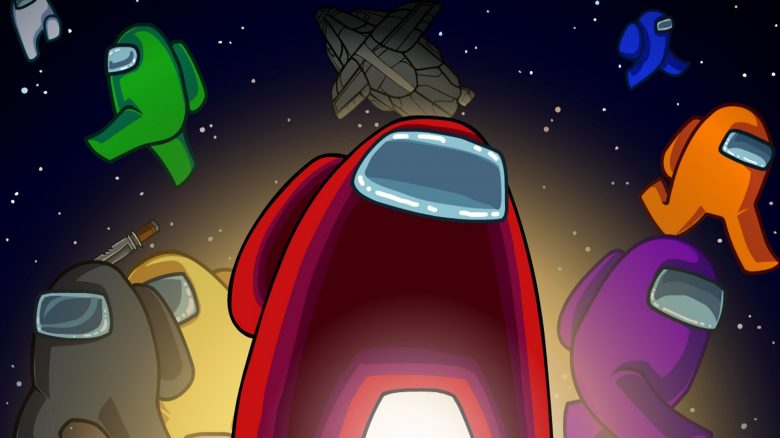
Starting in 2024, the manufacturer Unity will require developers to pay for game installations. They are shocked, taking to the barricades and do not want to participate.
Most developers who cannot or do not want to develop their own engine for their game rely on software like Unity or Unreal Engine. Here, important tools are provided as a complete package.
But now Unity is changing its pricing model and will charge developers for installations. Developers are accordingly angry and believe that in the end this will cost them more than they can earn with the games.
Developers have to pay when users install their games
What kind of change is this? On January 1, 2024, Unity will start charging developers a new Unity Runtime Fee
. This fee applies every time a game is installed after it has exceeded the minimum revenue and installation thresholds.
For the popular paid version Unity Plus, these values are set at $200,000 in the last 12 months and 200,000 lifetime installations – after exceeding these figures, developers will have to pay 20 cents per installation to Unity.
Why are developers affected? On reddit this news is being actively discussed. And the problem with the situation is quite clear:
- Games like Among Us have been installed millions of times, but most owners have long stopped playing the game. Users who have installed the game on their mobile phones are not counted.
- Some developers took advantage of large key seller offers, such as Humble Bundle, to quickly get their game to many people.
- If Unity now demands 20 cents per installation, this will inevitably lead to a huge burden for developers: either the budget for the next project is gone or the developer is bankrupt.
- Especially for developers who use Unity for cost reasons, this could have devastating consequences.
Another problem: It does not matter where you “acquire” the game. The rule applies to both games purchased on Steam and those obtained as a pirated copy from somewhere on the internet. In the end, every single installation counts. Even if you play the game for free through Game Pass or install a free ad-supported version from the Google Play Store.
Update from September 13 at 4:30 PM: Unity has issued a statement and explained a few details. If a game is installed via a subscription (for example, via Game Pass), then the operators of the subscription should pay the fees. This means: If you install a game via Xbox Game Pass, Microsoft would have to bear the costs, not the developer.
At least, developers should not be held responsible if players install a game multiple times. Unity confirmed this to the news magazine Axios (via axios.com):
After initially explaining to Axios that a player who installs a game, deletes it, and then reinstalls it would have to pay multiple fees, Unity’s Whitten later clarified to Axios that the company actually only charges fees for the first installation.
However, there is a restriction: If someone installs a game on both PC and Steam Deck, both installations would be counted. This is also one of the biggest criticisms, namely that Unity is charging fees for pure installations instead of licenses.
Moreover, games that are offered for free should not be affected. Because these should still remain below the revenue of $200,000.


Developers consider switching their engine or completely deleting their game
What’s next? The reactions from developers are pretty clear. No one is happy about the changes and many fear a sudden explosion of costs starting next year. Some developers, such as Innersloth, the team behind Among Us, have already stated that they do not want to participate. On Twitter, they said: “Stop it!” and made an emotional post on Twitter, which other developers followed:
Another team explains it in an image, which we embed here:
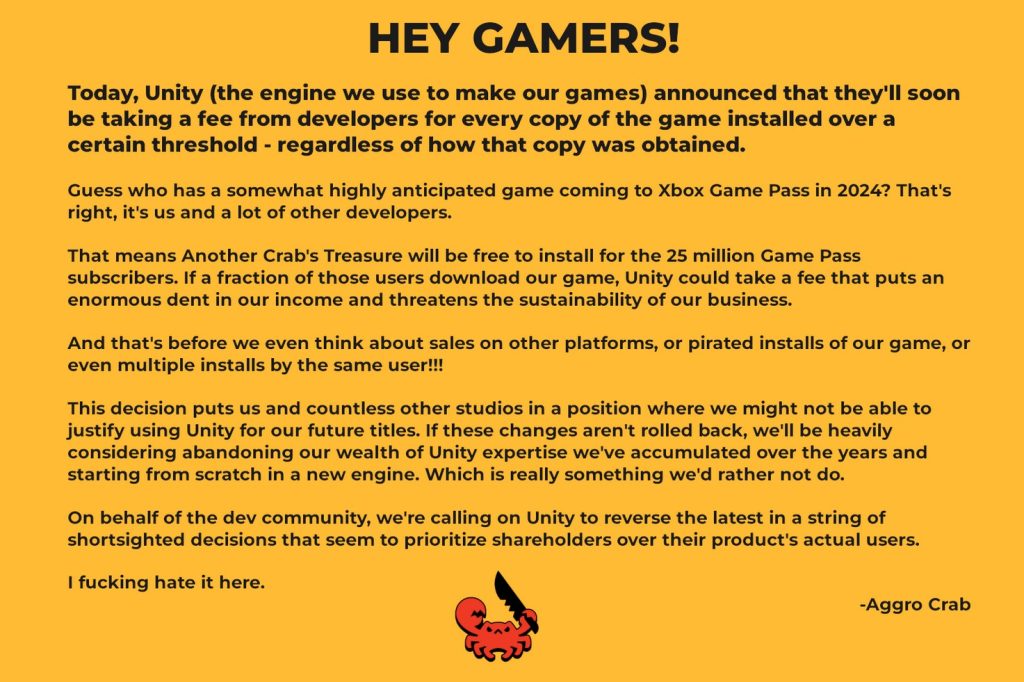
Many see the problem primarily in the fact that Unity is charging for installations and not for sold licenses. Especially developers who offer their games for free and finance them through a skin shop (like Among Us) will be hit hard. Because not every user buys a skin, even if they may install the game once to try it out.
Some players suggest that in the future, for every game that uses Unity, the connection be blocked that Unity uses to log installations.
Other developers have their own reasons for removing their game from Steam. And here it is not due to a potential explosion of costs from Unity:
Developer removes his viral hit from Steam to find peace of mind

Your opinion is important to us!
Do you like the article? Then let us know!