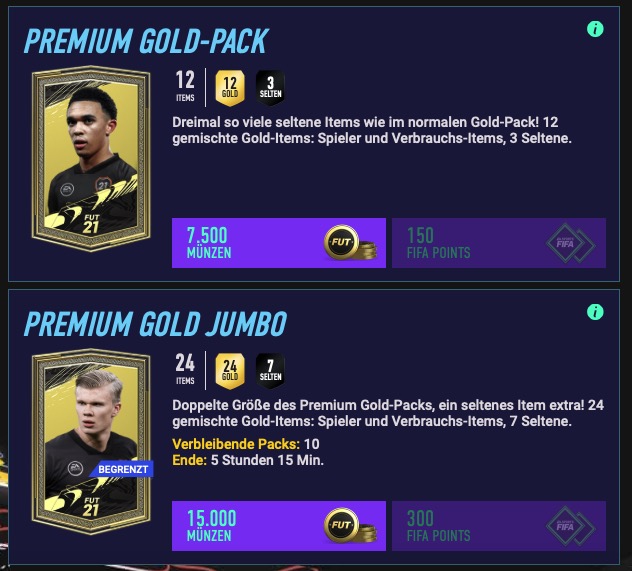
The packs in the Ultimate Team mode of FIFA 21 have been repeatedly criticized as a gambling mechanic. A ruling against the packs has now been issued in the Netherlands.
This is the ruling: The District Court of The Hague has issued a ruling against packs in Ultimate Team in favor of the Dutch Gambling Authority (Kansspelautoriteit or “Ksa” for short). The authority announced this today, October 29.
The ruling states that the FIFA series contains illegal loot boxes under Dutch gambling law.
According to the announcement (via Ksa), the cards violate gambling law because:
- the contents of the packs cannot be determined or influenced,
- and the cards have significant value and are tradeable.
A gambling activity in this sense is exclusively legal in the Netherlands if an appropriate license has been granted, which is not the case for FIFA.
As early as 2018, Ksa conducted a study on the connection between loot boxes and gambling addiction. Chairman René Jansen emphasizes in a statement, “It is crucial to protect vulnerable groups, such as minors, from the influence of gambling.” Gambling elements have no place, especially among this young target group.
In the course of this study, a number of companies adjusted their games accordingly – however, the parties responsible for FIFA in the Netherlands, Electronic Arts Inc. and Electronic Arts Swiss Sàrl, did not. Both in 2018 and 2019, it was communicated that the packs in this form violated the law.
However, a ruling has now been made. Accordingly, EA has three weeks from the date of the ruling to adjust the game. The ruling was on October 15, so EA now has about a week left. Otherwise, both companies would have to pay a weekly fine of 250,000 euros – with a maximum fine of 5 million euros.
EA will appeal
This is what EA says: In a statement to English-language publications such as Eurogamer and PCGamesN, Dirk Scholing of Electronic Arts commented on the ruling. According to him, players worldwide have enjoyed the Ultimate Team mode for many years, which is why they are disappointed with this decision and what it could mean for the Dutch community. Dirk Scholing: “We do not believe that our products and services violate any gambling laws in any way.”
They now intend to appeal this decision. At the same time, the statement emphasizes that Electronic Arts is committed to providing “all our players in all our games with choice, fairness, value, and fun.” They are also open to discussions with the gambling authority to find solutions.
Packs in Ultimate Team – a long history
This is what’s behind the packs: The decision of the Dutch court is the next chapter in a long history. The problem with the packs in Ultimate Team is that they can be purchased not only with in-game currency “coins” but also with real-money currency “FIFA Points.”
The problem: There is no guarantee as to what you will pull from the sets – no matter how much money you invest. Pulling strong and valuable players from regular packs requires a huge amount of luck. Even with the best packs in the game, you can still have bad luck and pull only weak, worthless players. While you may be able to buy more packs with real money, and you can sell the players from them, there is no guarantee of getting strong players directly for real money.
In FIFA 19, it was introduced that you can at least superficially view the probabilities in packs. And the chances of getting good players are generally very weak.
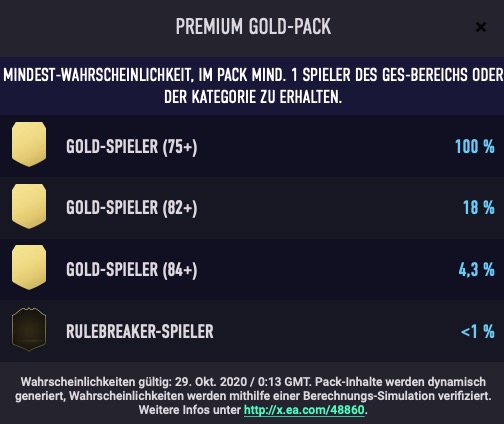
This is why there has been long-standing criticism of the packs:
- In FIFA 20, a player reported how the addiction to packs cost him his tuition money.
- A FUT advertisement for FIFA 21 in a toy catalog caused outrage.
- The streamer Trymacs showed in a large stream how poor the chances are.
- The FIFA pro Tim Latka stated that he wants to forgo real-money investment – out of responsibility to those young players.
The issue of loot boxes and FIFA keeps coming up – usually because young players might be lured into gambling here. For example, there is also an investigation in the UK this year into how loot boxes fall under gambling.
The Netherlands is not the first court to issue a ruling against loot boxes in FIFA. In Belgium, the sale of FIFA Points has been banned for a long time.