


Annoyed guests, burnt food, and financial difficulties – that sounds pretty stressful. Nevertheless, MeinMMO author Linda Baumgartl has fallen in love with a restaurant game where you have to face all these challenges. And no, it’s not Overcooked.
What could be more relaxing than being besieged by virtual hordes of hungry guests after work? At the same time, you risk your non-virtual friendships because someone once again didn’t clean the floor properly and now doesn’t want to admit it. What’s that all about?
Okay, maybe it’s not really relaxing. But it’s certainly more fun, especially when you sit on the couch with your friends and can hurl absurd, of course completely ironic insults at the culprits right away.
What game are we talking about? The game in question is the couch co-op game “PlateUp!” Together with up to four players, you build your own restaurant, which might even become a franchise if successful.
You can play online or locally with shared screen. Solo play is possible, but it’s not the focus of the game.
- On Steam, PlateUp! is currently 70% off and costs €5.85.
- The offer lasts until Monday, December 1.
- There is also a free demo available.
In the trailer, you can see different restaurants in action:
Like Overcooked, but better
If you’ve heard of a couch co-op restaurant game, it was probably Overcooked. The series has enjoyed great popularity for years (via SteamDB) and is one of the best titles in the genre. I’ve also spent several hours in Overcooked, especially Overcooked 2, before I discovered PlateUp! for myself.
At first glance, both titles look quite similar:
- Chaotic restaurant game where you have to process your guests’ orders as quickly as possible
- Focus on couch co-op
- Cute comic style
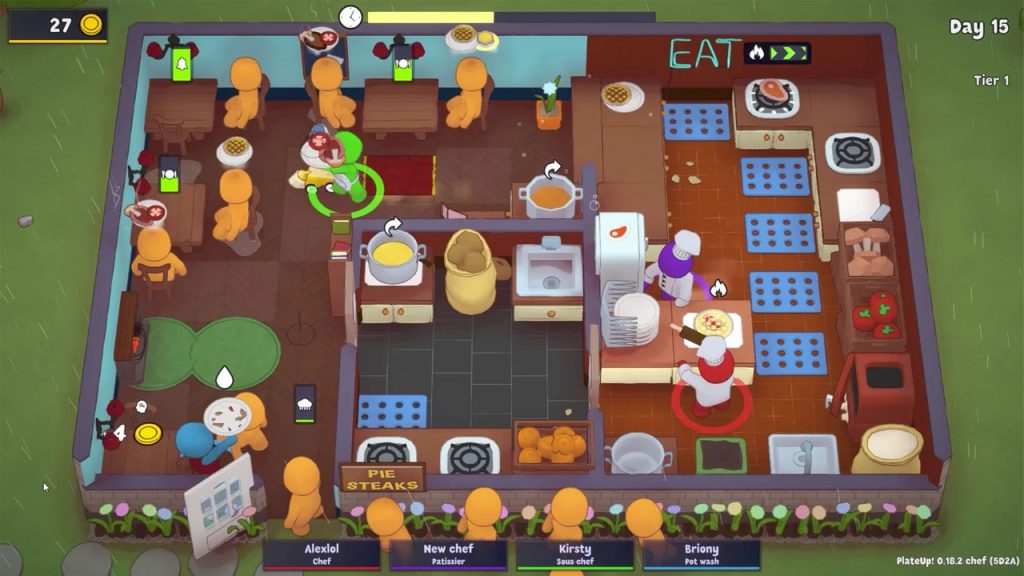
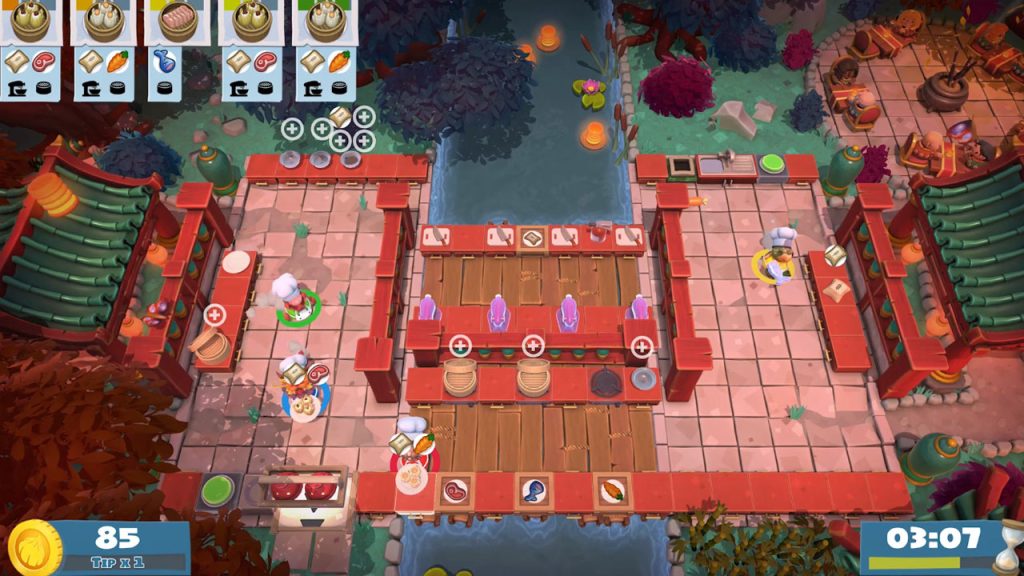
But on closer inspection, it becomes clear that PlateUp! is much more than a cheap copy. This is already due to a fundamentally different game principle:
- In Overcooked you play through separate levels. The challenge mainly lies in handling the given kitchen. Sometimes your kitchen is spread over two flying islands. Other times it is crossed by an icy river. That’s usually not very practical.
- In PlateUp!, however, you build your completely own restaurant. Here, the difficulty lies more in investing in the right upgrades and placing everything cleverly.
As a big fan of all kinds of building games, I feel right at home here. It’s just super satisfying to continuously improve and optimize your restaurant over time. PlateUp! creates the perfect blend of chaotic cooking action and strategic building game. It gives you enough freedom to tinker around and try out different approaches while also providing you with fixed goals and challenges, keeping it demanding.
Every restaurant has its own challenges
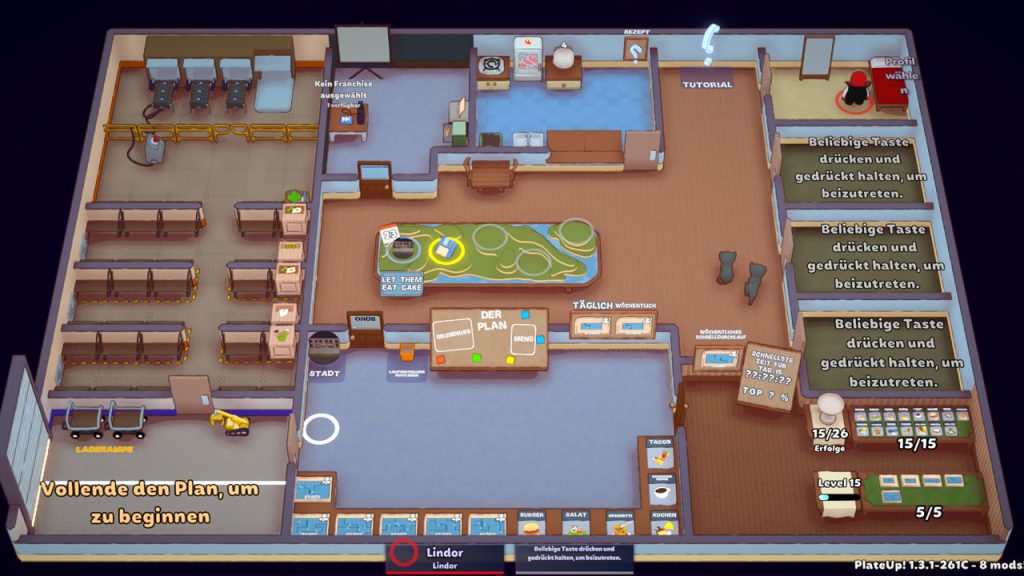
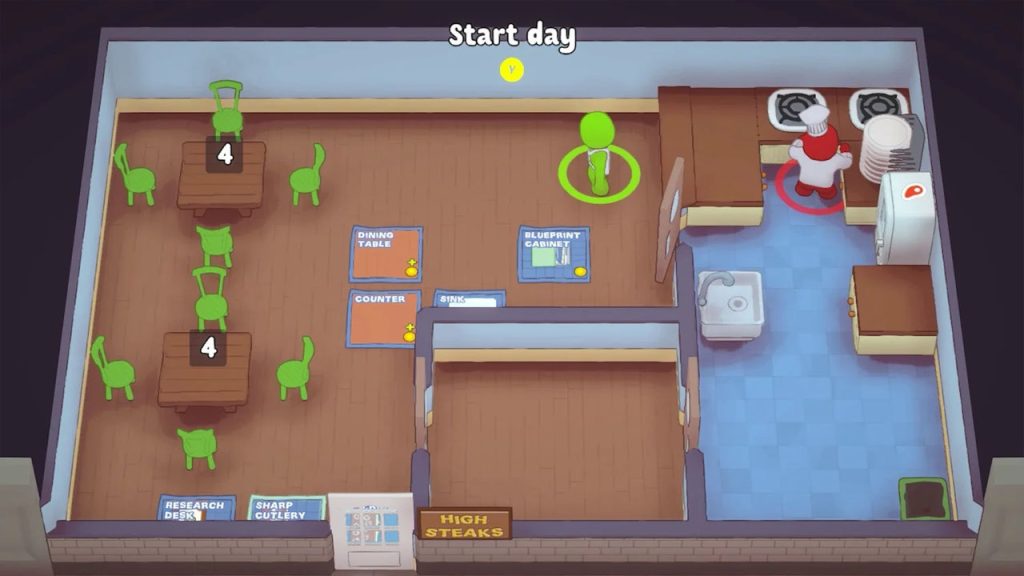
Before you start a round of PlateUp!, you first need to establish the basics of your restaurant. You choose the layout of your building, a dish that you want to offer at the beginning, and optionally two helpful items, which you will have to unlock first. This selection is extremely important for the course of the round and is essentially equivalent to choosing a level.
The goal of a match is to survive 15 game days with your restaurant. Each day, a certain number of guests arrives whom you must serve. If even a single guest leaves the house dissatisfied, you lose the match.
Fortunately, you don’t have to manage all this with your scant starting equipment. After each day, there is a planning phase. With the money you’ve fought hard for, you can buy new furniture, kitchen appliances, decorations, and equipment. You are always limited to a randomly rolled selection of objects.
It’s particularly important to not only buy more items but also better items. Many things in PlateUp! have various upgrades that you can obtain either randomly or through a research table. Such upgrades include:
- A stove where nothing can burn anymore
- A table where guests pay more
- A dishwasher that…well…washes your dishes automatically
However, not every progress is always pleasant. Every three days, your restaurant earns an additional star, which usually also brings more challenging guests. In true roguelike style, you are presented with a choice of two options from which you must choose one. This can be something like a new dish, more guests, or food that burns faster. In any case, it doesn’t get easier for you.
An exception to this are the decoration rounds. After five game days, you can choose a positive effect that you can activate through decoration items.
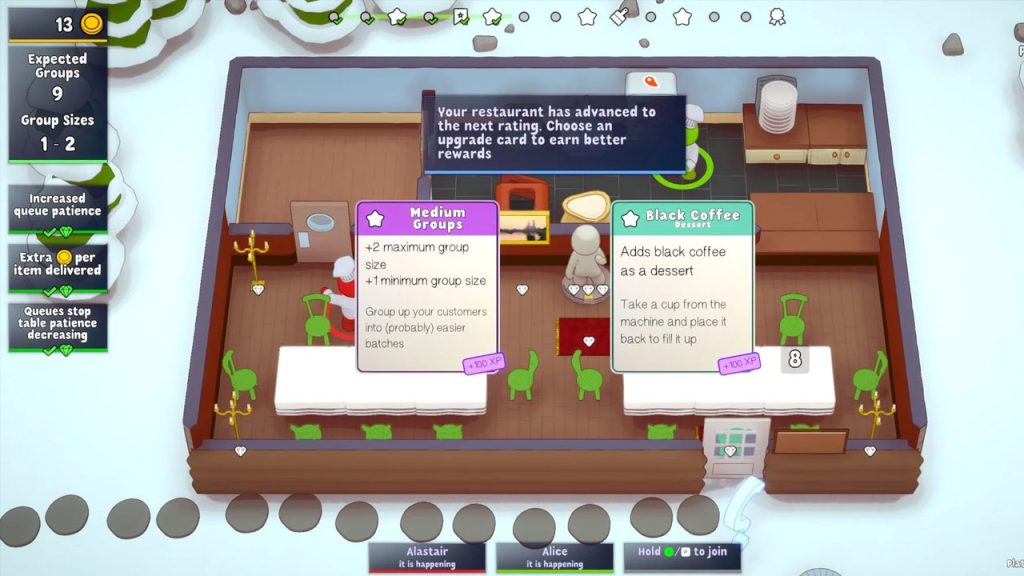
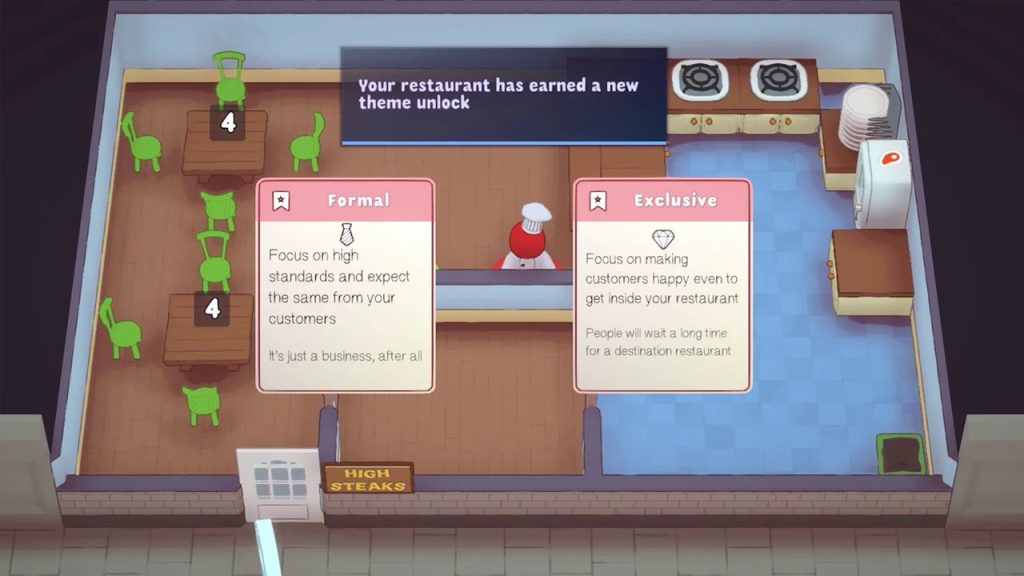
It’s precisely these roguelike elements that make the game so brilliant for me. Every round is unique and challenging in its own way. Over time, you’ll learn which innovations harmonize well together and which combinations you should avoid. For example, if you offer a more complicated dish, additional sides and desserts can quickly break your neck. In a relaxed café, you can serve plenty of pastries, ice cream, and cakes instead. Discovering this is a lot of fun and invites experimentation and optimization.
If you have no friends, machines will help
As mentioned at the beginning, I believe PlateUp! shines especially in coop. The hectic kitchen stress brings about excitement and funny moments immediately. Anyone can jump straight into the game. And there are plenty of tasks that can be shared among players.
Nevertheless, PlateUp! also works significantly better in solo play than I’ve experienced with other coop games of this type.
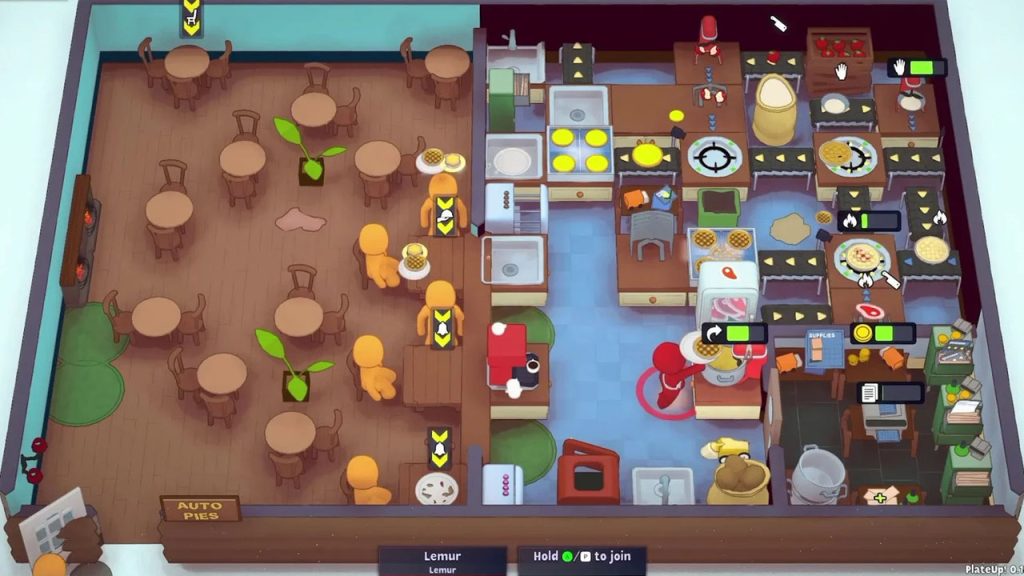
This is mainly because you can almost fully automate your restaurant, especially the cooking process. For this, there are things like conveyor belts, mixers, and portioners with which you can build complex automation processes. Eventually, your kitchen will resemble a stuffed production hall. But as long as the right food comes out at the end, your customers will be happy about it.
Through clever automation, you could theoretically manage to run a large restaurant entirely by yourself. However, you will be somewhat dependent on getting the right objects offered for purchase early on.
Of course, these options are also available in coop. If you want to play beyond the first 15 days, you should definitely consider mechanical assistance.
From shabby pub to restaurant empire
What I particularly like about PlateUp! is that after a winning match, the game doesn’t immediately kick you out of your restaurant. If you want, you can seamlessly continue playing until the ever-growing influx of visitors overwhelms you completely. Short round or long-term play, the choice is yours.
If you’ve survived at least 15 days, you will also have the opportunity to start a franchise. This means you start a new restaurant but take upgrade cards from the last match with you and gain additional bonuses. Here, you need to plan even longer-term and can create a true restaurant empire.
This may be less suitable for a quick party round. However, it’s even nicer if you want to enjoy the game long-term – for example, with a partner.



After 50 hours I was head chef
Even outside of individual matches, you make progress in PlateUp! over time. Most importantly, you unlock more layouts for your restaurant and more dishes. This keeps the game interesting and fresh even over a longer period.
After about 50 hours of gameplay, I have now unlocked all game content and feel like a little head chef. Nevertheless, I still don’t feel I have “finished” PlateUp!. Particularly regarding automation and longer franchises, there’s much deeper to dive, which will certainly occupy me for a few more hours.
Additionally, PlateUp! has become my favorite title in my “party repertoire”. No matter in what configurations I’ve played the game so far, it has always been well received and has provided a few funny gaming hours. Overall, I can recommend PlateUp! both as a casual coop game for a round with friends and for longer sessions with more strategy and optimization.
If you’d rather cook for well-known Disney heroes than for faceless stick figures, Dreamlight Valley might be right for you. MeinMMO author Johanna tells you why she finally got into the game: In a simulation on Steam, I help famous Disney heroes from my childhood, which has kept me busy for almost a week for over 20 hours

Your opinion is important to us!
Do you like the article? Then let us know!