

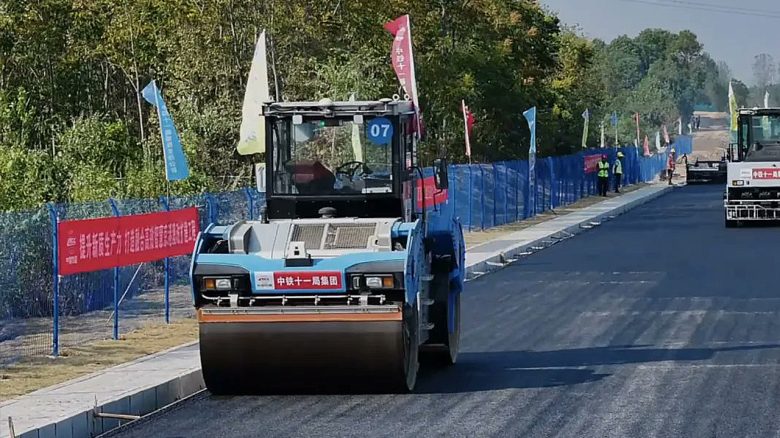
China relies on AI, drones, and robots. A nearly 160 kilometers long section of a highway was built for the first time without humans as workers.
Were no humans involved in the construction? According to researcher and author ChenKojira on X, formerly Twitter, the conglomerate of several Chinese state-owned enterprises relied solely on machine power and artificial intelligence. No human was at the controls, neither in the vehicles nor via remote control.
The result is a 157.79 kilometers long and 20 meters wide section, which is part of the Beijing–Hong Kong and Macau Expressway
. This total of more than 2,000 kilometers stretches from Hong Kong and Macau in the south up to Beijing in the north.
Road construction completely without humans on the construction site
How did the construction proceed? After the route was designed and planned in the conventional way by humans, the implementation took place using various construction vehicles and drones. The latter took on the monitoring and also controlled the surface apart from all dimensions. The news platform Deepnewz also reports on material deliveries by drones; approximately 10,000 units were used in total.
According to Chinese reports, this type of road construction using AI, robotic vehicles, and drones is a world premiere. Ultimately, the project achieved all goals and adhered to the millimeter-precise specifications set by humans, states ChenKojira on X.
An AI parade to celebrate the highway
The following images were taken during a staged mini-parade to showcase the devices in action. For this, the Chinese authorities also invited around 700 selected individuals to witness the spectacle and inspect the new highway. The images come from the X account tphuang.
Is this way of building roads better? According to Chinese sources, it was faster than with human involvement at the construction site. However, we do not have data on exact construction times or costs. Therefore, the claims that a new milestone in road construction has been achieved with previously unattainable road widths while maintaining high efficiency cannot be verified.
Based on the images and reports, it can only be confirmed so far that a highway was built and comprehensive automation was utilized. Whether only robots will be used in the future to construct further sections of the highway remains to be seen.


Similar to here, online shopping is extremely popular in Asia. However, Japan is slowly running out of workforce for this. Because someone has to drive the trucks to deliver the packages. The country may take a unique approach to solve the globally known problem: Japanese love shopping online, but who brings the goods to the customer? A 500 kilometers long conveyor belt is supposed to replace 25,000 trucks

Your opinion is important to us!
Do you like the article? Then let us know!