

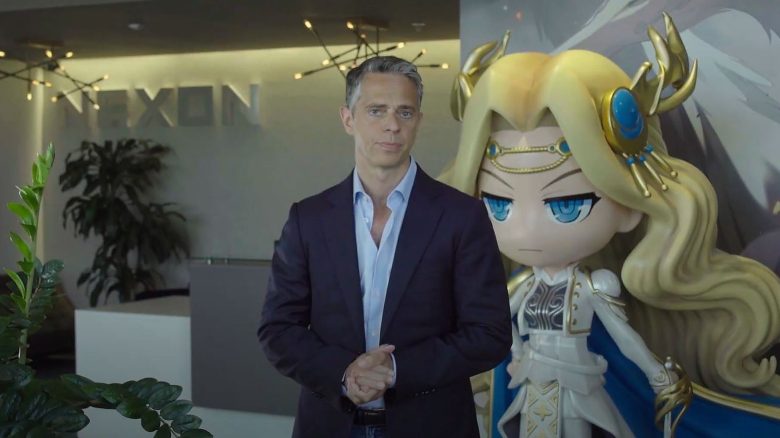
The South Korean gaming publisher Nexon is one of the most successful providers in the MMORPG sector. CEO Owen Mahoney is stepping down after 13 years. In an interview, he provides insights into the business with MMOs and MMORPGs. He resists games that cost $200 million and employ 1,000 people. The outgoing CEO raves about “The Finals,” which is being developed by fewer than 100 people.

Which 5 games is Nexon mainly known for? The publisher Nexon is one of the most successful providers of online games in the world. However, many of their players are particularly known in Asia:
- The MMORPG “Maple Story” has been running for 20 years
- The MMORPG “Dungeon Fighter Online” is nominally the largest MMORPG in the world
- Currently, the shooter “The Finals” is considered a hope on Steam
- As a publisher, they have released the fan favorite “Dave the Diver”
- As an example of a failed project, “Lawbreakers” can serve, which was released in 2016 and never really worked
The Finals is currently a major shooter hope:
Who is this? Owen Mahoney has been in the rare position of leading a studio based in Japan with most developers in South Korea as CEO from the West.
He is stepping down after 13 years at Nexon, 10 of which as CEO, and will take on an advisory role in the company.
“Best pipeline of all time”
Why is the CEO leaving? In an interview with GamesBeat, Mahoney says they are planning a leadership change because things are going so well right now, and it is important to arrange for succession in the long term.
Mahoney emphasizes that Nexon currently has “the best pipeline of all time,” and The Finals had a fantastic beta.
The company is in shape, firing on all cylinders. It’s a great time to step down. A new leadership is now in a position to succeed rather than immediately grapple with challenges.
MMORPG running for 20 years, grows by 46% in the last quarter
How does he view MMOs? For Mahoney, MMORPGs are a valuable, long-term investment. He speaks of “living virtual worlds” and “longevity.” He cites MapleStory as an example, which grew by 42% in the last quarter.
There has never been such a game that has grown and thrived for over 20 years. It is unique in gaming history; no one expected anything like this.
AAA games with a $200 million budget and 1,000 developers do not work
He sees this as a problem: Mahoney talks about how to keep game costs low. The future in AAA gaming cannot be having 1,000 people working on a game:
“If you are a game developer and have to manage a team of 500 or 1,000 people, you are no longer a creative person. You are a personnel manager. And that is not why you got into gaming.”
He cites MMORPG pioneer Raph Koster, who shares the same thesis: AAA gaming in its current form is no longer financially viable.
Mahoney says that by developing the right tools and working on the workflow, you can make game developers game developers again. You cannot solve problems by throwing more and more people at the problem:
- Customers are dissatisfied because the industry too often makes the same product.
- Game developers are dissatisfied because they work hard but are doing assembly line work.
- Moreover, investors are also unhappy because people like Mahoney approve $200 million projects, and when such projects flop once or twice, people ask for his head.
According to Mahoney, the development of AAA titles, which are getting increasingly expensive, is simply not sustainable. This is not the business Nexon wants to be in.


“The Finals” as a counter-model – Fewer than 100 employees
What is his alternative? For Nexon, it pays off to maintain lively virtual worlds that run for a long time:
“The games fluctuate a bit, quarter by quarter, but essentially they grow very steadily over a period of years or decades. This gives us enormous stability. We don’t have to replace old, lost revenue with new ones. We can build on them.”
Moreover, Nexon’s products stand out from others through this approach. Instead of throwing people at a problem, they prefer to work on good software solutions.
The team working on The Finals has fewer than 100 employees – nevertheless, The Finals is an AAA game.
In this way, you can develop multiple games in parallel with the same number of people that other studios use to work on a large title, and thus have several irons in the fire.
What kind of software does he mean? Mahoney has high hopes for artificial intelligence. Currently, people are “painting virtual leaves on virtual trees in Photoshop” and being treated like factory workers. Creative work is not demanded of them.
Mahoney hints: If AI takes over such tasks and creatives can work creatively again, more exciting games could emerge. Then the industry could continue to grow.
What it’s about: This is a purely business perspective on gaming and MMOs, where there is not a word about design or game ideas, but purely about costs, manpower, body count, and software tools.
The interview shows why so many developers are afraid of AI, which rationalizes their jobs in the name of efficiency and shareholder value. Mahoney suggests that this will release creative energy. However, the question is whether the person who previously “painted virtual leaves on virtual trees” suddenly steps out and develops brilliant gaming ideas or is rather pushed out of the industry.
More about The Finals, which Mahoney raves about:
5 reasons why The Finals could be one of the best PvP shooters – and 3 reasons against it

Your opinion is important to us!
Do you like the article? Then let us know!