

The Fortnite star Ninja serves as a hook for discussions: women in gaming or Sony’s refusal of crossplay. Both topics are closely related to the US gaming site Polygon, believes our author Schuhmann. They cleverly exploit the popularity of Fortnite and Ninja to deliberately construct outrage.
What happened? Last Thursday, Samsung introduced its new phone. Samsung had previously struck a deal with Epic: Fortnite Mobile would run exclusively on Samsung devices for a few days.
At the edge of the event, Twitch star Ninja appeared. He conducted an interview with the US site Polygon. In this interview, however, the discussion was not about Fortnite, the game Ninja is known for, but about other topics.
Topics that surprisingly fit well with Polygon’s profile.

Who is Ninja? Ninja is Tyler Blevins. A guy who has been on Twitch for ages. The hype around Fortnite has brought him to the top and earned him 10 million followers on Twitch.
Who is Polygon? Polygon is a US gaming site that prefers to cover “left”, “cultural”, and “political” topics:
- women in gaming
- minorities in gaming
- LGBT topics
- and similar
Additionally, Polygon made the topic of “Sony and Crossplay” such a central issue in June and July that it feels like the authors wanted to tear down Sony’s blockade themselves. However, the topic has noticeably cooled down in recent weeks.

Two stories developed: From the interview with Ninja, Polygon created two articles:
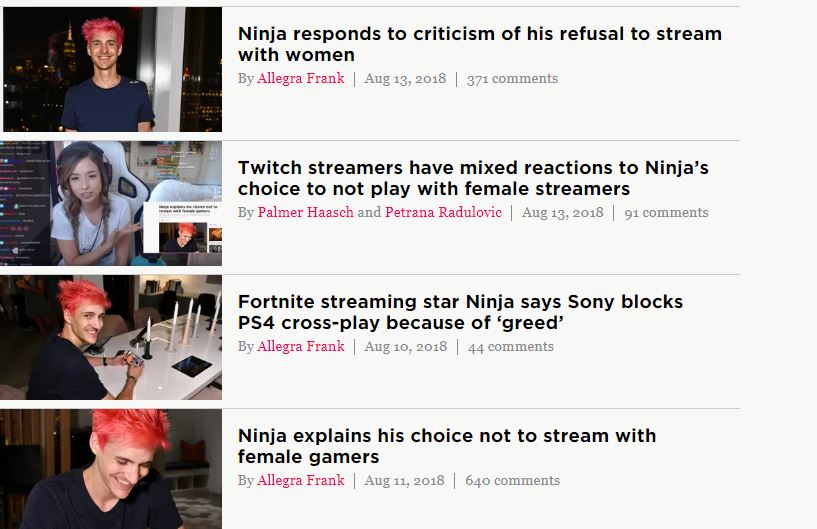
- The first was “Fortnite Streaming Star Ninja says Sony blocks PS4 crossplay due to greed” – the story came out on August 10 (via Polygon)
- The second was: “Ninja explains his decision not to stream with female gamers” – from August 11 (via Polygon)
Both stories fit perfectly with Polygon. But which one will prevail and win?

“He doesn’t stream with girls” is a hit, “Sony greedy” flops
How did both stories go over?
Ninja’s statement about Sony’s greed has almost completely fizzled out. Hardly anyone commented on the topic; apparently, people had grown tired of reading about Sony’s evil deeds.
Ninja’s view that Sony refuses crossplay for monetary reasons wasn’t anything new either. We had already heard and understood that a couple of months ago.
The story that Ninja doesn’t play with girls to avoid the inevitable rumors has caught fire and is the big topic surrounding Fortnite in recent days. Almost every gaming site in Germany reported on the topic, even general interest media picked it up.

Polygon itself wrote two follow-up articles:
- How streamers react to Ninja’s decision not to play with female streamers – from August 13 (via Polygon)
- Ninja responds to criticism of streaming with women – also from August 13 (via Polygon)
The original article by Polygon regarding Ninja’s refusal to stream with women has 640 comments. In comparison: The one about Sony’s refusal to play with other consoles has only 44.

Clicks, Links, and Trouble
What can be seen here?
Firstly: “Oh, he could be sexist” beats “Oh, he says something bad against Sony” by a long shot.
The interesting thing here is how Ninja and Fortnite are being used to set the agenda for topics that align with the interests of a gaming site. Polygon does not want to talk about gameplay but rather other things. Specifically about Sony’s crossplay and women in gaming.
Better culture than gameplay
Win-win for both sides? Surely there were countless other things in the interview that could have spun into stories. For example, how the hell Ninja sees the cursed game that made him so famous. But gameplay does not fit Polygon. “He doesn’t play with girls” does.
Ninja does not determine what is discussed here, but serves as an instrument to occupy topics. Whereby he is not a victim here, but can be criticized for being aware of this to further strengthen his brand.

Clever, but also kind of creepy
Powder keg topic: That the statement “He doesn’t stream with girls” is a powder keg that could inadvertently ignite a sexism debate should be clear to everyone, including the authors at Polygon.
Under the latest news on GameStar on the topic, comments are disabled; they fear too much moderation effort.

Clever but artificial: These are the topics that are meant to be discussed, according to Polygon. And a lot of clicks and links from other sites bring such articles, which strengthens their profile.
So: Cleverly done, Polygon. But it is somewhat frightening how artificially and deliberately such topics can be brought to the fore. And how well it works.
More on the topic: