


The tabletop role-playing game Dungeons & Dragons and one of the most popular collectible card games ever have more in common than many realize. Magic: The Gathering likely would not even exist without D&D, as it originated from a very specific idea that every role player would likely know.
Why would Magic: The Gathering not have existed without D&D? The creator of Magic: The Gathering, Richard Garfield, was himself an avid D&D player and was heavily inspired by pen-and-paper role-playing games in his concept.
His original vision for Magic was a compact card game that could be played like a mini-game ideally during the breaks of long D&D sessions. Or also as a bridge between sessions when no appointment could be arranged for the entire group – a situation that many role players are all too familiar with.
This close connection is still evident today: both games share many fantasy elements – such as well-known creatures like dragons, goblins, and elves, classic spells like Fireball, or overarching themes like magic and adventure. D&D had already established a large fantasy community in the 80s and 90s, which provided the ideal breeding ground for the success of Magic.
Without the fantasy culture shaped by D&D, the rise of Magic would hardly be imaginable – an influence that is still reflected today in crossovers of the two games, but they also have more in common than many would assume.
The “Planes” as a Basis for Crossover
What connects Magic and D&D aside from the origin story and community? As both Magic and D&D are brands of the company Wizards of the Coast, there have been efforts for years to more closely integrate the two franchises. A significant touchpoint of both games is the so-called “Planes” (or “Layers”) in the lore of Magic.
They represent entire, self-contained realities or universes, often referred to as “worlds.” Each plane is a self-contained world with its unique geography, ecology, society, history, and often specific magical laws.
These planes are separated by the so-called Blind Eternities, a chaotic, empty space that is deadly and impassable for ordinary mortals.
In the card game, you take on the role of a “Planeswalker,” an extremely powerful mage who collects knowledge, skills, and allies through their travels, and who is able to traverse the Blind Eternities without assistance, thus traveling between the planes. These mages are often involved in multiverse-spanning conflicts and act as protectors (or threats) for the various planes.

Every card set of MtG (Magic: The Gathering) is set on one of these planes and reflects the respective character of the represented world. Meanwhile, there are numerous game-specific planes, but also many crossovers with other franchises such as The Lord of the Rings or Final Fantasy, which have found their way in as cards and own planes in Magic.
So too does D&D with the set “Adventures in the Forgotten Realms”, which brings the Forgotten Realms of the tabletop into the card game as a plane set, or the matching sets for the game Baldur’s Gate 3, which also finds its place in D&D. But Magic has also now become inseparable from the multiverse of D&D, so that many “worlds” are now shared.
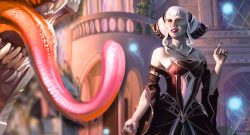
Inseparably Connected through the Planes
How does Magic reappear in D&D? To enable Magic fans who are also D&D players to use planes as settings for their campaigns in DnD with the rules of the 5th edition, Wizards of the Coast has repeatedly published PDF guides named “Plane Shift” for various planes of MtG since 2016. The different planes include, for example:
- Dominaria (via WotC): One of the oldest and most central planes in MtG, considered a sort of “fantasy standard” and home to many iconic characters and conflicts.
- Zendikar (via WotC): A wild, adventurous world full of floating islands, ancient ruins, and the devastating Eldrazi titans.
- Innistrad (via WotC): A gothic horror world inhabited by vampires, werewolves, zombies, and witches.
- Kaladesh (via WotC): A plane of invention, aether technology, and vibrant metropolises.
- Amonkhet (via WotC): An Egyptian-inspired world ruled by a dark god, where death has a different significance.
- Ixalan (via WotC): A world full of pirates, vampires, dinosaurs, and strange Aztec/Maya-inspired cultures in search of a golden city.
The name of the PDFs is based on the spell of the same name from D&D, which allows the caster in role-playing to teleport to other planes of existence. Also, the term Planeswalker, which plays a significant role in Magic, finds its place in the lore of the multiverse surrounding Dungeons & Dragons and is used for important figures such as Elminster, Tasha, and Mordenkainen, who also travel between the planes.
In addition, there are now several source and rulebooks that draw on Magic’s planes as campaign settings for D&D, such as Strixhaven (via DnD Beyond), Ravnica (via DnD Beyond), and Theros (via DnD Beyond).
Thus, the multiverse of Dungeons & Dragons has become noticeably intertwined with the lore of Magic, and Magic would certainly not have been as successful today if D&D had not laid the conceptual groundwork.
Dungeons & Dragons is considered the first tabletop role-playing game in the world to be titled as such. Its collectible card game counterpart has meanwhile achieved another special title, as researchers around the globe seem to agree – Magic: The Gathering is the most complex card game in the world: We now know what the most complex game in the world is – and you know it

Your opinion is important to us!
Do you like the article? Then let us know!