


Today, on Thursday, June 20th, it happened: The controversial game “Banana” surpassed Counter-Strike 2 and is the most played game on the PC platform Steam. The man behind the game insists: It is not a scam. However, there was a fraudster on the team, from whom they have now – allegedly amicably – parted ways.
What kind of game is this?
- The essential gimmick of “Banana” is that every 3 to 18 hours you play the game, you receive a banana: This is an image that can be traded on the Steam marketplace.
- The most bananas are offered for the minimum amount of 3 cents, but some rare bananas go up to $500.
- The game is apparently mostly kept alive by bots. Some users are said to use thousands of bots simultaneously, as a team member admitted in an article by Polygon. That’s so many bots that Banana is currently statistically the largest game on Steam. It has surpassed Counter-Strike 2 in terms of concurrent players.
Many are reminded of NFTs by “Banana”:
Developer Promotes Legal “Infinite Money Glitch”
What is the appeal of the game? One of the developers said, as Polygon reports: The game is a legal “Infinite Money” glitch. Players would make money with a free game while selling virtual items.
Where do the fraud allegations come from? There are 3 major points of criticism that YouTubers like Charles White express:
The whole system resembles the NFT model: The actual images have no value but are pure speculation objects. So it could be that prices suddenly crash and buyers are left with huge losses if they have “invested in rare bananas.”
The situation is opaque: Some suspect that the developers are generating the expensive bananas themselves to manipulate supply and cash out: A classic “Pump and Dump” scam.
You can’t even do anything with the bananas, as the option to at least use the banana as a skin in the game has not yet been developed.
The “Infinite Money Glitch” has a catch: Because someone has to buy the worthless bananas.



Banana had a disgraced fraudster on the team – but didn’t know about it
This is the new development: The developer now emphasizes in a statement that they are not a scam.
To prove this, they explain that they have amicably parted ways with a disgraced fraudster on the team, Theselions. Because the developer was, as a YouTuber points out, actually involved in a scam just as they are being accused of with Banana.
A previous game by Theselions was “allegedly accidentally” a Bitcoin Pump-and-Dump fraud before Valve removed it from the Steam store.
In any case, they have parted ways with this developer. They are also not upset with Theselions or separated in a dispute but say they did nothing to warrant being banned.
In any case, his “inventory has been cleared of all valuable bananas.”
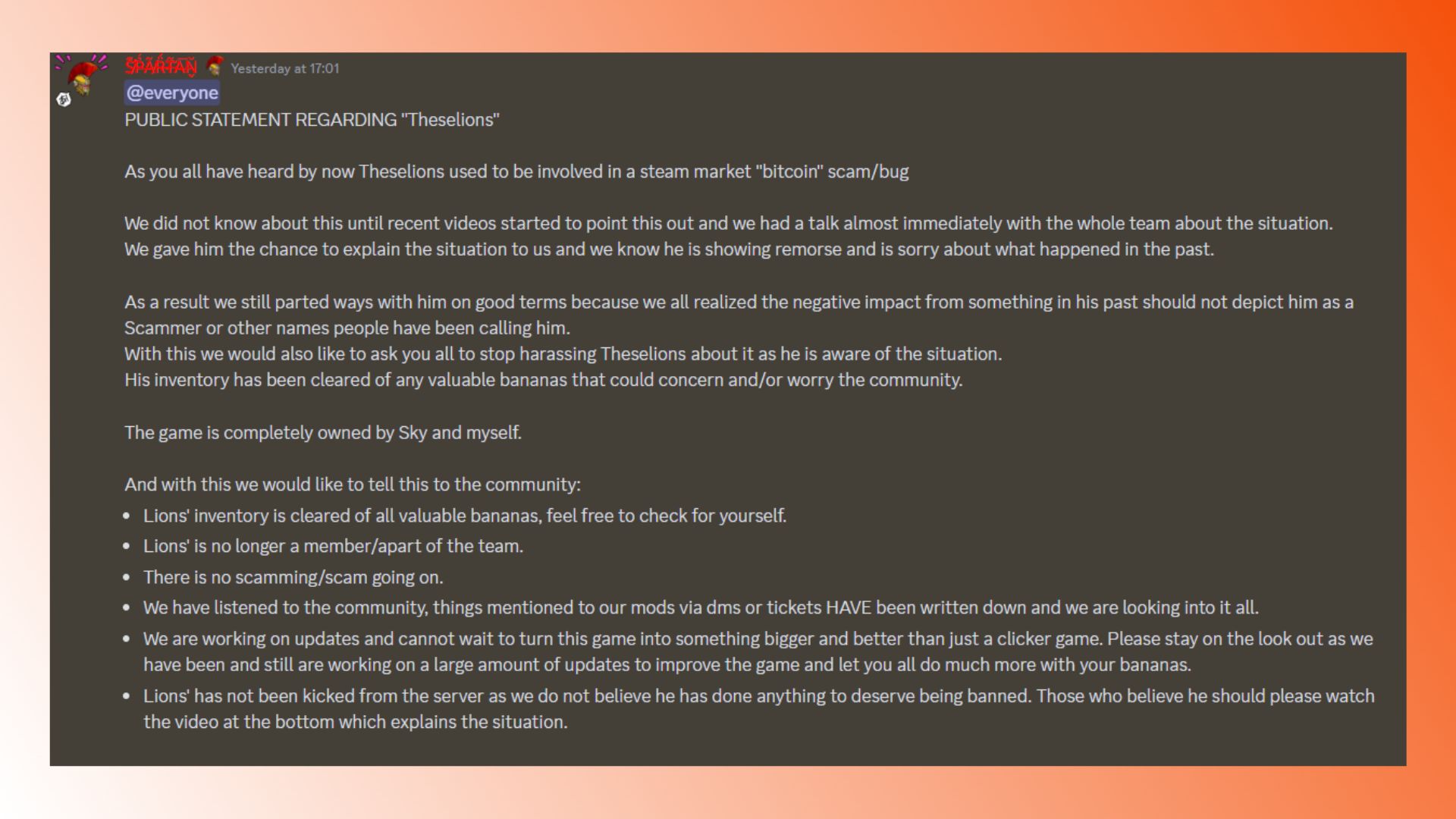
This is what the man behind Banana says: The developer behind Banana writes that they can’t wait to transform the game into something “bigger and better” than just a clicker game.
Soon they will be bringing “a large amount of updates” to improve the game and let people do much more with the bananas.
What exactly can be done with an image of a banana remains open by the developer.
What’s behind this: The mere statement that Theselions’ inventory has been cleared of all valuable bananas should be a huge red flag for anyone seriously planning to invest money in the game.
Because if the developers’ inventories are full of valuable bananas that they can throw on the market at any time, then that is the template for a “Pump and Dump” scam:
- Even if one engages with the logic of such a “virtual currency”, one must understand that the value of “rarer bananas” depends on them actually being rare.
- But if it only seems that they are rare, and the developers behind the game are secretly holding a massive number of rare bananas, then the “rare bananas” are no longer rare, but worthless.
- Thus they are even less valuable than the common bananas, with which one also cannot do anything.
Ultimately, you are paying money here for a few pixels and very vague promises.
It is ironic that Banana is precisely displacing Counter-Strike 2 at the top of Steam. Because although Valve’s shooter is undoubtedly a “real” game, there is also a wary eye on the skin trading there, from which Valve makes a fortune: Steam: Despite much criticism, Counter-Strike 2 is a financial giant hit for Valve because of casino mechanics

Your opinion is important to us!
Do you like the article? Then let us know!