


In Baldur’s Gate 3 (Steam) is an important decision completely irrelevant. This unnecessarily devalues the game, finds MeinMMO Tiefling Cortyn.
Baldur’s Gate 3 fascinates the masses. It is a deep role-playing game with numerous decisions that have far-reaching consequences. Often, one only notices the effects of a decision many hours later and cannot change it anymore.
But the most important decision in Baldur’s Gate 3 deviates from this concept.
Spoiler alert: This article deals with one of the most important decisions in Baldur’s Gate 3. Therefore, the article contains significant spoilers about the gameplay of Baldur’s Gate 3.
The story of Baldur’s Gate 3 begins dramatically. You have been kidnapped and infected by a Mind Flayer. A parasite, a so-called tadpole, has taken root in your head, threatening to turn you into a Mind Flayer in a few days if you do not find a cure.
However, it quickly becomes apparent that this parasite apparently brings certain advantages. You are telepathically connected with other parasite carriers and can use special psychic powers to easily convince other characters.
But there is more: Soon you will find other parasites whose knowledge you can absorb to develop special powers. These are really strong talents that make you stronger and more versatile in battles. From “ranged counters to spells” to pushing all enemies within a certain HP value (which was 23 in the end) away, or a “stop” command that prevents enemies from attacking.
Whether you want to take advantage of this power is one of the major decisions in Baldur’s Gate 3 that runs throughout the game.
And this is the crux: It is completely irrelevant to the story’s progression whether you use the power of the parasite.
Seductive power – without side effects
It has absolutely no impact on your character or the ending whether you use your Illithid powers. It does not matter if you only have one worm in your head or have absorbed 22 more. It is completely irrelevant whether you use your Illithid powers on every possible NPC or always choose the “hard” way of an actual skill check.
In my first playthrough with a friend, we decided to take opposing approaches. While the Halfling wanted to get rid of the parasite at all costs and never used the powers, my Tiefling eagerly embraced every parasite and used the powers uninterrupted.
With each new parasite, she became more powerful and, to be honest: The abilities are absolutely overpowered in combat. Being able to transform into a Displacer Beast or instantly kill all enemies below a certain HP value (which ended up being 23) was just crazy. Oh yes: Permanent flying is also nice or being able to cast spells for free.

I thought: I would be punished for constantly using the power of the parasite
The abilities in combat and the absolute dominance in conversations led to ongoing discussions on Discord. We were both sure that this choice would have consequences in the end. We were sure that the Halfling could better cope with a final conflict against the parasite, while my Tiefling, who permanently used these powers, would probably head towards an “evil” ending, and the reckless use of this power would break her neck in the end.
We did not just come up with this out of thin air – the game implies this all the time. The first time I absorb another parasite, the danger is clearly highlighted.
All companions and NPCs repeatedly warn against giving in to these powers. One simply does not know where this leads, and in the end, one only submits to the Mind Flayers.
Even the neutral narrator voice indirectly warns against it. When one first “consumes” an additional parasite, a statement like: “So much potential, but also so much danger. Knowledge that is ready to be harvested from you. But at what price?” is made.
If you then absorb the parasite, this is reinforced once more:
“The knowledge of the parasite nourishes your mind. Yet at the same time, you feel something important disappearing. Something, a part deep within you, is now forever lost.”
Empty words, devoid of any meaning.
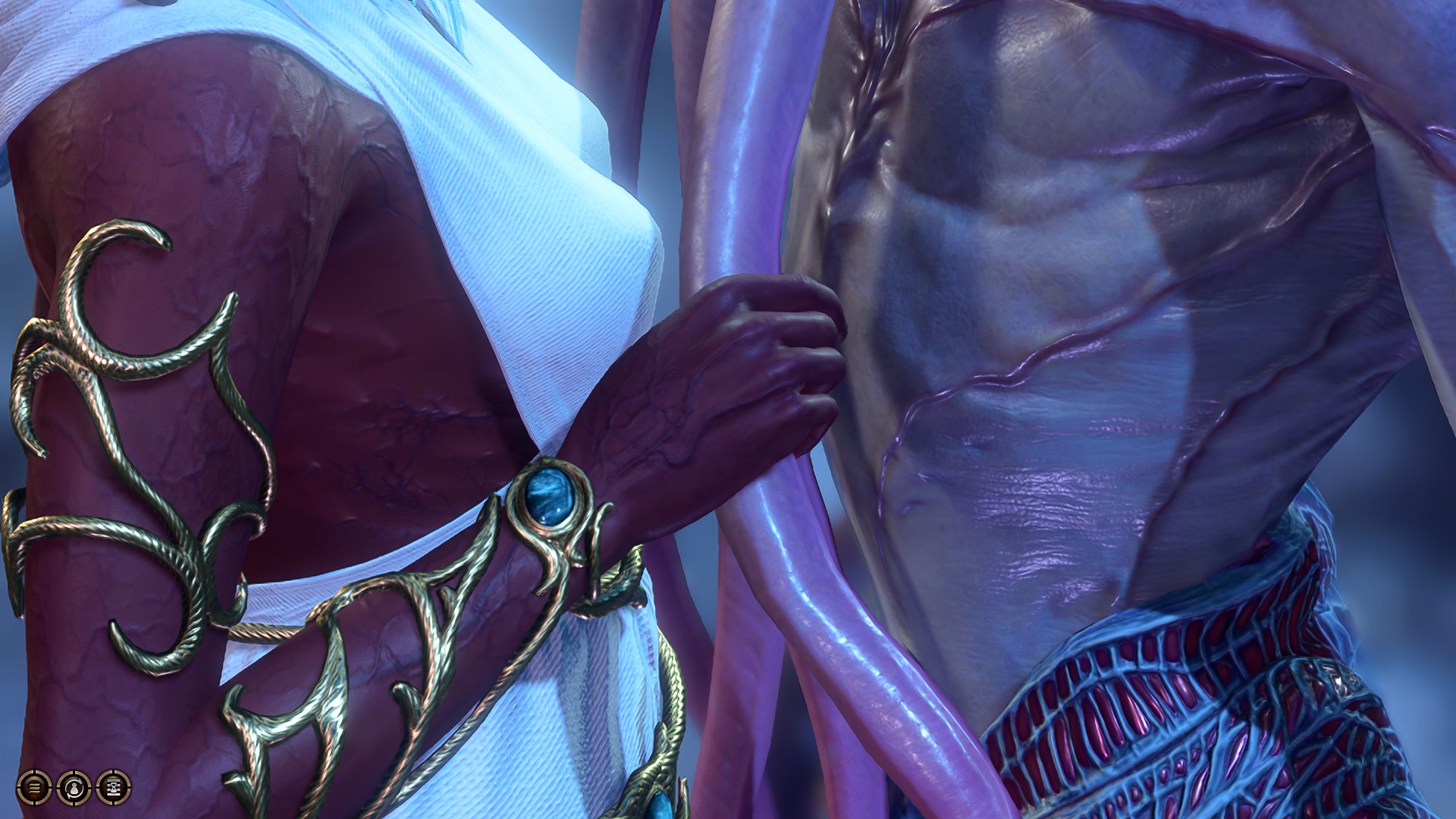
Many NPCs also seem much less interesting with the knowledge that one can easily follow the dark path. The “Emperor”, who constantly tries to tempt you to use the powers of the Illithids, seems less threatening. The lengthy quest line about a magical ring that is supposed to completely stop the influence of your parasite becomes irrelevant – it does not work anyway, although the quest and the text claim otherwise.
Just a gameplay mechanic without profound meaning?
Of course, one could now say: “Why are you getting so worked up, it’s just an in-game explanation for a new talent tree, lol.”
But that is simply not true. The decision to never use the parasite, only to use it in an emergency, or to use it permanently is a fundamental theme in Baldur’s Gate 3. It is the conflict that rages not only in the minds of the characters being played but also in those of the players in front of the screen.
That there are no consequences to using the powers does not even make sense from a gameplay perspective. Because whenever you use the powers of the parasite, it is almost an “automatic success” – you almost always only need to roll against a difficulty of 2. This factually means that only a critical failure (i.e. a rolled 1) can fail.
But why should a player decide to make a roll on charisma or strength, where you have to beat a 15 or 20, when one can simply choose “Illithid knowledge”, which is the “easy mode” without player and narrative consequences?
That one can just draw on the Illithid knowledge “for free” is unfortunately just one thing: bad game design.



I find that tremendously unfortunate.
Baldur’s Gate 3 is a game that consistently takes its players very seriously. With just one click on the wrong object, you can turn an entire village against you and trigger a life-and-death battle. With just one decision, you can shape the fate of dozens of NPCs and drastically change the course of the story.
The absence of this great final consequence, whose importance is emphasized throughout the game, deprives Baldur’s Gate 3 of a worthy conclusion. Ironically, in the most important decision, Baldur’s Gate 3 no longer takes its players seriously.
Even though the journey was immensely enjoyable, it gives the ending a very bitter, disappointing aftertaste.
Baldur’s Gate 3 has placed great importance on the fact that my decisions have consequences and are logically followed through for well over 100 hours. Yet the thematically most important decision of whether to use the power of the parasite or not remains completely without consequence.
And that is just one thing: damn unfortunate.

Your opinion is important to us!
Do you like the article? Then let us know!