

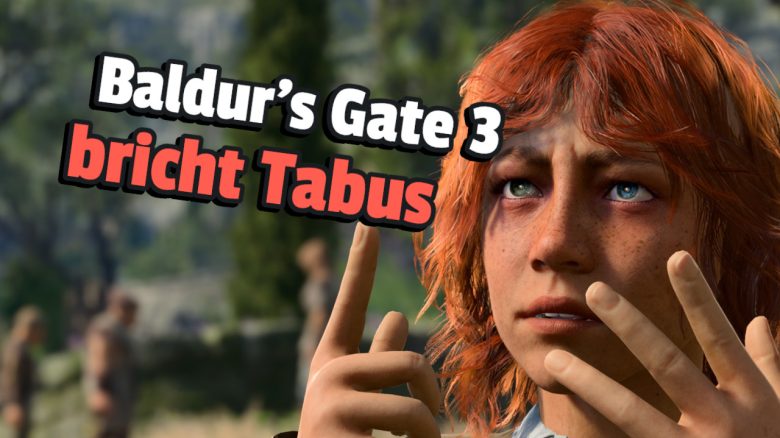
By now, it should be known that Baldur’s Gate 3 offers you as many freedoms as hardly any other game. This also means that moral boundaries no longer really exist and taboos can be broken.
Spoiler Warning: The article contains information about critical moments in the story of Baldur’s Gate 3.
What kind of crime is this?
- In movies and gaming, there is a great taboo that is almost never broken: children who can die.
- There are almost no games with child NPCs where they can be killed or even just attacked. The “Rick & Morty” shooter High on Life has something like this as an Easter egg, but even there, with the weapon comment that such silly actions raise the game’s age rating.
- Baldur’s Gate 3 deals with this taboo much more openly. Here you can not only kill children, but it is also hardly avoidable.
Where does it appear in Baldur’s Gate 3? There are at least two prominent places where you encounter children that you kill directly or indirectly:
- the goblin children in the camp who stand in front of Halsin and throw stones at him
- the tiefling children and their thieves’ guild in the refugee camp
Although you don’t necessarily have to kill the goblin children, they do intervene in the fight, when you want to rescue Halsin. If you choose to let them escape, they call for reinforcements and make the fight significantly harder.
The tiefling children inevitably die when you follow an evil path and want to recruit Minthara. During the goblins’ attack on the camp, all tieflings are killed, including the children in their cave.
Here you don’t wield the sword yourself, but you still make the decision and the death sentence for the refugees. As far as we know, the tieflings and other children besides the goblins are not actively “killable” – although some players even wish for that (via Larian forums).
The sheer amount of possibilities is one of the reasons for the success of Baldur’s Gate 3 – even if decisions can be cruel:
Killing children in Baldur’s Gate 3 is somehow … acceptable?
Baldur’s Gate 3 not only breaks a taboo here, but there are also no gameplay penalties for it – aside from the obvious ones: You lose all “good” companions if you slaughter the tieflings.
As a good paladin you do not break your oath if you decide to kill the goblin children. The colleagues at Millenium provide an explanation: the alignment system of Dungeons & Dragons.
This system divides characters into 5 categories: Lawful, Chaotic, Good, Evil, and Neutral. Goblins are naturally “neutral evil” creatures. Therefore, as a paladin, it is considered acceptable to kill them – even children.


In the “evil” path, where the tieflings die, it looks a bit different. Here you primarily have to live with your conscience, because one of the children is holding a fan letter to you when it dies. Tough stuff.
However, the game never brings up what you have done again. Neither one of your companions nor any NPC ever mentions the dead children to you.
The possibility that children can die in Baldur’s Gate 3 is cruel. Nevertheless, it fits into the world, which really allows you almost everything and … is simply not nice. After all, mind-flaying tentacle monsters are trying to conquer everything. And players of Baldur’s Gate 3 are somehow used to cruelties: players find speedruns in Baldur’s Gate 3 dark because your companions often suffer terrible torments

Your opinion is important to us!
Do you like the article? Then let us know!