


AMD’s DLSS alternative is getting support from 2 popular game engines. This means that many players are likely to soon benefit from the technology. MeinMMO explains what AMD’s FidelityFX Super Resolution is all about.
Which player would decline if they were offered significantly more FPS at the same performance? Probably very few, as high FPS are, especially for many fast-paced games such as competitive games, an important requirement.
Nvidia’s DLSS technology (Deep Learning Super Sampling) and AMD’s FidelityFX Super Resolution (FSR) promise exactly that, namely significantly better FPS at the same performance. And many players are excited to get significantly more FPS in their games.
With a beta update for the Unity engine and a patch for the Unreal engine, the development and dissemination of AMD’s FidelityFX Super Resolution is progressing rapidly (via pcgamer.com).
So far, only about 12 games support AMD’s new technology, which the manufacturer had only announced at the beginning of June. With the announced updates for the engines, the number of supported games could significantly increase.
AMD’s FidelityFX offers you more FPS in games at the same performance
What is DLSS and FidelityFX Super Resolution, anyway? With Nvidia DLSS, the game is internally calculated at a lower resolution and upscaled to a higher resolution, such as 4K, using an AI algorithm to increase FPS.
AMD has introduced an alternative with FidelityFX Super Resolution that also aims to provide a scaling technique. However, AMD’s technology is still in its infancy compared to Nvidia’s DLSS.
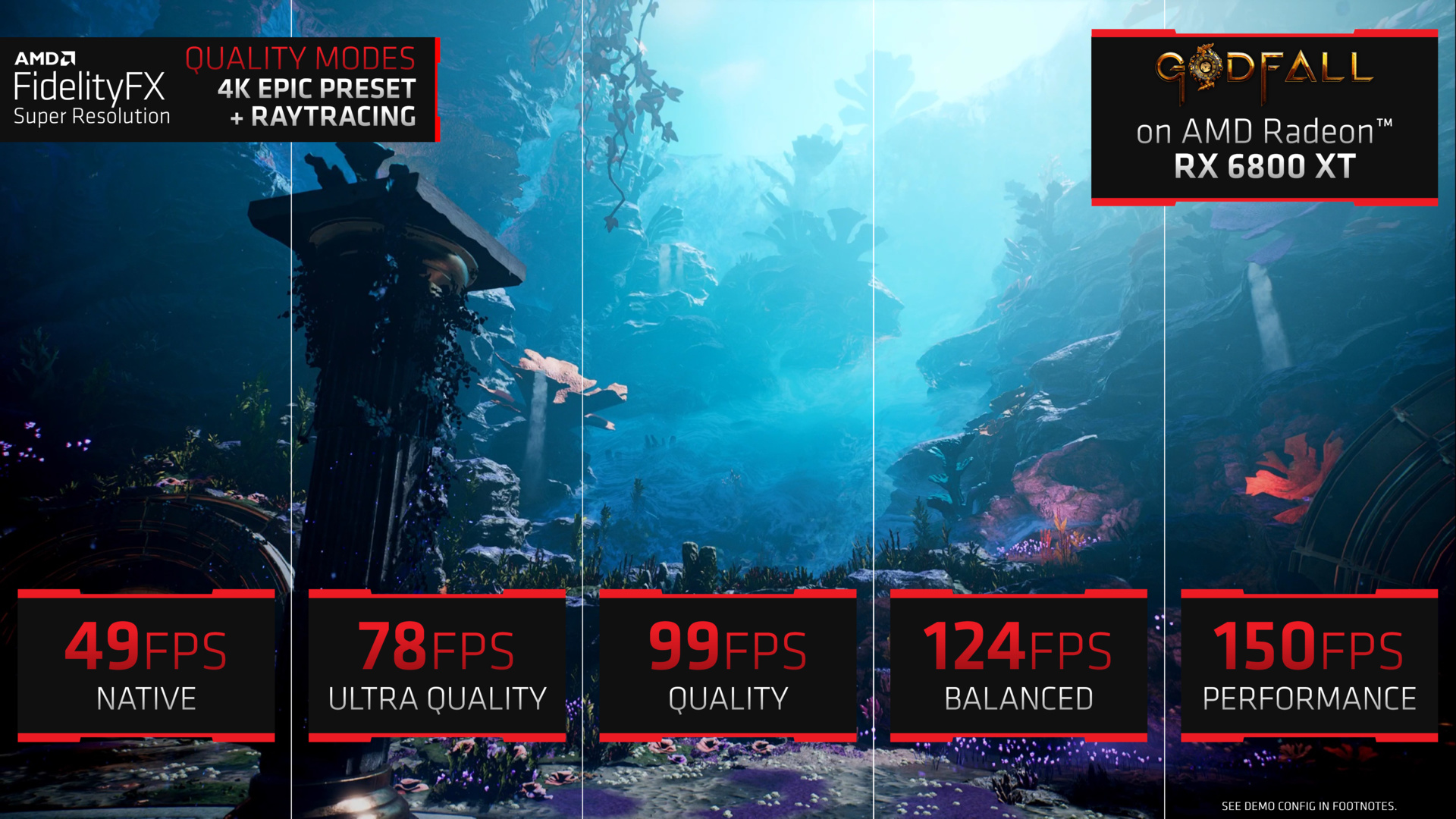
What is special about AMD? AMD relies on open-source technology and works with both AMD and Nvidia graphics cards.
Nvidia’s DLSS technology only works on RTX graphics cards, as DLSS requires specific computation cores known as Tensor cores on the graphics card.
How well does AMD’s technology work? So far, the new technology has been quite convincing. Especially the image quality suffers due to the so-called upscaling of textures. As a result, higher resolution textures, in particular, can appear slightly blurred.
Gamers Nexus has tested FSR thoroughly and is quite impressed. Although AMD’s FSR does not offer such a significant increase in framerate as Nvidia’s DLSS, the technology works with almost every modern graphics card.
With the official support from UnrealEngine and Unity, several games that will support AMD’s technology are likely to come soon. Microsoft has also stated in a statement that they also intend to support FidelityFX Super Resolution on the Xbox Series X soon.
Why is the technology so important? To be a seriously strong competitor for Nvidia in the graphics card market, AMD also needs a strong DLSS alternative. Nvidia currently has the upper hand in this regard and is a strong argument for purchasing an RTX graphics card. However, AMD could have the advantage that the technology could theoretically support any newer graphics card.

Your opinion is important to us!
Do you like the article? Then let us know!