

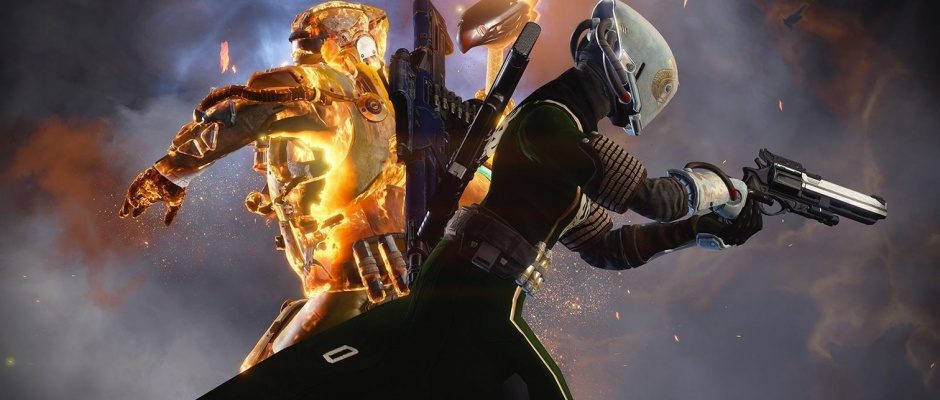
Activision frees Bungie. What does that mean for Destiny 2? Our author Schuhmann analyzes the situation.

“Activision and Bungie are getting a divorce – and Bungie keeps the kids, meaning Destiny 2”: That’s how the headlines looked on Thursday evening.
This spontaneously triggered 3 reactions:
- At Bungie itself, employees reportedly popped champagne corks, as reported by a friendly informant from the US site Kotaku
- Activision’s stock price dropped nearly 10% almost immediately – Activision now has lawyers on its tail who want to “check” this
- And players shouted “Finally free” – screamed Guardians on our Facebook “The best news in a long time”
But it’s not that simple.

What could Activision be to blame for?
Only those involved know exactly what is happening with Destiny. Little is leaking out. However, there are three main crisis points for which Activision could indeed be held responsible, based on everything we know:
- The casual orientation of Destiny 2 – it was probably Activision’s idea to sell many more games now that it is on PC
- The idea that Destiny 2 must become an “eSport title” and therefore must be as polished and balanced as possible – it is part of Activision’s philosophy to turn everything into an eSport and an event, like with Overwatch
- And that Destiny 2 was released in fall 2017, even though the game was apparently not ready – Activision wants annual games for its franchises, which is known from the contracts
These are the 3 problems that can be fairly certainly traced directly or indirectly back to Activision’s influence, based on everything we know or suspect.
This influence has already led to some gritting of teeth in the aftermath of Destiny 2. The mistakes Bungie has admitted to have all come down to time constraints and casual orientation.
But what is Activision not to blame for?
Bungie is already to blame for many issues itself. That’s because
- too little content comes to Destiny 2 – these are probably problems with the tools and organizational structure of Bungie. They had to restructure heavily for 3 years because they were not prepared for the launch of a live game
- Destiny 2 was rebooted in 2016 and therefore was not finished in fall 2017 – something must have gone significantly wrong in the process, with the dismissal of a game director and a renewed reboot, Destiny 1 had already been “restarted”
- and the failures, mishaps, and incidents that occurred in winter 2017 – that was a nightmare cycle of mistakes, shitstorm, apology, and reiterated mistakes. Much surely lay on the “too early release” of Destiny 2, but there were so many communication errors involved that it is hard to search for blame anywhere other than at Bungie itself
What disadvantages does Destiny 2 have now due to the separation?
- The subsidiary studios are gone – Activision had provided Bungie with several studios to supply Destiny 2 with content. Vicarious Visions and High Moon Studios did great work. The PC port and the Forsaken main campaign were praised.
- Bungie has to take care of a lot more stuff – If Bungie does not find a partner, they will also have to handle the publishing part. What impact this will have is unknown. Especially here in Europe, we could suffer and move further out of focus of Destiny – Bungie is actually a purely US studio.
- The scapegoat is gone – Now people can no longer pin every problem on the evil publisher, but Bungie has to take responsibility.
These advantages does Destiny 2 have through the separation:
They can now do what they think is right without having to make compromises. Recently, it has become clear that Bungie wants to take Destiny in a “core gamer” direction. They can now do this without making any compromises.
If they fail, they will fail with their own ideas and not because they had to make a compromise between core gaming (The Taken King) and casual gaming (Destiny 2 Vanilla).
That both games are supposed to come from the same team is actually hard to explain without referring to “external influences”.

The biggest advantage of the split is the symbolic power.
Without the change, it would have been difficult for Bungie to market a “Destiny 3” in a way that convinces players that something has really changed.

Potential buyers would have said: “I already bought Destiny 1 and Destiny 2 and each time it took a year until you made the game I wanted. Why should this time be different?”
Now Bungie can say: “This is the Destiny we always wanted to make. This is now solely our decision. No one is now interfering with us. Check it out, this is what you always wanted.”
The separation from Activision has not solved many problems for Bungie – but it has done one thing right: It has now built a functioning narrative framework around Destiny 3.
Destiny 3 will be of significantly more interest after the separation from Activision than without this separation. But it still has to be a good game.


Your opinion is important to us!
Do you like the article? Then let us know!