

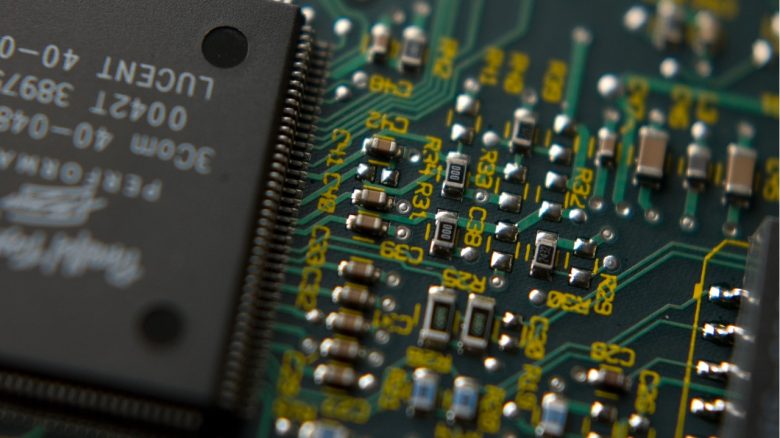
Semiconductors are found in graphics cards and processors. Now researchers have tested a new material that could make GPUs much faster in the future. However, it will likely still be a long way off, as the researchers explain.
Semiconductors are small components and are found in many electronic devices. In everyday life, you encounter semiconductors in many places. Without these parts, you wouldn’t be able to use your computer, your smartphone, or any other everyday devices. Without semiconductors, you couldn’t even turn the ignition key in your car.
Semiconductors have also been responsible for the fact that you could hardly buy graphics cards and PS5 consoles.
A research team has now experimented with new materials. They found that these materials are much better than the silicon currently used in semiconductors. MeinMMO explains what it’s all about.

New material could significantly increase semiconductor performance
What is currently in semiconductors? Currently, the industry mainly uses silicon to produce semiconductors. However, silicon has the disadvantage of not being able to conduct heat well. Devices with silicon semiconductors therefore always require a comprehensive cooling system to prevent the chips from overheating.
The industry also tries to make the chips in their devices smaller and faster. But developers are now facing the natural limits of silicon.
What is the new discovery? A team of researchers from MIT, the University of Houston, and other institutions conducted experiments and found that cubic boron arsenide is theoretically a much better material for semiconductors (via meche.mit.edu).
Jungwoo Shin, the lead author of the study, described the new material as a potential “Game Changer”:
- Cubic boron arsenide conducts heat 10 times better than conventional silicon.
- The study also shows that cubic boron arsenide conducts both electrons and its positively charged counterpart, the “electron hole” (or defect electron), better than silicon.
Both points are weaknesses of silicon. The poor thermal conductivity and the conductivity of electrons restrict the speed of semiconductors. This could mean a huge performance boost for electronic devices.

It could still take years until the new material is used
When could that happen? So far, cubic boron arsenide has only been produced and tested in small, inconsistent lab batches. This is still very labor-intensive and costly.
Therefore, it is also still unclear whether cubic boron arsenide can be produced economically. That would also be a prerequisite for it to potentially replace silicon in semiconductors in the long term.
Gang Chen, a professor in MIT’s Department of Mechanical Engineering, who is also part of the team, explained that scientists also took years to get silicon to the level of purity that chip manufacturers require for their semiconductors. He himself refers to the material as a “promising candidate for the next generation of electronics.” (via fortune.com (Paywall)).
Tips for new hardware: If you are considering upgrading your PC this year and, for example, buying a graphics card, you should definitely get informed about AMD’s RX 7000 and Nvidia’s RTX 4000 series. Because there are already lots of rumors:

Your opinion is important to us!
Do you like the article? Then let us know!