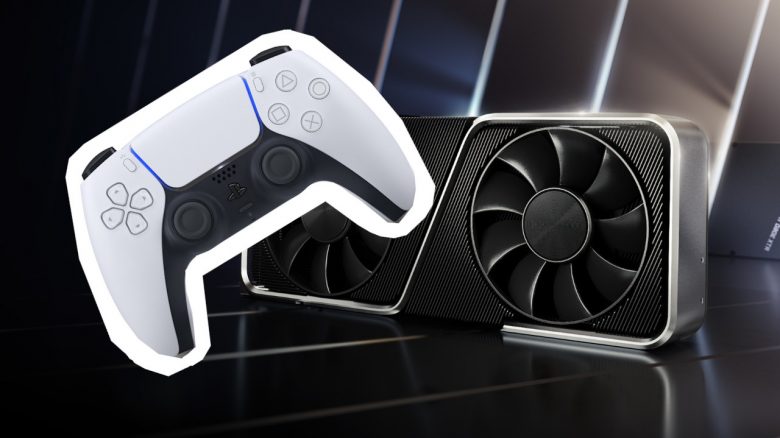
An Nvidia patent promises haptic feedback while gaming on PC. This is reminiscent of the DualSense controller of the PS5.
The DualSense controller is one of the best features of the PlayStation 5 (via Screenrant.com). This is mainly due to the haptic feedback that makes the gaming evening a special experience.
Because the controller allows you to truly experience the game: If you walk over a sandy beach or want to reload your weapon, you get noticeable feedback from the controller, known as haptic feedback. Some PS5 games already support these features and more games are expected to follow.
What PS5 players already get with the DualSense controller could also be available for PC in the near or distant future. At least, a patent suggests this. Nvidia filed this patent with the US Patent Office in 2019. Now the developers have updated and renewed the patent on April 20, 2021. (via patft.uspto.gov).
Nvidia could bring haptic feedback to PC with AI
This is how it currently looks: To implement haptic feedback on the PS5, Sony provides developers with specific tools that allow them to manually integrate feedback for the DualSense in their games.
Nvidia seems to want to take it a step further with a patent.
How could Nvidia solve this? Instead of programming specific haptic effects like feeling sand or the recoil of a weapon by hand, they want to leave this task to AI. The patent states:
This publication envisions a haptic control interface that intelligently invokes haptic effects for content, particularly through the use of machine learning to recognize specific features in the content and then evoke certain haptic effects for those features.
Nvidia’s patent, via patft.uspto.gov.
The artificial intelligence is supposed to generate noticeable (haptic) effects that we players can then experience while gaming. In the long term, the AI should be able to directly recognize specific features and translate them into haptic feedback.
What about implementation? Nvidia has had good experiences with AI-driven technology so far. Nvidia’s graphics cards, among other things, use DLSS (Deep Learning Super Sampling).
This is an upscaling technology developed by Nvidia to upscale textures while saving performance. Especially graphics cards like the GeForce RTX 3060 benefit enormously from DLSS: In resolutions beyond Full HD like WQHD, performance can be increased by 30 to 40 % with DLSS activated.
Nvidia’s experiences and quite positive results suggest that implementation could indeed work if the manufacturer invests resources in the technology. On the other hand, Nvidia might also be interested in providing this technology exclusively to GeForce players. This would leave gamers using AMD or Intel out in the cold.
On the other hand, the patent does not initially indicate whether Nvidia wants to develop devices themselves or share the data with existing devices. For example, peripheral manufacturers for mice, keyboards or headsets could benefit from such technology, as they already have the know-how for their devices and would only need to integrate Nvidia’s technology.
Haptic feedback already plays an important role in gaming
Where is haptic feedback already available? Many gaming controllers like the DualShock or the Xbox controller already rely on rumble effects. During the unboxing of the PS5, testers praised especially the DualSense and its significant advancements. The rumble effects are much better balanced, and the trigger buttons are also praised.
But it’s not just controllers that use such features. A special technology was developed by Razer with HyperSense for its headphones. This is a technology that also relies on haptic feedback and is used, for example, in the Razer Nari Ultimate. Here, explosions are translated into movements that we then feel through the headset.
Also, in Razer’s new innovative gaming chair, HyperSense is expected to be used. If you play CoD Warzone, for example, and a bomb explodes to your right, the chair should also vibrate to your right and create a corresponding sensation.
| Preview | Product | Rating | Price | |
|---|---|---|---|---|

|
Razer Nari Ultimate - Drahtloses Gaming-Headset mit HyperSense-Technologie selbstregulierendes... | Zu Amazon |
*Affiliate-Links. Wir erhalten bei einem Kauf eine kleine Provision von Amazon. Vielen Dank für Eure Unterstützung!
If Nvidia really implements its technology, it could be a big step for PC gamers in the long run, as not every developer would need to program haptic feedback independently and ideally only provide assistance for the artificial intelligence.
If you’re looking for a “more normal” gaming headset without haptic feedback, we recommend checking out our buyer’s guide to the best gaming headsets. Here we present the best gaming headsets you can currently get. You can also find a more comprehensive review of the Nari Ultimate on our list.