

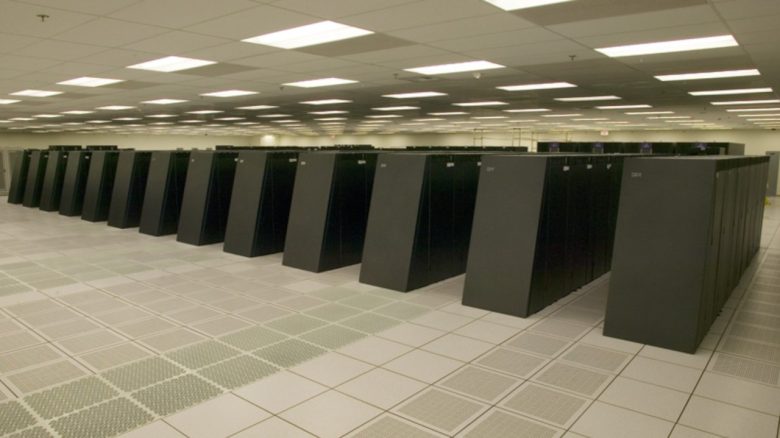
In 2004, BlueGene/L by IBM was the strongest supercomputer in the world. Today, its computing power is surpassed by an Nvidia RTX 4090 graphics card.
The development of computer hardware is progressing at a rapid pace. As a PC gamer, one regularly hears about new processors and graphics cards that typically bring significant performance boosts compared to their predecessors.
Supercomputers are used in highly professional fields. These systems with countless processors perform complex calculations and are unaffordable for the average person.
A comparison between such a supercomputer and a modern graphics card, reported by 3DJuegos.com, shows that gamers now have access to hardware with great computing power.
RTX 4090 has more computing power than a supercomputer 20 years ago
What kind of computer is this? BlueGene/L was commissioned by IBM in 2004 and was at the time the fastest supercomputer in the world (via top500.org). In its original configuration, BlueGene/L had 32,768 PowerPC 440 processors running at a clock speed of 700 MHz.
Its computing power was 70.72 TFLOPS at that time. The unit FLOPS describes the number of floating-point calculations a single processor can perform per second. The price was around 22 million euros (list price: about 1.4 million euros per rack. BlueGene/L started in 2004 with 16 racks). For comparison, an RTX 4090 currently costs about 2000 euros.
How much faster is the RTX 4090? In terms of pure computing power, the Nvidia graphics card outshines the 2004 supercomputer. With about 83 TFLOPS, it exceeds the 70.72 TFLOPS of the supercomputer in floating-point calculations. If the RTX 4090 is overclocked, more than 100 TFLOPS are even possible.
However, this triumph over the supercomputer is only theoretical. The stated values of the RTX 4090 refer to 16- or 32-bit floating-point calculations. But the computing power of systems like BlueGene/L refers to 64-bit floating-point calculations. In this case, the RTX 4090 clearly falls short and only achieves 1.29 TFLOPS (via techpowerup.com).
Nevertheless, this comparison shows very clearly how much the performance of hardware, and especially graphics cards, has developed over the past two decades. Modern graphics cards now take on not only the graphical representation on the screen.
Their technical architecture has become increasingly complex over the years. They can perform AI calculations through additional computing cores, for instance. This sometimes leads to applications that lie outside of a gaming PC, as recently proven by a student.



What was BlueGene/L used for? IBM’s supercomputer from 2004 was used for complex calculations in scientific research that require particularly high computing power. At the Lawrence Livermore National Laboratory, biologists decrypted the processes of protein folding or gene development in this way.
In other scenarios, supercomputers are also used in weather forecasting, physics calculations, and data analysis. For example, the performance is used for weather forecasts, the discovery of oil and gas reserves, or for complex calculations in astrophysics or fusion research.
What capabilities do current supercomputers have? Currently, the supercomputer Frontier, with its HPE Cray EX235a architecture, is the benchmark (via top500.org). It achieves an incredible 1.1 ExaFLOPS. (1 ExaFLOPS = 10 to the power of 6 TFLOPS). This requires proper cooling and space.
The computing power of BlueGene/L was repeatedly increased through several upgrades. In its final form, the supercomputer reached over 478 TFLOPS. In this version, the supercomputer outperformed the RTX 4090 graphics card again in theoretical results.
The SNES (Super Nintendo) was released 14 years before BlueGene/L and had only a computing power of 2.5 MFLOPS. There was also a version of the SNES presented collaboratively by Nintendo and Sony. Since only one known copy of this game console exists, a YouTuber took the last known prototype as a model to build his own Nintendo PlayStation: Sony and Nintendo buried their joint game console 33 years ago – A YouTuber simply builds his own version

Your opinion is important to us!
Do you like the article? Then let us know!