

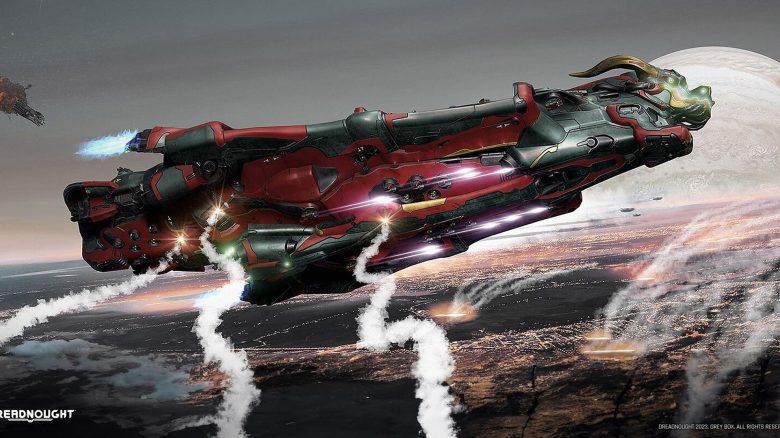
The SF-MMO Dreadnought was released in 2018 on Steam, a year earlier aspiring commanders could already play it on PlayStation 4. Especially in the beta, the “World of Tanks in space” generated excitement. Even in the last 30 days, it had 92% positive reviews on Steam. But somehow the spark never caught on: Greedy microtransactions allegedly brought the game down, some claimed.

What was the idea behind Dreadnought?
- “World of Tanks in space” describes it quite well: Dreadnought primarily focused on size. The spaceships that players controlled were massive and rather sluggish battleships with gigantic dimensions. Every broadside had to be well thought out.
- Dreadnought aimed to give players the feeling of commanding a huge battleship: You were the commander of a massive space barge, not a nimble starfighter, but a hefty star destroyer.
- However, on Steam, the game could never really establish itself: Player numbers had been stuck in the double digits for the past 3 years: Now, on June 11th, it came to a complete end. The servers shut down, it can no longer be played.
This was the trailer for the release of the open beta on PS4:
SF-MMO Dreadnought closes on July 11th on Steam and PS4
What is the farewell like? The farewell to Dreadnought was actually planned for March 19th, but the game was granted an extension until July 11th.
On Twitter, the team posted a message expressing their “mixed feelings” about the farewell. They were grateful for the journey, had created something very special, but were also looking forward to focusing on new projects.
On Twitter, some express their regret over the end of Dreadnought. They say things like: I don’t even know how this happened. I thought it was so great in the beta, but then I lost track of it.
What caused the game’s failure? Looking at the player numbers on Steam, Dreadnought was never really successful; it seemed to be too niche and never managed to achieve a certain level of recognition:
- In October 2018, it had an average of 1,682 players on Steam
- By March 2019, it was only 124 players. From then on, the game never really recovered.
- Finally, when the end was already in sight, there were still about 29 players online on average per day.
Upon its release on PS4 in 2017, developer Yager faced the challenge of switching from full-price titles like Spec Ops: The Line to free-to-play with microtransactions. Thus, there were “boosters for faster collection of experience points.” The game also offered “hero ships” with particularly thick equipment.
Why is this problematic? Generally, microtransactions that provide any, even slight, advantage are considered “problematic.” Purists typically only accept purely cosmetic items.


Players see this as a reason for failure: In the reviews of the game on Steam, which are otherwise predominantly positive, it is frequently noted that these microtransactions ultimately stood in the way of the game’s success:
If microtransactions are your priority, this will happen. A promising concept was completely ruined by greed.
Another user with 1,080 hours in the game states: The game lost many players when it transitioned from beta to release. Apparently, the microtransactions back then caused a mass exodus:
At least it was never pay-to-win. It wasn’t as bad as people said, especially when players found out that you could farm credits and experience points in the “Proving Grounds” mode.
Other reviews mention that Dreadnought is a unique game without any real alternative. However, many believe the microtransactions had significantly hindered the game. One person says they wouldn’t mind spending money on a DLC, but it would need to contain some real effort.
Some fans urge Yager to release the source code so that the game can continue to live on.
This is what it’s about: Although it’s understandable, one shouldn’t talk about “greed” in such a case. Yager certainly didn’t become rich with “Dreadnought” from an average of 30 players.
For MMOs that are meant to be continuously developed, financing is challenging:
- The model of selling purely cosmetic items only works for extremely successful games like Fortnite or League of Legends.
- Practically all other games must find a compromise between “fair free-to-play” and economic pressures.
- Ultimately, the market can only support a limited number of games-as-a-service titles at the same time. Games that fail to generate and maintain a “buzz” at release are inexorably heading for an end.
The Berlin studio Yager is currently not having a good run: In addition to Dreadnought, it had to shut down its second MMO “The Cycle.” However, the studio’s financing seems secure, as it has a strong partner in Tencent:
Steam: German response to Escape from Tarkov shuts down servers in autumn

Your opinion is important to us!
Do you like the article? Then let us know!