

The costs were still immense. Players had to pay between five and eight dollars per hour. Later, as internet prices fell, so did the game fees. In the 90s, with technological advancements, MMOs finally got going.
The 90s began with Neverwinter Nights
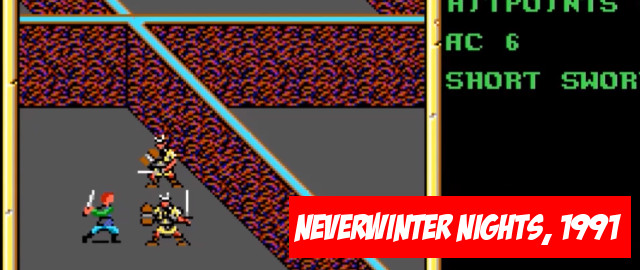
Released in 1991, Neverwinter Nights was the first financially successful graphical MMO and perhaps the first “real” MMORPG as we know it today. Like many games before it, Neverwinter Nights – which should not be confused with the similarly named role-playing game by Atari – was based on Dungeons and Dragons.
With its guild system, it brought another social component into the MMO world and also increased team play and interactive role-playing through its good chat system. In competitions, players could also compete in the well-balanced combat system. In 1995, it already held space for 500 players on a server, but it only ran until 1997, as it could not keep up with other MMOs.
Legends of Future Past, 1992
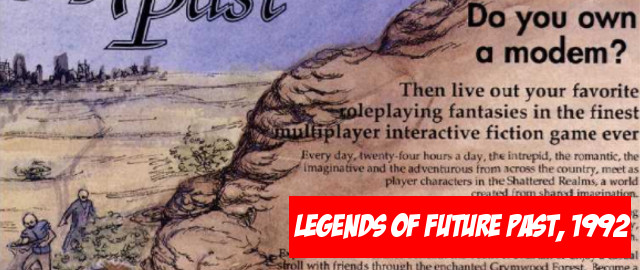
Legends of Future Past offered an innovative crafting and reward system in 1992, which would be groundbreaking for later MMOs. Suddenly players had a real goal to work towards that kept them engaged apart from the social component. Also, paid gamemasters were employed for the first time, coordinating the game, helping players, and contributing creatively.
Birth year of the classic MMO: 1996 with Meridian
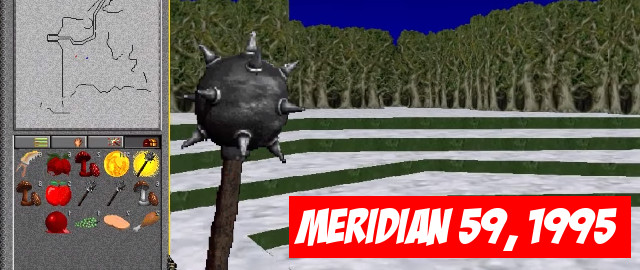
1995 is often cited as the birth year for the classic MMO. That year, Meridian 59 was released: A sword & sorcery title that was revolutionary for its time because it was a 3D title! Players could create their own content, engrave items, and set up rooms.
The DOOM-like game offered space for 250 players per server and was no longer billed by the hour but charged $10 monthly. Although during the beta phase, a proud 25,000 players were registered, it ultimately didn’t become a hit.
The term “Massive Multiplayer Internet Game” reportedly originated from Meridian 59. It was later popularized by Richard Garriott with Ultima Online.
“It’s 1996…”
Until 1996, MMOs were treated as a stepchild; marketing was weak, and the genre did not receive much attention. However, starting in 1996, as the internet gained popularity, the media took notice of MMOs, and they were no longer played solely by hardcore gamers, especially in North America and South Korea. Many titles rode this wave of enthusiasm.
The year 1996 alone brought forth several notable titles:
- Legends of Kesmai: A successful fully 3D title with drop-down view
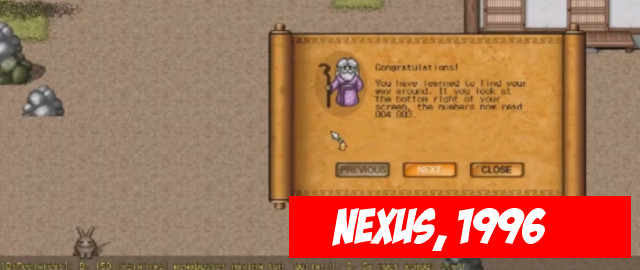
- Nexus: The first Korean MMORPG drew from Korean mythology and was widely successful, breaking a new record with 12,263 players logged in simultaneously!
- The Realm Online: At peak times, a maximum of 200 players were online at the same time and could storm into battle in turn-based fights.
- Furcadia: It was the first MMO where players could play anthropomorphic avatars!
Ultima Online, 1997
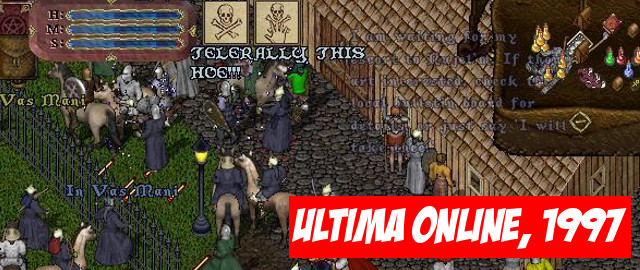
The next milestone was reached in 1997 with Ultima Online, which is the first MMO for most people. Despite mixed reviews, which mostly criticized the ongoing lags and excessive complexity, UO was incredibly successful from the start and was the first MMO to ever record 100,000 registered users and even up to 250,000 at its peak.
The game is based on the single-player title and was able to draw from a wealth of background stories, races, classes, and much more. It established its own society, and suddenly you could be almost anything you wanted! Character development was groundbreaking and featured an interesting aspect with the learning-by-doing system.
By the next milestone, many other MMOs had been launched, including:
- Tibia, 1997: One of the most successful MMOs of its time. Plus: It is a German game.
- Dark Eden, 1997: It was likely the first horror MMO and was unique in its setting, as it did not take place in a medieval-oriented world like other MMOs but in modern times.
Lineage, 1998
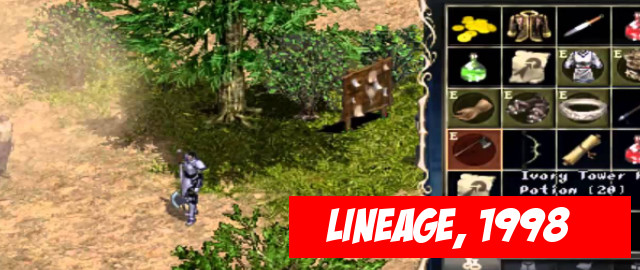
In 1998, internet cafes in South Korea were populated with MMO players. The reason was Lineage from NCSoft, which is one of the financially most successful games of this video game company. Content-wise, it offered classic grinding, similar to what one knows from Diablo.
One of the developers of Lineage, Jake Song, was interviewed by IGN in 2001 and provided interesting insights in retrospect:
“In the early 90s, it was hard to get financial resources for game development and good talents. It was simply not considered a serious business. However, after the success of Lineage and Nexus, other companies jumped on the bandwagon, and talented people took notice. Right now alone, over a dozen MMOs are playable or in open beta. And there are over 100 games in development!”, Jake Song
Everquest, 1999
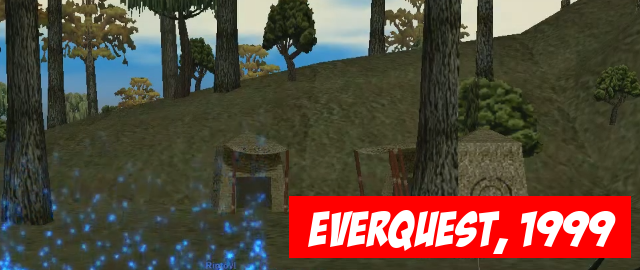
In 1999, the standard MMO Everquest from Sony was launched and quickly became the most successful MMO of the 90s. After a year, it had surpassed Ultima Online’s subscribers and could already record about 500,000 registered users by 2004. The developers drew inspiration from the old MUDs.
EverQuest also introduced complex raids that required players to exhibit teamwork and patience. Beyond that, it was a difficult game from the start with many choices and character development paths.
The year 1999
- Dark Ages: The first MMORPG to introduce a complex political system.
- Helbreath: The Crusade: Released in the USA 3 years after Korea. It still has a loyal player base and hundreds of private servers.
- The 4th Coming: Canada. One of the first online games to introduce the rebirth system.
- Asheron’s Call: Huge marketing campaign. Unique game world with its own races that does without dwarves, elves, etc. A detailed background world. Achieved up to 150,000 players.
Learn more about the players of the 2000s on the next page!
In the 2000s, the flood did not stop – on the contrary, more and better MMOs flooded home computers!

Your opinion is important to us!
Do you like the article? Then let us know!