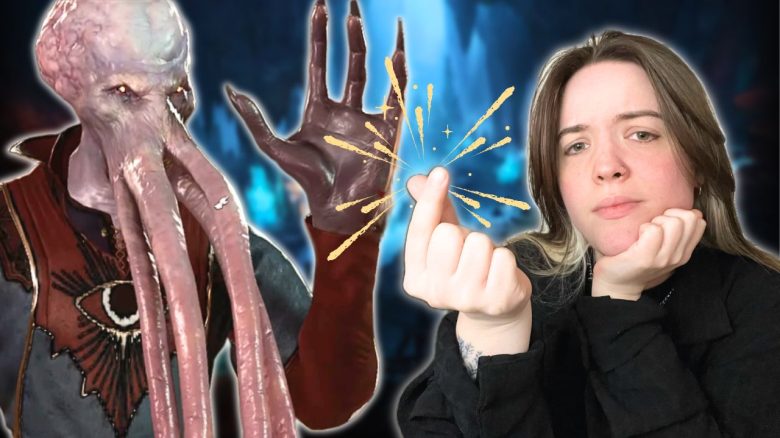

MeinMMO author Christoph Waldboth loves role-playing games but has a problem with most modern titles like Baldur’s Gate 3 when it comes to the great threat within. A JRPG with 30 years behind it excels far better in this discipline.
I love role-playing games. I usually spend my time in Western titles such as those from CD Project Red (Witcher, Cyberpunk), Bethesda (The Elder Scrolls, Fallout), Larian (Baldur’s Gate 3), or most recently Kingdom Come: Deliverance 2.
What bothers me about many of these games: They present me with a danger right at the beginning that threatens to destroy the world and its inhabitants. Whether it’s a demon, a dragon, or a parasite in the protagonist’s head – often I find these threats quite irrelevant.
Because there are tons of side quests on the left and right that often tell much more interesting stories. I often leave the main quest aside for a few hours. This seems particularly absurd when the world is supposedly on the brink of destruction.
What I find missing in many modern role-playing games is a sense of urgency.
This brings me to Chrono Trigger: Recently, I listened to an episode of the Gamestar Podcast. The occasion for the discussion was the 30th anniversary of Chrono Trigger. Heiko Klinge and Michael Graf from Gamestar spoke highly of the JRPG. So I decided to finally catch up on this classic.
I grabbed the Steam version for 15 euros and started with high expectations. After all, the SNES game was developed in 1995 by a real dream team:
- Hironobu Sakaguchi (creator of Final Fantasy)
- Yuji Horii (creator of Dragon Quest)
- The character design is by Akira Toriyama (creator of Dragon Ball, who unfortunately passed away in 2024)
- The music was composed by Yasunori Mitsuda (Xenogears, Mario Party) and Nobuo Uematsu (Final Fantasy).
After a short playtime, I was blown away. And this was despite the fact that I usually don’t have much interest in JRPGs. My enthusiasm was mainly due to one point that Chrono Trigger handles better even 30 years after its release than Baldur’s Gate 3 or Witcher 3.
Everything is connected
Chrono Trigger tells a time travel story. The world is destroyed in 1999 by an evil parasite named Lavos. This must be prevented by traveling through various eras of the past and future.
We play as the protagonist Chrono, who himself remains relatively colorless. More interesting are the six companions, of whom always up to two are with us in our party. They have their own backstory and sometimes even quests.
These side quests are all connected to the main quest. The great threat never fades into the background. I am constantly reminded that the parasite is lurking underground. All NPCs and locations are also related to this.
Overall, Chrono Trigger tells its story very consistently and without major lulls. The game also owes this to its gameplay, which is nearly perfectly balanced. The game world, which changes according to the time period, invites exploration but is still manageable and full of details that refer back to the threat.
The battles are also awesome: Unlike other JRPGs, there are no random encounters. Each boss requires a specific tactic, and sometimes I can even decide in which era I want to fight them. This way, I can influence the outcome of the game and unlock one of 13 endings.
In summary: Chrono Trigger presents me with a problem that I want to solve urgently and as quickly as possible. Everything is interconnected, and nothing feels arbitrary.



Modern games can learn from Chrono Trigger
As much as I enjoy the side quests in Baldur’s Gate 3, it always feels strange to me when the parasite in my head suddenly becomes quite irrelevant for a few hours. It diminishes the threat.
While playing Chrono Trigger, I found myself wondering how Larian’s highly praised masterpiece would look if the developers had cut out all quests unrelated to the main plot.
The result would certainly be a more linear and shorter game. Whether it would be worse can only be speculated – but I don’t believe so.
If modern role-playing games can learn anything from Chrono Trigger, it is this:
- Tell exciting and compelling stories.
- Create characters and places that are connected to the great threat.
- Don’t hesitate to cut content to create a shorter but more immersive experience.
A good role-playing game should be more than just busy work.
That a 30-year-old JRPG solves the problem of urgency better than Baldur’s Gate 3 or The Witcher 3 honestly surprised me. Maybe I now have to catch up on a few more of the old classics. I would especially recommend Chrono Trigger to you. MeinMMO editorial director Schuhmann had his own problem with Baldur’s Gate 3: I started Baldur’s Gate 3 twice and was disappointed: Only when I did what many warned against did I like it.