

Too few players, canceled projects, and questionable MMO releases. The world of MMORPGs can be sad and depressing. In addition to success stories, there are always failures. We will take a look at them today.
The development of each MMO tells its own story over the course of its “life.” Many of them unfold positively, the games evolve, and gamers are satisfied. Leading the pack is Ultima Online, which launched in 1997 and paved the way for an entire genre. Other MMOs were at least for a time the most popular games on the planet. This includes World of Warcraft, which at one point was THE game.
Then we have our selection of these six titles, whose stories range from “Oh my God, how could this happen?” to “This was bound to happen.”
Tabula Rasa, a developer flies into space
The story of Tabula Rasa is one that can literally be called “spaced out.” The game had all the ingredients to become successful: a publisher with plenty of money, a developer with an impressive portfolio, and an original idea. Loyal fans were also on board. So how could it all go wrong, and why did the developer fly into space?
By around 2000, developer Richard Garriott already knew that MMOs had a firm place in the future of gaming. With a good idea and lots of capital, one paves the way for a potential video game hit. Garriott gained experience as the developer of Ultima Online, the great MMO pioneer.
After Garriott sold his company Origin Systems to EA, where hardly anyone believed in MMOs, it was time for him to move on. He founded a new company and took on the highly successful publisher NCSoft. They had already launched an incredibly successful MMORPG in South Korea with Lineage. NCSoft was pleased to work with Garriott to penetrate the US market even further. Together, they worked on the MMO Tabula Rasa.
No one could have guessed that a story would unfold that would stretch out like chewing gum for seven years.
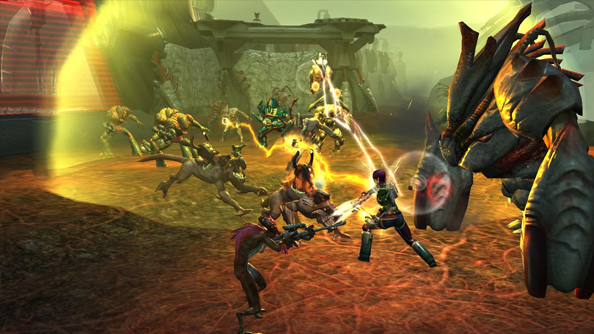
Tabula Rasa was a sci-fi MMO with a futuristic setting on two planets. The good (Allied Free Sentients) fought against the evil (Bane). At first glance, an interesting concept. The lore was deep, there were dynamic missions, intricate skill trees, clan wars, and a challenging PvP system. The developers tried to incorporate all of that into a single game, and that took time – a lot of time.
When World of Warcraft was released in 2004, WoW and MMORPGs were on everyone’s lips. Almost everyone was talking about the MMO from Blizzard, and nearly everyone was playing it. This gave the team still working on Tabula Rasa a new focus. Finally, ideas had to be implemented.
The release of Tabula Rasa didn’t happen until November 2007. Late for the community, which was already served by other MMORPGs, and far too early for the game. Because in fact, 2007 Tabula Rasa was, according to the developers, not even ready for beta testing.
As a result, the developers worked hard in the coming weeks to implement the promised features into the game. In 2008, when many MMOs crashed, Tabula Rasa truly appeared to be a good, original MMO, but by then it was already too late.

On November 21, 2008, NCSoft announced that Tabula Rasa would be shut down on February 28, 2009: The reason? Too few players. After seven years, NCSoft had enough of the game and ended the conflict between good and evil with a massive in-game battle. But that’s still not quite the end of the story.
The enthusiasm for space and an open letter
While working on Tabula Rasa, Richard Garriott developed a passion for space. It went so far that he bought the first space tourist ticket. Personal problems led him to sell the ticket in 2001. It wasn’t until 2008 – Then Garriott himself flew to the International Space Station as the sixth space tourist.

When he was back on Earth after his space visit, everything became strange. An open letter, purportedly from Garriott, informed the community on Tabula Rasa’s homepage that he had left the company because his space visit inspired him to “pursue other interests.” However, Garriott denied being the author of the post.
Shortly after, NCSoft announced that Tabula Rasa was being terminated.

Garriott then sued NCSoft for $24 million. Allegedly, NCSoft used the announcement of his departure to force him to sell his NCSoft shares at a great loss. The court awarded Garriott $28 million, and NCSoft agreed – case closed.
Perhaps NCSoft was simply quite annoyed by the fact that he used his money from Tabula Rasa to fly into space. But the irony of the situation is striking: Garriott earned enough money to fly into space, then actually flew into space and finally even got back about the money from NCSoft that he invested in the ticket.
On the next page, we will talk about a mix of MMO and shooter that hung between life and death.

Your opinion is important to us!
Do you like the article? Then let us know!