

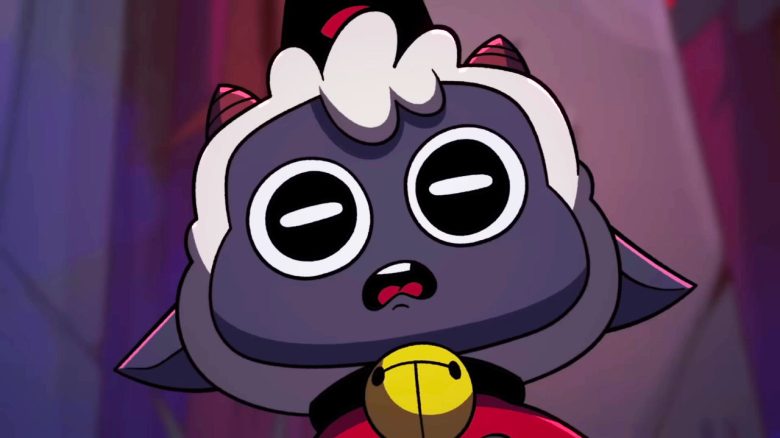
Cult of the Lamb is an unusual combination of a cute building game and hardcore fighting. In 2022 it became a huge hit and currently stands at 92% positive on Steam, but the success didn’t come overnight.
What kind of game is this? Cult of the Lamb is a mix of dungeon crawler and colony sim, where the goal is to build your own sect. The cutesy aesthetics stand in stark contrast to the questionable decisions players must make and the quite challenging gameplay when played on the hardest difficulty.
With this combination, the developer team Massive Monster hit a home run: Even before its release, MeinMMO editor-in-chief Leya gushed about the game. After its release in 2022, Cult of the Lamb quickly became a massive hit.
In the first week alone, the game sold over a million copies. On Metacritic, it is in the top 100 highest-rated games of the year, and Polygon and IGN include it in their best lists for 2022. On Steam, it reached a peak of 61,780 concurrent players and stands with 92% recommendations at “overwhelmingly positive” (via SteamDB).
2023 brought new content to Cult of the Lamb, among other things through a collaboration with indie favorite Don’t Starve.
Do you remember Flash Games?
How did it all begin? Jay Armstrong, Julian Wilton, and James Pearmain, the founders of Massive Monster, began their careers in the gaming industry years before they started working on Cult of the Lamb – initially with Flash games.
These mostly short browser games were extremely popular in the early 2000s, before they were slowly pushed aside by mobile games starting in 2010. Individually, the three developers had worked on more than 50 games and also collaborated occasionally.
With the decline of Flash games, they switched to console and PC games and formed Massive Monster in 2016. Jay Armstrong said in the Noclip Podcast: “We went from games that you can play in 5 minutes and build in 3 months, to full-fledged console games that take 20 hours and where we need 3 years to make them.”
By this time, they had no clue what they were getting into, as the developer adds. Therefore, the team opted for a seemingly logical step: they started remaking some of their old Flash games.
However, they quickly realized that their original plan to produce as many games as possible was not feasible: compared to Flash games, the games were much more time-consuming, and after the second title, Never Give Up, sold rather disappointing, a new strategy was needed.
From the flying whale to hell
How did Cult of the Lamb come about? The idea for a combination of building games like Stardew Valley or Rimworld with roguelikes like Binding of Isaac was born early on. However, finding a concept proved to be more difficult.
- In an early version, players were supposed to take on the role of a god whose people lived on a flying whale. The goal was to dive into the world below and gain new followers, but the game mechanics were too cumbersome and couldn’t be grasped quickly enough.
- In another version, players could rule over their own hell as the devil and torment lost souls. However, the inmates of this version of the afterlife proved too cute to torment.
The solution came with the idea of building one’s own sect and leaving it up to the player to be a benevolent or cruel leader. Thus, players in Cult of the Lamb can choose whether they want to treat their followers well or poorly, sacrifice them, or let them die of natural causes.
However, the new concept also brought new difficulties.
Building game between Satanism and pandemic
What problems were there? The team faced the challenge of unifying the two very different approaches into one game, so that both halves complement each other, but also provide fun on their own. This was achieved by simplifying both the building aspect and the dungeon crawler aspect, at least compared to games that only cater to one of the genres.
Here, the developers benefited from their experience with Flash games. As Armstrong explained in an interview with Game World Observer, they were used to discarding ideas that didn’t work: “You have to be quick and not get too attached to an idea. […] If something is confusing or the game isn’t moving in the right direction, then it has to go – even if you’ve worked on it for weeks.”
Another concern was, according to Julian Wilton, that publishers and distributors might be put off by the idea of a sect and the associated symbolism. Whether players would be bothered by it was, however, of no concern to them, as the developer stated.
In fact, some critics considered Cult of the Lamb to be “openly satanic” and “heretical,” especially for a supposed children’s game. However, the game is actually not rated for children. According to Wilton, it is up to parents to make their own judgment before allowing or prohibiting it for their children (via YouTube).
However, neither the agency VicScreen, which provided the crucial funding for Cult of the Lamb in 2020, nor publisher Devolver Digital, who additionally funded and eventually released the game, were deterred by the “satanic” symbols.
Although the funding allowed Massive Monster to hire additional help and temporarily grow into a nine-person team, there were further obstacles. The development took place during the corona pandemic, and the team was spread across several continents.
When Cult of the Lamb participated in the Steam Next Fest in 2022, it was quite nerve-wracking, as Armstrong reports. The event, where Steam users can play countless demo versions, is regarded as an important marketing event in the indie scene.
However, due to the pandemic, there had previously been no opportunity to show the game to potential players. Despite these concerns, the Next Fest was an overwhelming success: Cult of the Lamb topped the charts throughout the week and landed on the wish lists of numerous players. A good omen for the release.



How did the release go? So well that it seemed to surprise the team itself. Cult of the Lamb was released on August 11, 2022, on PC, as well as for PlayStation, Xbox, and Switch. In the first week, it reached the milestone of one million units sold, a tremendous success for a small team.
Since then, the developers have delivered several patches to fix minor bugs, as well as free content updates. In parallel, however, it seems that work is already underway on the next secret projects.
Recently, however, the planned change in Unity’s pricing policy caused a stir, as it could lead to delays. The developers even joked about simply deleting their successful game once the changes take effect.

Your opinion is important to us!
Do you like the article? Then let us know!