

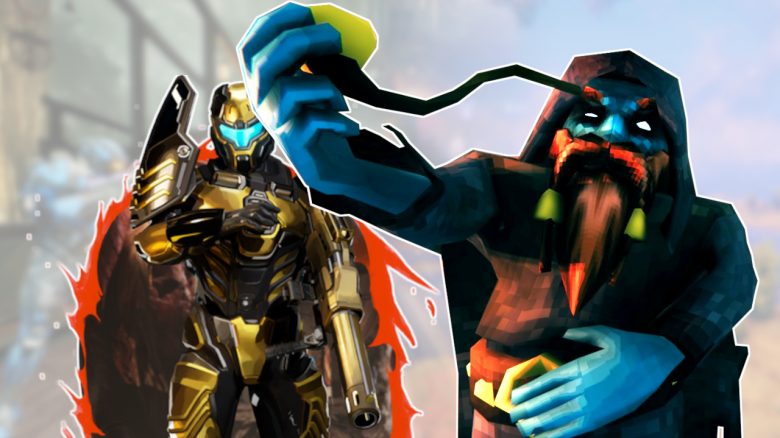
Many big AAA titles are losing their charm because they no longer dare enough – at least that’s what MeinMMO author Benedict Grothaus thinks. Two “small” indie games on Steam show that the big studios need to dare more again: Valheim and Splitgate.

I love indie games. Not all of them, but generally the title from a small studio that simply wants to realize its vision appeals to me much more than the million-dollar project of a “big player” like EA, Ubisoft, or Activision Blizzard.
The reason is quite simple: Indie studios clearly convey the message that they are making the game for me – for the nerd who is exactly into their stuff. Completely uncompromising. Let the masses despise the game, as long as the core players remain loyal.
Two new games from independent studios illustrate this perfectly.
What kind of games are these? The survival game Valheim and the shooter Splitgate have had immense success on Steam and are still popular:
- Valheim was released on February 2 in Early Access, quickly surpassed ARK and already had over a million players after a week. Even today, an average of over 16,000 people still play the Viking survival MMO (via steamcharts.com).
- Splitgate has been in beta since 2019, but only gained popularity on Steam in July 2021. The game got players faster than server capacity and currently over 23,500 people play it on average on Steam (via steamcharts.com).
Both games even managed to surpass huge long-runners on Steam like Rainbow Six Siege, Apex Legends, or GTA V in their prime.
“We do this for a very special audience”
What makes these games so good? Both Valheim and Splitgate have their own unique gameplay mechanics. Something that is not designed to be played by many players.
Valheim is a challenging survival game with a Souls-like combat system and a fixed story. You follow a more or less linear progression and fight your way through enemies and bosses, while also crafting new building parts, armor, and food.
Splitgate is inspired by old, fast shooters like Quake or Unreal Tournament and spices up the gameplay with portals like in Portal. You literally fly over the maps and open a rift in space to simply appear somewhere else, completely surprising your opponents.
Both types of gameplay take some getting used to, and you need to want that. They are unusual and perhaps a bit uncomfortable – I can’t get a grasp on Splitgate, but the player numbers speak for themselves.
Why can they afford this? In a “Fireside Chat” for Valheim, Richard Svensson, creator and lead designer, as well as Robin Eyre, generalist artist, talked about the new update Hearth & Home. They also explained what Valheim essentially means for them.
They do not want to create the best game for everyone, but the best possible version of Valheim – of the game they envision. They continuously polish existing elements until they are satisfied with them.
The goal is not at all to appeal to as many people as possible. “We’re not here to make a generic ‘everyone loves this game’ thing,” Eyre explains. “We never made this game for everyone, but for a very small, special audience.”
AAA titles lose their identity and too often follow formulas
The problem with big games: The more successful a game is, the more success is expected. This has always been the case and will remain so. Indie games are exempt from this pressure, but AAA titles have to meet certain standards.
This leads to often relying on familiar patterns and slightly modifying them to guarantee further success. There are smaller innovations here and there, but major innovations have been missing in franchises such as Call of Duty or Assassin’s Creed for a while now. Keyword: Ubisoft formula.
It feels a bit as if the love for their game is being lost at the big studios. As if many decisions are only made to maximize profit, not to realize the game’s own vision.
This vision doesn’t even have to resonate well with players. Valheim and Splitgate show: If the studio stands behind the project, the game will be accepted. No matter how crazy it is. As long as you can tell there’s passion involved – at least as long as the quality is not absolutely far from good and bad.

Are all AAA titles bad for that reason? Absolutely not. Despite all the criticism, I still enjoy playing Call of Duty, Rainbow Six, World of Warcraft, and more from time to time. The games wouldn’t be so massive if they were terrible.
The point is merely that the development of many of these titles is increasingly shifting in a direction aimed at appealing to as many people as possible. This dilutes the substance of what the games once stood for.
WoW is the best example. From the former nerd jewel for geeks with absolutely no life to the lifestyle project for casuals with little time. For growth, it sounds logical to want to appeal to more people. But it is also understandable if those who “made the game big” feel neglected.
AAA titles cannot easily copy indie flair
The crux of the matter is that big studios cannot simply do it like Valheim and Splitgate. They have sponsors and publishers they must satisfy and a massive crowd of players who want as much supply as quickly as possible.
Some aspect must be set aside, and usually, that is creative freedom. Why should anyone try much new if the tried and tested works?
Blizzard, Ubisoft, EA, and co. could not just copy the indie approach. There is really too much at stake. Nevertheless, I would wish that at least to a small extent, more courage to try new things would emerge.
Valheim and Splitgate just keep going
Meanwhile, the two underdogs simply take care of polishing their games to their satisfaction. Splitgate had to postpone its release, but has now received 100 million dollars – now everything is possible.
On the other hand, Valheim is releasing its first major update, Hearth & Home, on September 16. It features relatively few new features, mainly new food, recipes, and construction parts, as well as a few weapons or shields.
However, the developers have already warned that updates are mainly for polishing the current version of Valheim. New content will come when everything else looks good enough. Despite the enormous success, they are not in a hurry to force everything – even if they are not intentionally dragging their feet, as they say. It takes as long as it takes.
That such an approach works at least to some extent with big games is shown by Rainbow Six Siege – one of my favorite games. Here the development team keeps trying new ideas, although not quite as liberally as indie titles. Nevertheless, the game keeps getting better:
Rainbow Six Siege doesn’t need a successor

Your opinion is important to us!
Do you like the article? Then let us know!