


A 15-year-old just wanted to have some fun and annoy his classmates. To do this, he wrote a computer virus that spread secretly. In the end, Elk Cloner infected countless systems.
Computer viruses nowadays are designed to cause as much damage as possible on infected systems. Some of the malware spreads secretly spying on users and collecting personal data and passwords undetected, similar to an AI that listens to you while typing.
Computer viruses began over 40 years ago. At that time, a student created one of the first digital pests. He had no malicious intent, unlike the modern versions. He just wanted to have fun and annoy people in his environment.
Elk Cloner: A computer virus that just wanted to annoy
What kind of virus is this? Elk Cloner was programmed by Rich Skrenta in 1982. Victims of the computer virus were the then very popular Apple II computers, which used Apple DOS 3.3 as their operating system and were designed by Steve Wozniak, one of the 3 founders of Apple.
As a boot virus, it became active before the actual operating system started by embedding itself in the system memory. For this to happen, the computer had to be booted from an infected floppy disk. If a virus-free disk was inserted later, Elk Cloner would save itself in the boot sector.
How did Elk Cloner come about? At the age of 15, Rich Skrenta was known for writing small games. These were more popular among classmates and friends than, for example, Donkey by Bill Gates himself. He was regularly asked if he had programmed anything new.
Annoyed by this, the student decided to create a program that spread secretly. The virus remained undetected until it was supposed to scare the user of a system at a certain time for fun.
What did the virus do? Basically, Elk Cloner was harmless. The Apple II computers could only be infected via 5.25″ floppy disks, where the boot virus hid. On an infected computer, further disks were then infected to reproduce.
Unwittingly infected disks were passed around, and Elk Cloner was able to infiltrate more and more systems in this way. After a user had inserted a disk for the 50th time since the virus infection, the boot virus became visibly active.
The current screen content turned black, and instead, the computer displayed a silly poem by Rich Skrenta meant to scare the affected user.
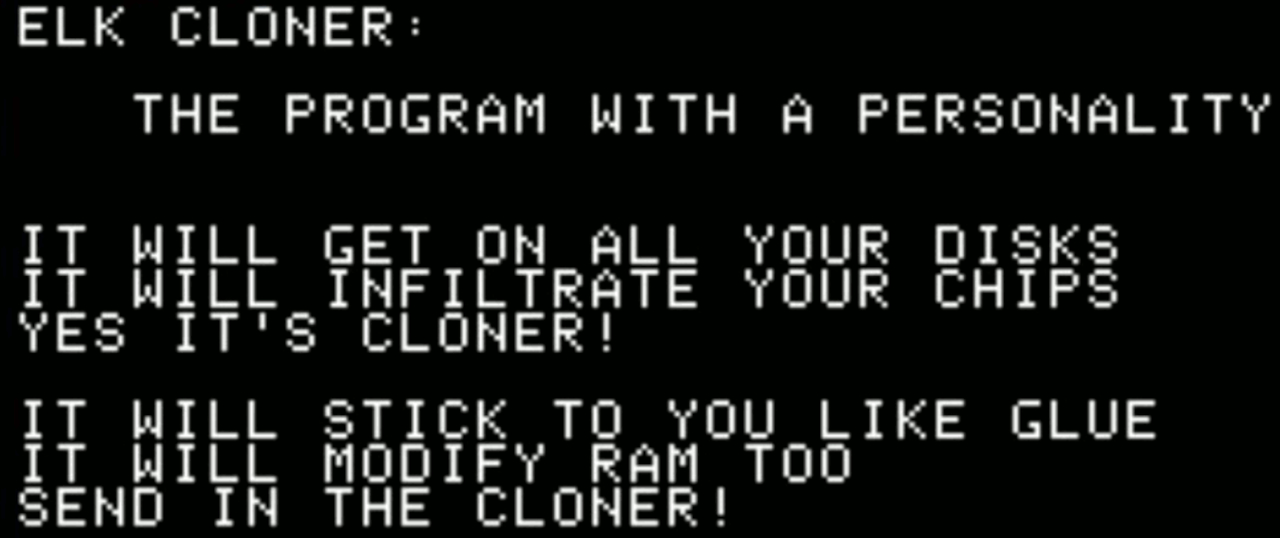
Elk Cloner:
The program with a personality.
It will get on all your disks.
It will infiltrate your chips.
Yes, it is Cloner!
It will stick to you like glue.
It will also modify the memory.
Send the Cloner!


What happened to Skrenta afterwards? Fortunately, not much more happened. No data was deleted or damaged. After a restart, the ordeal was temporarily over.
Apple then released one of the first antivirus programs to remove Elk Cloner from infected devices. If the student had been a few years older, Steve Jobs might have invited him for an interview.
After all these years, Skrenta regrets his “student prank.” Even today, he is mainly known for Elk Cloner and less for his other works. He wrote on his now no longer available blog skrenta.com:
Incredible. I programmed so much stuff for the Apple II: adventure games, compilers, an operating system. And the dumbest hack I ever wrote generated the most interest, to this day.
Viruses are far too common today. You can’t put the genie back in the bottle. The only consolation I find is that the genie would have come out anyway. But it’s great fun to be the first to let it out.
This story shows how one of the first computer viruses could spread without internet access at the time. 14 years ago, a German artist started a project that essentially represents an offline network. But even his Dead Drops are not safe from viruses and other malware: In Germany, there are over 400 USB sticks protruding from walls – What is the ‘Dead Drops’ project?

Your opinion is important to us!
Do you like the article? Then let us know!