

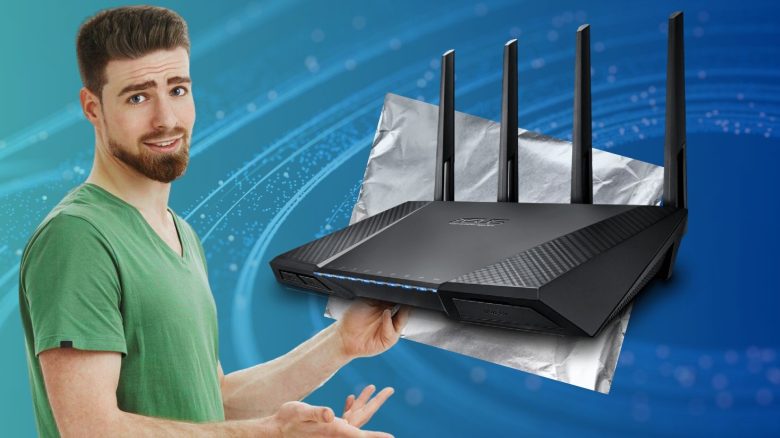
An image of a router wrapped in aluminum foil is circulating on the Internet. The trick is said to help with internet problems. We will reveal what’s really behind it.
Which image are we talking about? On April 19, 2025, a post on X created a stir: It featured an image of a Netgear router sitting on a sheet of aluminum foil, with aluminum foil placed behind the device. The caption read, “Place aluminum foil behind your Wi-Fi router and thank me later!”
Over 59 million people viewed the post. Three months later, another user on X asked, “What is this actually supposed to do?” and brought the topic back into discussion.
If you’ve ever struggled with Wi-Fi symbols and connection issues, you’ve probably also wondered what the N symbol on your phone means. We clarify this for you in the following video.
Invisible Waves and the Art of Reflection
Can aluminum foil improve Wi-Fi? In fact, there is a kernel of truth behind the viral idea, even in the literal sense. Wi-Fi signals are electromagnetic waves, similar to radio waves or light. As the tech site HowStuffWorks explains, data is transmitted over Wi-Fi via radio waves, which can be reflected, just like light. These signals can be reflected and redirected by metal surfaces such as aluminum foil.
A reflector concentrates the signal purposefully, instead of allowing it to scatter uncontrollably in all directions. If you place the foil behind the router or antennas, it directs the signal where you need it, such as to a PC, console, or TV.
How effective is the effect? A research team from Dartmouth College in the USA tested the effect. In their video on YouTube, the team demonstrates how it combines 3D printing and aluminum foil to create custom reflectors. Using an algorithm, they calculated the perfect shape based on a building floor plan. The result: up to 55% better reception in targeted areas, scientifically measurable.
That the trick doesn’t just work on social media was shown by a test from CHIP Online. The editorial team built a reflector from paper, cardboard, and aluminum foil and was able to increase signal strength by up to 166%. The effect was especially noticeable over longer distances and through walls.
How is the trick implemented in practice? To improve your router’s signal, you need to consider a few things. The aluminum foil should not just be randomly wrapped around the router or antennas. The trick works better if you place the foil behind the antennas purposefully, like a parabolic reflector.
It is particularly useful when your router is poorly positioned – such as in a corner, behind furniture, or directly against a wall. A targeted reflector can then direct the signal to the desired location. However, if the router is already centrally located and free, aluminum foil can even interfere and decrease the range.


Using aluminum foil as a DIY hack can directly guide the Wi-Fi signal, a simple experiment with surprising effects. Wi-Fi problems might still be solvable with some aluminum foil. But what happens when you completely ignore basic security rules? An experiment vividly demonstrates what happens when you connect an outdated PC to the Internet unprotected.

Your opinion is important to us!
Do you like the article? Then let us know!