
How comfortable should it be?
Let’s look at another example that shows the dilemma developers face. Automated group finders, content searches, and dungeon browsers allow players to comfortably and quickly find companions for a PvE instance, the PvP area, or other content. There’s a teleport to the location on top of that. Once the last enemy lies defeated on the ground, you can return with the push of a button.
This kind of feature is now available in almost every modern MMORPG. On servers with low population, it would be impossible to find enough players for a raid or dungeon without such a group search.
However, players buy this comfort again at the cost of the MMORPG experience.
- All PvE content that is part of such a group search must be designed so that it can be completed by a random group without prior discussion. The result is often that these do not present any challenge.
- Due to the low difficulty and complete automation, there are hardly any interactions between players. You can be glad if a “Hi” or “bb” lands in the chat. If more words are exchanged, it’s usually because someone is unhappy with their fellow players.
- The constant teleportation to instance content diminishes the sense of the size of the game world.
That more and more MMORPGs allow players to tackle group content alongside AI companions does offer additional comfort and flexibility but further exacerbates the situation.
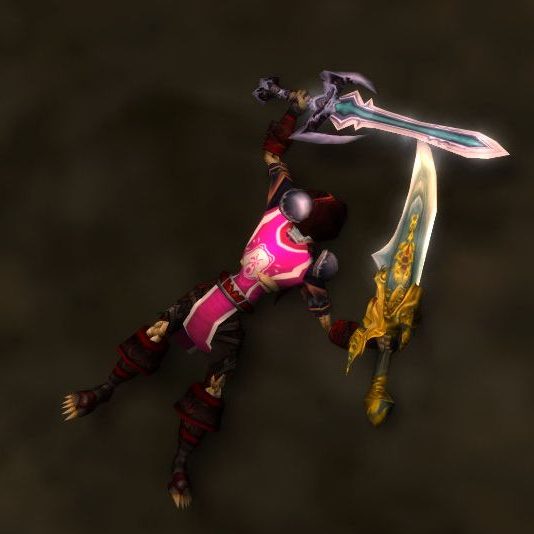
Transmog features are actually great but can also disrupt the best possible MMO experience.
A widespread problem
Other examples like the dungeon browser, while making an MMORPG a more comfortable, accessible, or/and option-rich game, also lead to a worse MMO experience, can be easily found.
- Transmog features that allow skins to be layered over the actual armor increase the flexibility in character customization but prevent direct visibility of what content a player has mastered based on their alter ego.
- In-game shops provide additional options for players with money but devalue earned loot and character progression.
- Multiple difficulty levels for group challenges reduce frustration and offer newcomers and casual players an easier entry point. However, due to the easy modes, victories over the same enemies feel less rewarding.
- Being able to master many contents solo significantly expands the audience of an MMORPG but undermines the essential cooperation and competition.
- Offering fully voiced dialogues instead of dry quest texts can significantly enhance the storytelling experience. However, it also means that players often set out alone rather than questing with others or chatting together in TeamSpeak or Discord about all sorts of topics.
- Early mount access at the start, along with fast travel options on every corner? This is comfortable, yes, but it harms the MMO feeling. Just ask all the vanilla WoW veterans how good and rewarding it felt to finally buy the first mount at level 40. And how connected they felt to areas like the Barrens that they had to experience on foot.
The events of Guild Wars 2 attract masses of players but offer little social interaction.
I can already hear you calling out: But Karsten, no one has to use the automated group search, the easy difficulty, or the voiced dialogues! One can also join communities in ESO, Lost Ark, New World, and so on and have the time of their lives!
You are right about that. However, experience shows that most players always take the path of least resistance. In other words: If something can be mastered solo more easily and comfortably than in a group, most will choose the easy and comfortable path.
I would also argue that most memorable social moments from modern MMORPGs usually relate to relatively small groups and not to large server communities where almost everyone knows each other or to random acquaintances that one could encounter almost daily in WoW Classic.
Memorable experiences within a relatively small group of people can nowadays be had in almost any multiplayer online game, regardless of genre. That is not what makes MMORPGs particularly special compared to other games.


Is there a light at the end of the tunnel?
I would love to conclude this column with an optimistic outlook. The sad reality, however, is that game development across all genres is becoming increasingly expensive. At the same time, it is difficult to lure players away from their current MMORPG, as they are socially attached, feel comfortable, are familiar with the game, and would have to leave behind so much they have earned.
Every developer must, therefore, necessarily try to appeal to as broad an audience as possible with their MMORPG project of the future and thus make decisions that cannot fully reflect the peculiarities of the genre. We can expect more MMO hybrids, more mobile ports, and more solo RPGs with optional multiplayer.
Anyone wanting to target a more niche audience must necessarily make compromises, which of course affects the quality of both technology and content. Moreover, teams with a small budget are quite unlikely to offer language servers for all important countries or to skip an in-game shop.
Old MMORPG veterans like me will likely have to come to terms with the fact that many games in the future will only scratch the surface of what the genre is actually capable of achieving. The good news: that can also be fun and doesn’t take up as much time. More personal accounts: When money was tight, I wrote stories about naughty superheroes

Your opinion is important to us!
Do you like the article? Then let us know!